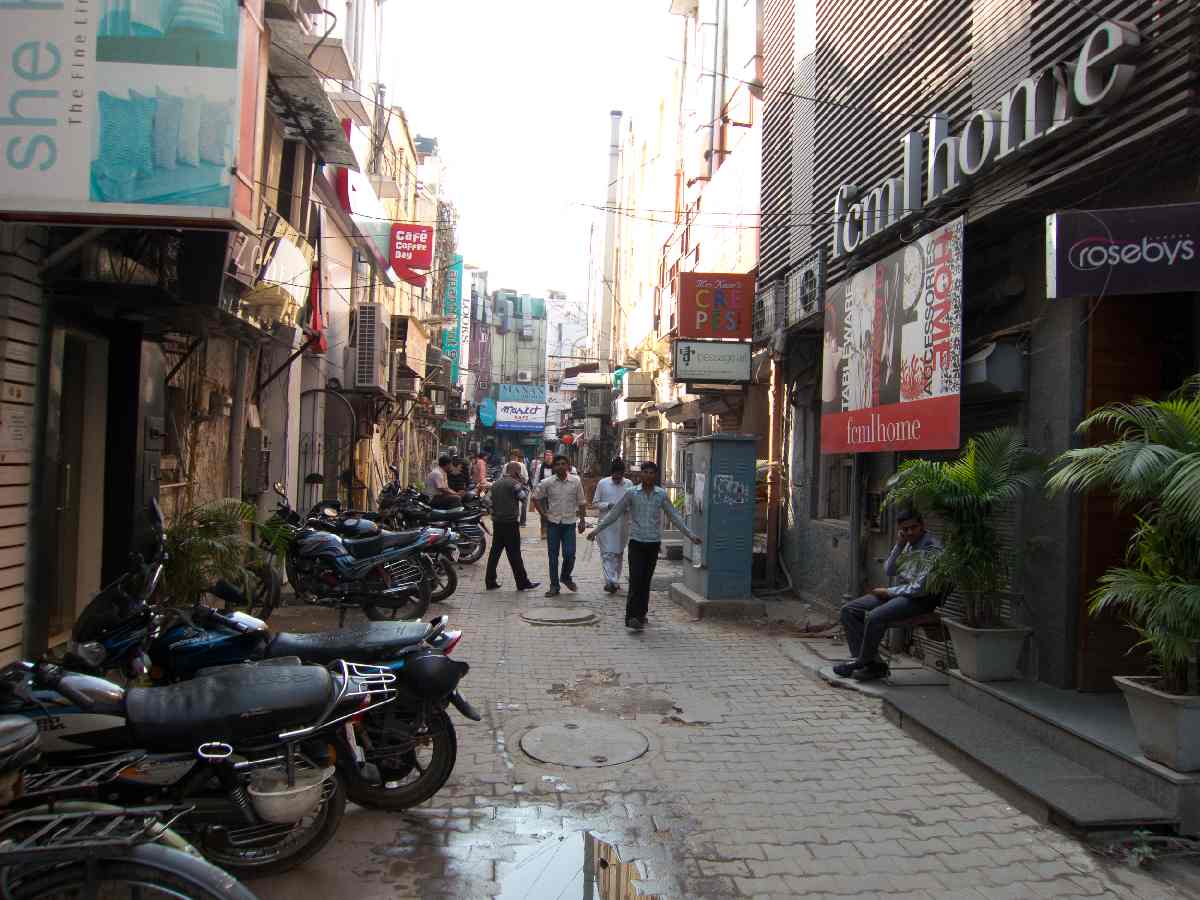
Middle lane, Khan Market started turning to commercial space in the 1990s
For Khan Market, every day feels like a festival. The mood remains electric and glitters once the sun disappears, as the rich and famous arrive for shopping and dining. Yet it is still alive with the smell of tears and the hopes destroyed in the Partition.
After the country was divided, millions of people lost their roots, homes, and dreams. They came to this city broken. It was at Khan Market that they got a new lease of life. The government created this market to help the refugees. It was named after the freedom fighter Khan Abdul Jabbar Khan, also known as Dr Khan Sahib. He was the elder brother of Frontier Gandhi. This U-shaped, two-storey complex has 154 shops on the ground floor and 74 flats above. In the beginning, the rent was only Rs 50. It is said that Khan Market got its name thanks to Mehar Chand Khanna, who was in Nehru’s cabinet and had also served as a member of Khan Abdul Jabbar Khan’s cabinet in the North West Frontier Province before the Partition.
“Refugee families put all their savings into small shops here. At night, they slept in the shops and opened them again in the morning,” says Varun Ahuja, whose family received a flat in Khan Market.
Ice-cream evenings
In the early days, shops like Bengal Sweets, Raj Sweets, Empire Stores, and Carry Home Ice Cream Parlour did brisk business. Famous writer Khushwant Singh and his wife used to come almost every day after dinner to eat ice cream at Carry Home. They lived right across the market in Sujan Singh Park. He loved chatting with the shopkeepers.
Link with ex-Commissioner
Fakir Chand & Sons is considered the oldest shop in Khan Market. It was started in 1951 by the father of former Delhi Police Commissioner Ved Marwah. Old wooden shelves here still hold books that tell stories of the Partition. Ved Marwah himself spent his childhood in this market. He once told this writer that while studying at St Stephen’s College, he used to cycle there from Khan Market.
Bahri Sons Booksellers has been a favourite haunt for book lovers since 1953. Balraj Bahri came from Pakistan and started a new life here. Today, the fourth generation of his family runs the shop.
Brands, taste and fashion
Khan Market is not only about books. There is always a crowd at Khan Chacha for rolls, kebabs, and Chinese food. Young people love places like Mamagoto, Latitude 28, Big Chill, and Third Wave Coffee. Boutiques like Ritu Kumar and Fabindia shine with elegant fashion. Silver jewellery, electronics, paints, kitchenware — everything is available here. But behind every shop lies a story of struggle and family success.
Says businessman Sandy Garg, who lived near Khan Market for several decades: “After the 1980s, Khan Market found its real identity. When people in Delhi had more money, they started coming here to walk and sit. After 1990, global brands arrived, and it became one of the most expensive markets in the world.”
Now, big politicians, businessmen, influencers, and ordinary Delhiites walk here together. In the evening lights, this shining market is a living example of Delhi’s changing face.
Khan Market is not just a market. It is a symbol of the pain of Partition, the hard work of rebuilding, the flight of success, and the meeting of cultures. “Even after 75 years, it is still young because here dreams are not sold, they grow,” says Garg.
Whoever comes to Delhi always visits Khan Market — to buy books, drink coffee, or simply to feel its atmosphere. Khan Market is not merely a market. It is living history.
Other refugee markets
If you have seen Khan Market, you must have noticed Refugee Market just a few steps away on Babar Road near Bengali Market. It is not as shiny as its neighbour, but its eateries, stationery shops, ration shops, and other stores have their own charm. It was allotted to refugees in the 1950s. Before the pandemic, children from Modern School and Rao’s Avenue Sarvodaya School used to shop here during the day. Cycle rentals were also available once. Many shops and owners have changed now, but Manchanda Book Store is still running. Many generations have bought their school books from here. Amrit Departmental Store was also famous.
Then we have Kamla Market, Khanna Market, Meherchand Market, and Gaffar Market. They were all built for refugees from Pakistan. “All these markets started in the early 1950s. The soul of these markets still has a refugee spirit because the majority of the shops are still owned by the original owners’ families,” says noted food blogger Amitabh S.
Khanna Market and Meherchand Market in Lodhi Colony were named after Meher Chand Khanna, the Union Minister for Urban Development. Gaffar Market is named after Khan Abdul Gaffar Khan, a companion of Mahatma Gandhi. Shops here were also given to refugees. Now their second and third generations run them.
Market for Tibetan refugees
Delhi also has a market for Tibetan refugees. Located on Janpath, it has about two dozen shops and is next to Janpath Metro Station. The Tibet Market was set up in 1967 so that Tibetans could earn a living. Most customers are foreign tourists who buy statues, shawls, paintings, and Tibetan crafts. Very few of the original Tibetans who came with the Dalai Lama are seen now. Their children run the shops. Sardar Mohan Singh and Bhai Mohan Singh helped set it up. They were the founders of Coca-Cola (in India) and Ranbaxy Pharma. Mohan Singh Place is named after Sardar Mohan Singh. His son, Charanjit Singh, was also a Member of Parliament from South Delhi in 1984.
Elected to the Delhi Golf Club general committee, Mansher Singh says he wants to build…
A $780 million market built on pavements, where the pleasure of reading meets the price…
Supreme Court advocate Abhishek Pawar alleges women were denied washroom access for seven to eight…
Each day of closure costs shops in Khan Market and Connaught Place between Rs 60,000…
Delhi generates nearly 15,000 tonnes of waste daily, prompting the government to deploy 1,000 mechanical…
Delhi Police has issued an NOC for the Congress rally at Ramlila Maidan on November…



