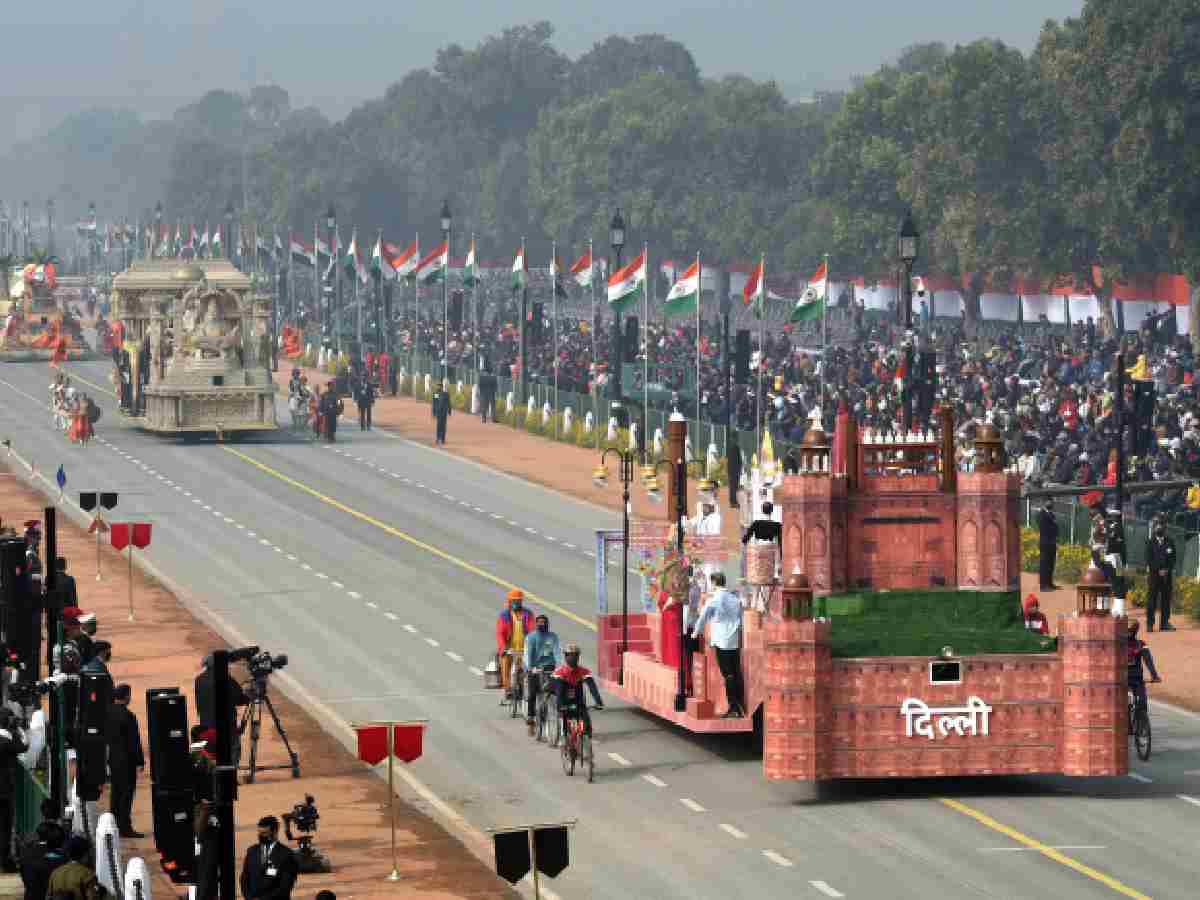
For Mohammad Taki, a businessman based in Delhi-6, watching jhankis (tableaux) on Republic Day is an article of faith. Like many others, he never misses the parade — but it is the tableaux that draw him back year after year, holding a special, almost ritualistic appeal.
As the morning sun rises over Kartavya Path on Republic Day, a unique spectacle unfolds before the nation. Amid marching contingents, military bands and aerial flypasts, one element consistently captures the collective imagination of millions — the tableaux, popularly known as jhankis. These moving artworks, rich in colour, sound and symbolism, narrate the story of India’s unity in diversity, one float at a time.
Typically numbering between 22 and 30 each year, Republic Day tableaux are elaborate floats presented by States, Union Territories, ministries and national institutions. They showcase India’s cultural heritage, historical milestones and developmental achievements through music, folk dances, regional costumes and thematic storytelling. Rolling down Kartavya Path (formerly Rajpath), the tableaux transform the parade into a living, breathing gallery of the Indian Republic.
Cultural beginnings
The Republic Day parade itself began in 1950, but the formal inclusion of tableaux came two years later, in 1952, at the behest of Prime Minister Jawaharlal Nehru. Nehru envisioned the parade not merely as a display of state power but as a cultural celebration reflecting the diversity of the newly independent nation. States were invited to present their regional identities through art, architecture, crafts, music and dance.
In the early years, tableaux were modest in scale and ambition. Rooted in the traditional concept of the jhanki — a term derived from Sanskrit and Prakrit, meaning a visual display or glimpse — they drew inspiration from temple chariot festivals and bhakti-era processions. Many resembled tableaux vivants, with performers holding frozen poses to depict scenes from folklore, agriculture or mythology. This marked a conscious Indianisation of the parade, moving away from colonial symbolism towards indigenous cultural expression.
From simplicity to spectacle
As India evolved, so did its tableaux. The 1950s and 1960s focused largely on regional culture and post-Independence unity, with simple structures and limited technology. By the 1970s and 1980s, participation widened as more States joined, and award categories were introduced to recognise excellence among States, Union Territories and ministries.
The real transformation began in the 1990s and early 2000s. Tableaux grew grander, bolder and more experimental. In 2004, audiences saw animatronic figures such as Madhya Pradesh’s Baloo from The Jungle Book, a live enactment of a Supreme Court bench, and Indian Railways’ interactive coach with moving passengers. Tamil Nadu’s 2006 tableau, inspired by massive temple chariot festivals, blended tradition with engineering ingenuity.
The 2010s expanded the thematic canvas further. Alongside heritage, tableaux began addressing contemporary concerns such as environmental protection, women’s empowerment, digital innovation and flagship government schemes. A striking example was the 2017 Goods and Services Tax tableau, which used symbolic bowling pins to represent the dismantling of multiple taxes such as excise and octroi, an official from the Defence Ministry — which oversees all aspects of the parade — recalled.
Technology meets tradition
In the 2020s, Republic Day tableaux entered a new era of technological sophistication. Animatronics, LED screens, 3D elements, laser effects and rotating platforms became common, while strict guidelines continued to prohibit commercial logos and ensure cultural authenticity.
The Ministry of Culture’s 2023 tableau, themed ‘Bharat: Mother of Democracy’, exemplified this fusion of history and technology and won first prize for its innovative storytelling. In 2024, a rotation system was introduced to ensure that every State and Union Territory gets an opportunity to participate at least once every three years, reinforcing the idea of inclusivity.
The 2025 theme — ‘Swarnim Bharat: Virasat aur Vikas’ — captured the tableaux’s enduring philosophy: honouring heritage while celebrating development. Sixteen States and Union Territories participated, highlighting narratives ranging from Uttar Pradesh’s Maha Kumbh Mela to Madhya Pradesh’s cheetah reintroduction project.
Behind the selection
Creating a Republic Day tableau is a rigorous and competitive process. States, Union Territories and ministries submit detailed proposals by a fixed deadline. These are assessed by a committee of eminent artists and subject experts in two stages — first through sketches and conceptual designs, and later via three-dimensional models. The panel often suggests refinements to ensure thematic coherence and visual impact.
Awards are conferred annually to recognise outstanding creativity and execution. In recent years, States such as Uttar Pradesh and Odisha, and ministries including Culture and Tribal Affairs, have received top honours, underscoring the prestige attached to participation.
Delhi’s tableaux
Delhi has not been a regular participant in the Republic Day tableau parade in recent years. However, whenever the capital has featured, its tableaux have left a strong impression. Delhi’s first tableau appeared in 1952, and in the early decades, the focus was largely on social issues and Central Government welfare schemes.
The 1965 tableau highlighted India’s strides in agriculture, at a time when the Green Revolution was taking root. Its foundations were laid in the capital itself — at the Indian Agricultural Research Institute (Pusa) and in Jonti village, located around 7–8 km from today’s Mundka Metro Station. High-yielding wheat varieties developed at Pusa by Nobel laureate Norman Borlaug and the team led by agricultural scientist MS Swaminathan played a pivotal role in this transformation.
Delhi’s 1966 tableau emphasised education for all. Adult education followed in 1978, while prohibition was the theme in 1979. After the establishment of Delhi’s Legislative Assembly in the 1990s, the tableaux began reflecting the city’s social and cultural character. A notable example was the 1993 tableau depicting Delhi’s Ganga-Jamuni tehzeeb. In 1999, a tableau on the life and culture of Chandni Chowk — the heart of Shahjahanabad — drew widespread appreciation.
The year 2000 saw Delhi’s tableau focus on the Kargil War, honouring soldiers from the capital such as Captain Anuj Nayyar and Captain Mohammad Hanifuddin, after whom roads in Janakpuri and Mayur Vihar are named. Tableaux on the life of Amir Khusro appeared in 2000 and again in 2004, celebrating his legacy as a poet, scholar, musician and Sufi thinker.
Following the redevelopment of Mirza Ghalib’s haveli, a tableau on his life and work was presented in 2001. The Delhi Metro Rail, a symbol of the city’s modern transformation, featured in tableaux in 2003 and 2006.
Delhi’s 2019 tableau focused on Mahatma Gandhi, highlighting the 720 days he spent in the city after his arrival on April 12, 1915. While Delhi expanded dramatically during this period, areas such as Chandni Chowk, Kashmiri Gate, the Red Fort and Qutub Minar remained largely unchanged — neighbourhoods Gandhi himself had walked through.
Beyond January 26
The role of tableaux does not end on Republic Day. Many are later displayed at public venues or repurposed for cultural festivals, exhibitions and educational programmes. From Uttarakhand’s depiction of Kedarnath to Delhi’s portrayal of Shahjahanabad, they continue to inform and inspire, serving as visual textbooks of India’s evolving story.
A moving republic
From simple static displays to immersive, technology-driven spectacles, Republic Day tableaux have mirrored India’s own journey — from a newly independent nation to a confident, forward-looking democracy.
They remain a powerful symbol of virasat aur vikas, rolling down Kartavya Path each year and reminding citizens that India’s strength lies in honouring its roots while embracing the future, concludes Rama Kant Tiwari, former principal of DAV School, Darya Ganj.
Elected to the Delhi Golf Club general committee, Mansher Singh says he wants to build…
A $780 million market built on pavements, where the pleasure of reading meets the price…
Supreme Court advocate Abhishek Pawar alleges women were denied washroom access for seven to eight…
Each day of closure costs shops in Khan Market and Connaught Place between Rs 60,000…
Delhi generates nearly 15,000 tonnes of waste daily, prompting the government to deploy 1,000 mechanical…
Delhi Police has issued an NOC for the Congress rally at Ramlila Maidan on November…

