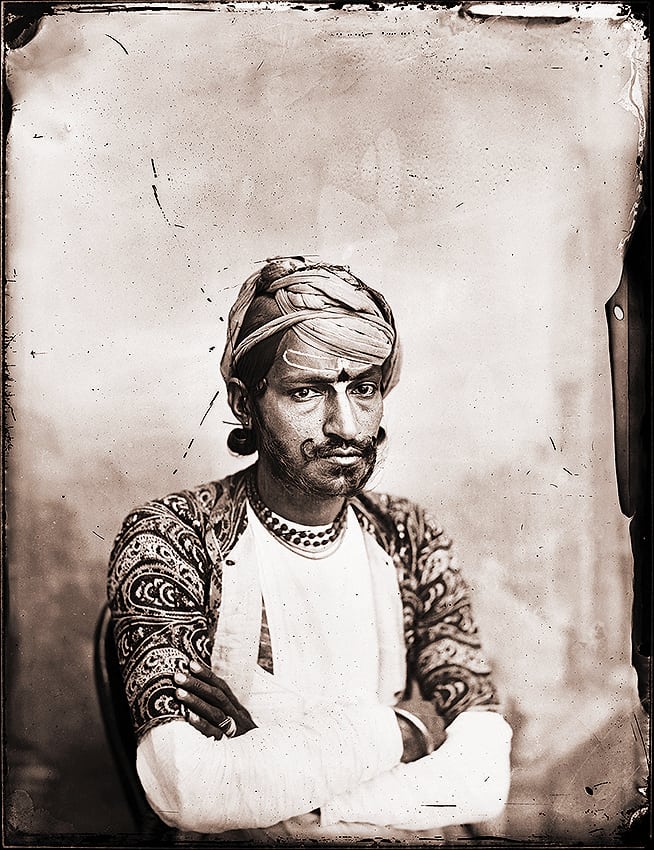
Straight from the archives of the Jaipur’s City Palace Museum, some unseen photographs reveal Maharaja Sawai Ram Singh II’s early engagement with photography as India’s first known photographer-king.
These rare images will be on display at the exhibition – ‘A Reflective Oeuvre: The Pioneering Photographs of Maharaja Sawai Ram Singh II’, on the occasion of World Photography Day.
Meticulously preserved and digitised over the last several years, the exhibition presents rare reproductions of portraiture and urban documentation from the 1860s and ‘70s, exploring a self-reflective persona through visual citations from the practitioner’s oeuvre.
“In the oeuvre of Maharaja Sawai Ram Singh II (1834-1880), we witness the ‘I’ revealed by the eye,” reads the note on the exhibition.
Mastering photography in his days, his skills with the camera can be quite clearly observed through his landscape and urban imagery, the studied replication of art objects, and the depiction of women and men of the court. All of which eventually reveals a self-reflective persona, able to respond with circumspection and compassion to his surroundings and subjects.
The photographs on display reveal Ram Singh’s engagement with photography as reportage and experimentation through his adept copying, portrait making and urban documentation. Constantly testing his skill with reprography and emulation, his work as a copyist or a ‘photophile’ is most unexpected.
From Raphael’s Sistine Madonna, Victorian busts, masonic emblems and other objects, he reproduced them all. Always the observer, he offers a visual counterpart to the interior images of the French author Émile Zola (1840-1902), as well as to the English fantasy writer Lewis Carroll’s early piece entitled ‘Photography Extraordinary’ (1855), which offered the possibility of photographing literature for dissemination.
Ram Singh’s wide range of works present the work of a practitioner who constantly manoeuvres between the image as a private and public statement, as we move from an akhara, a tropical greenhouse, and the palace garden to other, more formal subjects. His images invite a dual reading of photography as a discursive interest and as fictional performances or enactments by his courtiers and himself.
Sawai Ram Singh’s photography may be investigated now for its citations or reference points to his own interests in image-making that are far removed from mere illustration. His images make us question whether early photography in Jaipur is the appropriation or culmination of various traditions of art from the court.
The exhibition will be on display at Art Heritage Gallery from August 19 to September 18
At least 50 cases have already been reported this month; NCPCR guidelines mandate help desks,…
DMRC says zero reduction in train trips, attributes decline to security measures and public apprehension…
A Delhi court denied bail to a former DU professor accused of raping a student,…
Delhi Police charged seven dhaba workers in the fatal beating of a Manipuri musician who…
Seven Delhi STPs failed DPCC standards in September, dumping high levels of faecal coliform and…
AISA chief Neha Bora petitioned the Delhi HC against a police notice requiring a peace…

