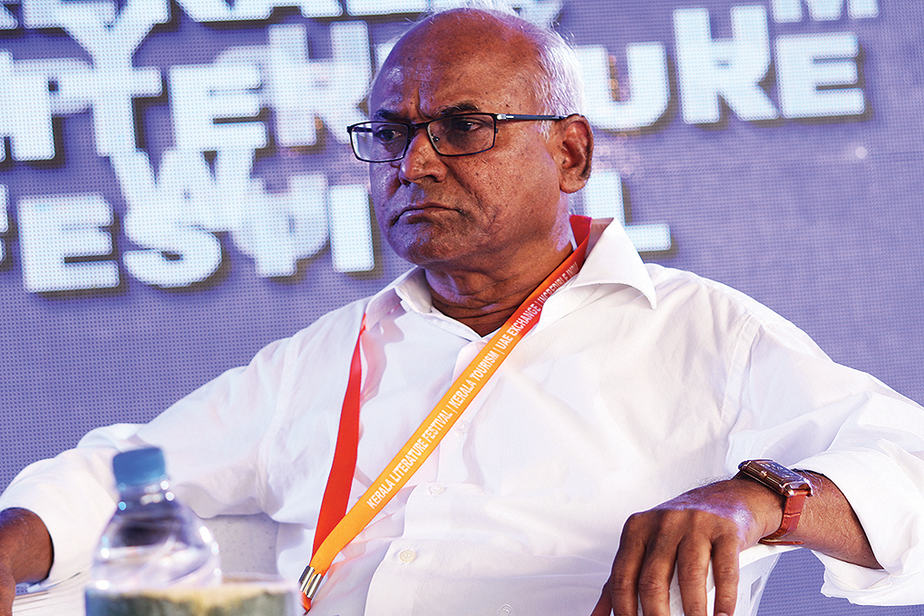
India is no stranger to censorship. From banning beef, forcing unnecessary cuts in films, to the recent blocking of 800 porn sites, India has seen its fair share of restrictions in the past few years. Now the attack is on the academic circuit.
Delhi University’s Standing Committee on Academic Matters has recommended removing three books of professor Kancha Ilaiah from the MA political science syllabus. Why I am not a Hindu, God as Political Philosopher: Buddha’s Challenge to Brahminism and Post-Hindu India: A Discourse in Dalit-Bahujan Socio-Spiritual and Scientific Revolution are a part of the reading list of courses on ‘Social Exclusion: Theory and Practice’ and ‘Dalit-Bahujan Political Thought’ courses.
Claiming controversial content, committee members stated that they decided to remove the books because they are insulting to Hinduism. “We felt it would not be appropriate for students to read it.”
Reacting to this proposal, Ilaiah, the Dalit activist and writer issued a statement, “This is an unfortunate anti-academic attempt, which is part of the larger RSS-BJP’s agenda to not to allow plural ideas to be taught to the students in the universities. The right-wing academicians who demanded removing the books said ‘his understanding of Hindu faith is wrong and there is no empirical data to establish his understanding’. While saying so they have not shown the basic academic ethic of reading my books.”
Patriot did take a look at these books. Why I am not a Hindu describes Prof. Ilaiah’s experiences as a Kuruma, the shepherd caste, along with examining the socio-economic and cultural differences between the Dalit-Bahujans and other Hindus in all social and political systems.
God as Political Philosopher: Buddha’s Challenge to Brahminism talks about Buddha as a man and not a god and as India’s first social revolutionary, critical of the caste system. The book stresses on his rationalism and describes Buddha as more of a social thinker than a religious man.
The third book Post-Hindu India: A Discourse in Dalit-Bahujan Socio-Spiritual and Scientific Revolution is based on the study of the productive knowledge systems of the Dalit–Bahujan communities of Andhra Pradesh, and provides a critical take on Brahmanism. It has been nine years since it was published. Ilaiah raised questions on why the book has been banned now.
This move of academic censorship has drawn criticism from several professors who did not shy away from weighing in on the controversy on social media. Aditya Nigam, author and professor at the Centre for the Study of Developing Societies has posted on Facebook that, “removal of books earlier was to ‘hurt sentiments’ and now, members of the Academic Council who pushed for this, claim Ilaiah’s writings are ‘defamatory’! They also argue that the word Dalit be replaced with Bahujan. We know where all this is coming from but have yet to evolve an adequate response, intellectually speaking, to such perversity — which basically means that if you let this pass, tomorrow on you cannot teach any critique of the powerful and dominant interests, be it caste, class, patriarchy.”
Stressing on the importance of students engaging with different texts that critique diverse faiths for developing a critical thinking, TT Sreekumar, professor at The English and Foreign Languages University, explains, “It undermines the fact that religious criticism is an important part of the critical pedagogy followed by varied disciplines such as political science, sociology and history. It will be even more embarrassing, if by the same token, Dr BR Ambedkar’s books are required to be withdrawn because they are sometimes far more critical of the Hindu faith than Prof. Kancha Ilaiah himself.”
Pointing out to the relevance of contrasting perspectives he adds, “Such censorship restrains teaching of historical facts about India’s varna system that Ilaiah tends to problematise in his works. The peculiarity of the varna system was that it had its insiders and outsiders. People not belonging to the four varnas were not part of Hinduism, but they were supposed to be subservient to the belief system followed by the four varnas. It is impossible to teach societal relationships in India without taking a critical look at both varna and caste, the two integral aspects of the Hindu faith. Ilaiah’s works represent the voices of the “varnaless”, the outsider-insiders of Hindu faith.”
Along with this, the standing committee has also demanded replacing the word ‘Dalit’ with ‘Bahujan’ or ‘Ambedkarwadi’ in all books within the University’s academic discourse. Earlier the committee had also recommended removing Prof. Archana Prasad’s and Nandini Sundar’s work from the MA history syllabus.
“Their right to ask for what they want to teach is part of their academic freedom but asking for removal of other books that they do not agree with is anti-academic and destructive. Universities are meant for teaching and debating diversified ideas, concepts. Hundreds of thoughts must clash there. Universities are not theological institutes where only one religious idea is taught,” Ilaiah concludes.
Delhi HC will rule Oct 23 on AISA chief Neha Bora’s plea against a police…
A CREA analysis shows Delhi's winter AQI has seen no steady gain since 2022, with…
DMRC will plant over 28,000 saplings across 991 MCD parks in 3 months to offset…
Delhi HC quashed an FIR against an SSC aspirant, ruling mere presence at a protest…
CJP leaders Saurav Das and Ashutosh Ranka sought more time to join the Delhi Police…
Delhi Police held 3 more people, including a couple using a minor to sell heroin…



