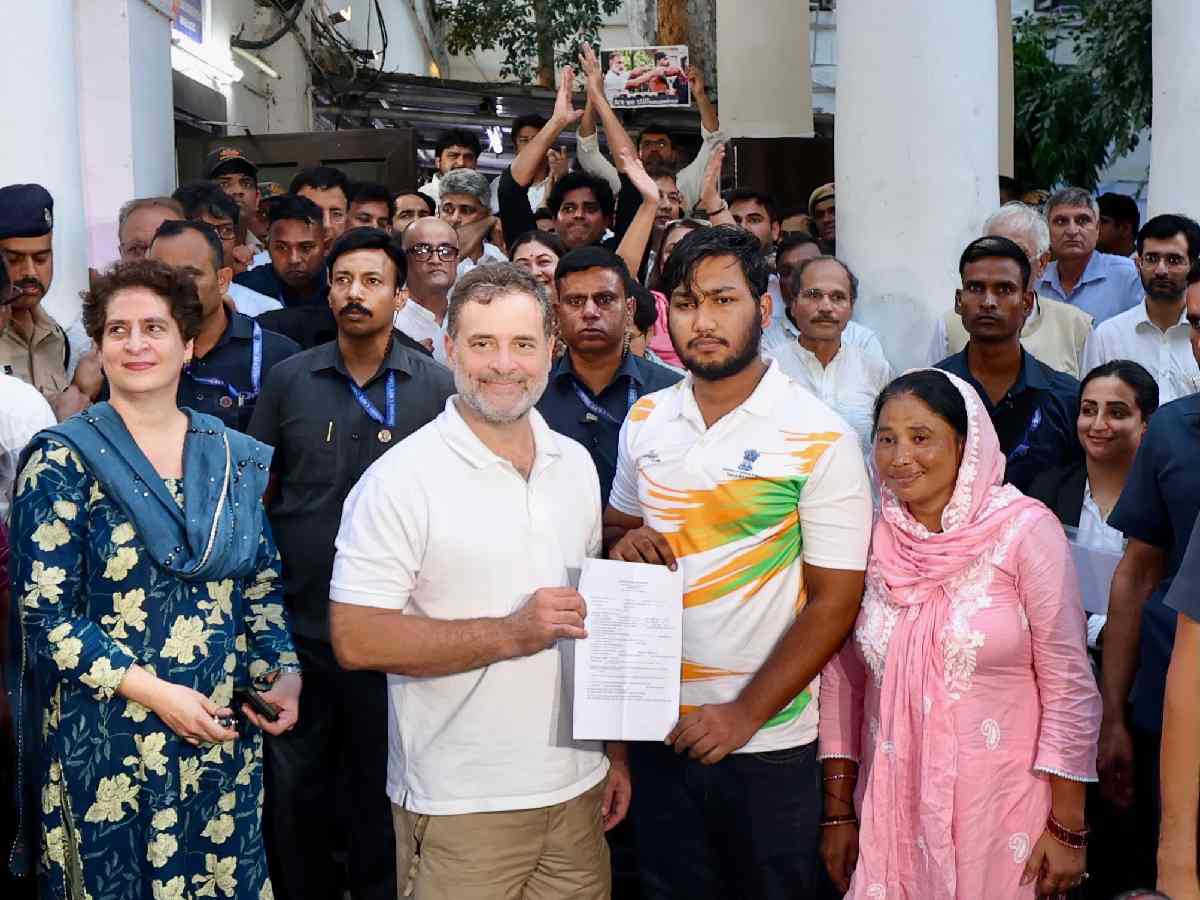
Rahul Gandhi with pellet viction Sahil Lochab
Delhi: Allegations that security forces used pellet-firing shotguns during the Cockroach Janta Party (CJP)-led march towards Parliament on July 20 have come under renewed scrutiny following an Amnesty International investigation and the registration of an FIR after a sit-in by Leader of the Opposition in the Lok Sabha Rahul Gandhi.
Amnesty said on August 24 that footage verified by its Evidence Lab showed a Rapid Action Force (RAF) officer firing a shotgun into a crowd during the march, challenging the Delhi Police’s denial that pellet guns had been used.
The march was organised to protest against the alleged paper leak in the National Eligibility-cum-Entrance Test (NEET) and alleged irregularities in the 2025 Delhi Police recruitment examination.
On August 21, Gandhi accompanied 19-year-old Sahil Lochab to Parliament Street Police Station to seek the registration of an FIR over the pellet injuries Lochab allegedly sustained during the protest.
When the police did not immediately register the complaint, Gandhi began a sit-in at the police station. More than six hours later, an FIR was registered against unidentified persons under Sections 118(1) and 125 of the Bharatiya Nyaya Sanhita, following which Gandhi ended the protest.
The development came after the Supreme Court constituted a five-member High-Powered Enquiry Committee to investigate allegations arising from the July 20 CJP-led protests.
The committee will examine allegations of excessive and disproportionate force by the police and paramilitary forces, including the use of pellet guns, electric batons, lathi charges and tear gas. It will also investigate allegations of violence by protesters against security personnel.
Amnesty cites verified footage
Amnesty said witness testimony and visual evidence confirmed that police and paramilitary personnel used pellet-firing shotguns, tear gas launchers, grenades, batons and electric shock devices against protesters in Delhi and Bihar.
“The weapons were deployed in a manner that breached international law and standards and domestic policing guidelines,” Amnesty said.
The human rights organisation said its findings contradicted the police account that force was used only after protesters turned violent.
Its Evidence Lab verified two videos showing an RAF officer firing a shotgun into the crowd at the intersection of Connaught Place and Sansad Marg. Two other protesters were seen with wounds consistent with those caused by birdshot, a hunting round that disperses numerous small metal pellets, it said.
Amnesty also said the police did not issue a public warning before the weapon was fired, as recommended by the Bureau of Police Research and Development.
Records point to pellet use
Right to Information (RTI) responses obtained by All India Trinamool Congress spokesperson Saket Gokhale show that at least 10 people were treated for pellet or projectile injuries following the July 20 march.
Lady Hardinge Medical College confirmed treating nine people with pellet or projectile injuries, while Safdarjung Hospital reported treating one person with a pellet injury.
Those injured included 25-year-old artist Prashant Kumar Singh, 25-year-old Shaikh Irshad Mansoori, Lochab and a journalist. Medical records also indicate that a 32-year-old woman, Nutan, suffered injuries from a blunt weapon during the protest.
On July 21, the Delhi Police denied that pellet guns had been used to disperse the protesters. A senior official also told Patriot that the force did not possess such weapons.
“We do not have them in our inventory since they are not required for the regular maintenance of law and order,” he said.
However, a general diary entry recorded at Parliament Street Police Station on July 22 disclosed that the RAF had fired two rounds from an anti-riot weapon.
Also Read: Jantar Mantar stir brings Delhi Police’s surveillance mechanism under scrutiny
Separately, The Indian Express reported, citing a preliminary Central Reserve Police Force inquiry, that a single RAF member had fired at least seven rounds containing metal pellets in Connaught Place. Five rounds reportedly struck protesters, while two hit the ground.
Lochab recounts firing
Lochab alleged in his complaint that the police had initially refused to register an FIR. The case was eventually registered following Gandhi’s sit-in on August 21.
“Around noon, a lathi charge occurred, causing a stampede. I ran with the other youths in the crowd and reached the area near Palika in Connaught Place. When I reached the front of the crowd, I was holding the Indian tricolour, surrounded by thousands of students and youth,” the Najafgarh resident said.
Lochab said the use of tear gas and further lathi charges worsened the stampede.
“I was looking the other way when I suddenly felt something strike the right side of my chest and arm and the area near my eye. When I turned around, I saw a person in a blue uniform holding a large gun,” he said.
Lochab said multiple metal pellets struck him, after which he lost consciousness as students gathered around him.
“Metallic pellets were fired at me about six times, causing bleeding from my eye, face, hand and chest. I completely lost vision in my right eye,” he said.
Police recruitment plans disrupted
Lochab, who had been preparing to join the Delhi Police, said his injuries had disrupted his studies and recruitment plans.
“I am a student of the School of Open Learning at Delhi University and, being the eldest in the family, I have to figure out a way to provide a decent life for them. I had joined the protest because I am a student myself, and I was protesting against both the NEET paper leak and the irregularities noted in the 2025 Delhi Police exam,” he said.
“My only fault was that, as a student, I was peacefully standing up to speak my mind; in return, I lost my eye and was left with hundreds of pellets embedded in my body,” he said.
Lochab said he could no longer apply for the physical tests for which he had been preparing and that his studies had been disrupted.
“My family’s financial situation does not allow me to afford long-term medical treatment,” he said.
According to the FIR, an examination on July 25, 2026, found that Lochab had no vision in his right eye. He was examined again at the Dr Rajendra Prasad Centre for Ophthalmic Sciences at the All India Institute of Medical Sciences on July 31, but doctors reached the same conclusion.
“On August 1, 2026, a second surgery was performed on my eye. However, my vision remained unchanged, and doctors again stated that the chances of regaining sight are negligible,” the complaint read.
It added that, on July 31, a doctor recorded “small metallic pellet injuries” across Lochab’s body, which were also documented in his medical reports.
Court says calls and small UPI transactions do not establish a link to the alleged…
A 22-year-old domestic worker was apprehended near the Nepal border in Bihar after allegedly fleeing…
A 17-year-old boy was apprehended after a video showing him displaying an illegal firearm circulated…
Supreme Court seeks Delhi Police response on Athar Khan’s bail plea in UAPA case linked…
Delhi Chief Minister Rekha Gupta said the government is working to provide IGDTUW with a…
A 19-year-old e-rickshaw driver was allegedly stabbed to death in Paharganj following a dispute over…
