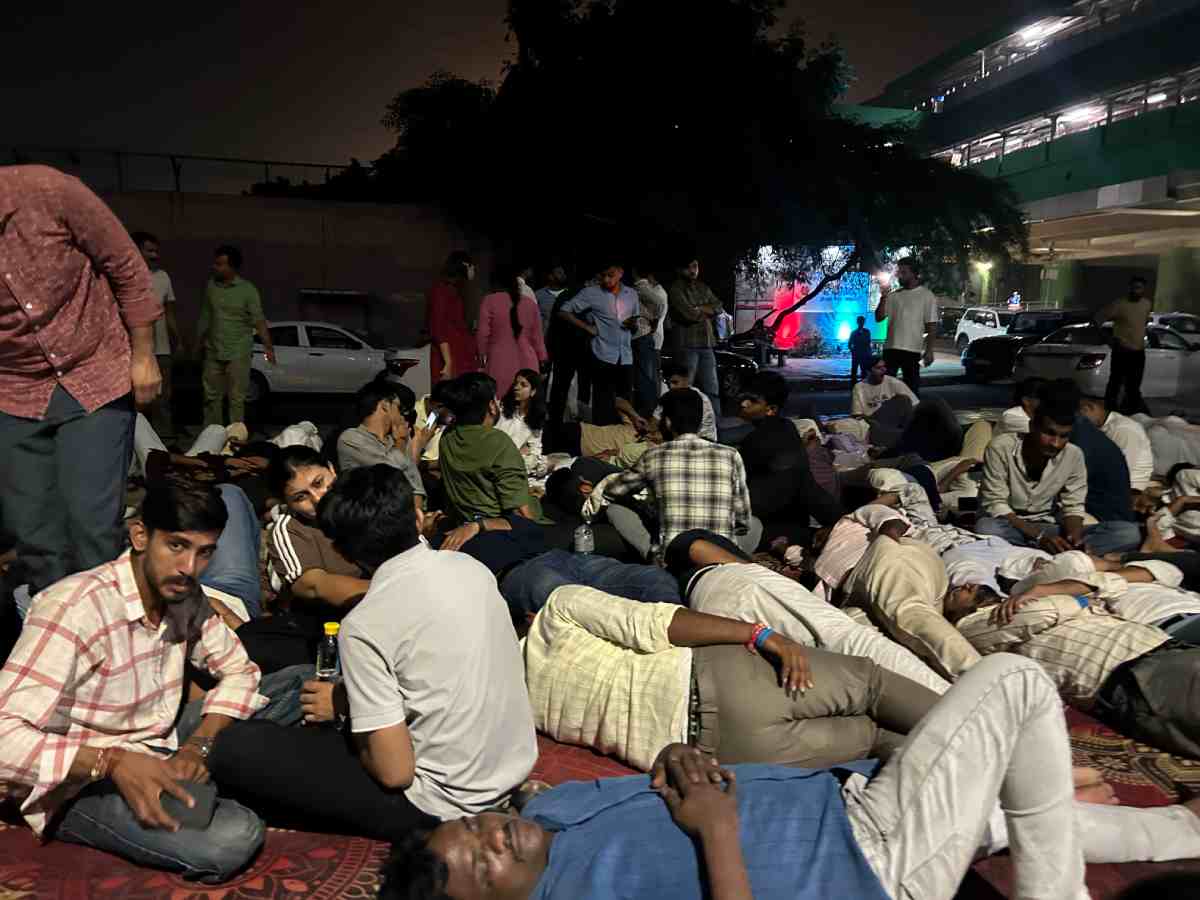
Outstation DU students caught between safety concerns at home and the fear of falling behind in Delhi
The September 6 Satya Niketan building collapse has left several outstation students at Delhi University caught between their education in the Capital and concerns at home. While families weigh questions of safety and accommodation, students staying away miss lectures, worry about attendance and risk falling behind academically, even as the financial burden of rent, deposits, food and daily expenses has not disappeared simply because they have left the city.
For Kanika, 22, an economics student at Ram Lal Anand College, the collapse has revived a familiar argument. Returning to Delhi from her hometown in Uttar Pradesh had already required considerable effort from her family. After the incident, relatives and people in her neighbourhood began questioning that decision.
“When I went back home after the incident, people around me started saying that they had already warned my family against sending me outside to study,” she said.
The comments went beyond concern about the collapse and became a judgement on her decision to study away from home.
“They were saying that Delhi is not a safe place for girls and that we should not have sent a girl so far away to study,” Kanika said.
She said the comments upset her, especially given the effort involved in reaching university in the first place.
“I had fought a lot to come here and study; you know CUET exams are not that easy, you really have to study hard to get into DU,” she said.
Kanika intends to return to Delhi, but she does not yet know when.
“I will come back to Delhi, but I am not sure when. It may be by the end of September,” she said.
The uncertainty has unsettled her academic routine. A student physically away from campus is not only missing lectures; she is also separated from the everyday academic environment that surrounds her: classroom discussions, interactions with teachers, peer groups and the pace at which coursework moves.
For Kanika, however, the issue is also deeply personal. The collapse has given renewed force to relatives who were already sceptical about women moving to Delhi for higher education.
‘Cost of going home’
Raghu Chaturvedi (name changed), a second-year BA Economics student at Motilal Nehru College, from Kanpur, Uttar Pradesh, said he went home after the collapse, despite having secured an opportunity to stay in his college hostel.
“I was scared after the collapse and went home,” said the 20-year-old.
Chaturvedi had been paying Rs 11,000 a month for a room, excluding food. Before that, he had paid a monthly rent of Rs 15,000 and a deposit of Rs 30,000. In his current accommodation arrangement, he had paid a deposit of Rs 22,000.
The financial commitment has made the situation more difficult for him. Returning home has not meant that the expenses associated with studying in Delhi have disappeared, while his academic responsibilities continue.
“Though I have already spent so much on rent and other things. But after seeing something like this happen, I felt that going home was the safer option.,” he said.
The academic consequences, however, have become a separate concern.
According to Chaturvedi, the classes he has missed have put him behind academically. At the same time, the lack of online classes has left students away from Delhi without a clear alternative.
“Classes have been missed, and my studies have fallen behind. No online classes are being provided to students,” he said.
Attendance is another concern. Chaturvedi said students fear losing attendance-based internal marks because they cannot attend classes in person.
“I am worried about attendance because if the attendance is short, my internal marks can also be affected,” he said.
Living in uncertainty
Ashvik, 19, from Chhattisgarh, is a first-year political science student with Hindi at Motilal Nehru College. He had been in Delhi for roughly one and a half months when he fell ill and was hospitalised.
His experience has combined health problems with the uncertainty created by the collapse.
“I had already fallen sick after coming here, and then this collapse happened. For someone who has come from outside to study, all of this becomes very challenging,” he said.
Ashvik said his parents wanted him to return home. He had considered it and even tried to make arrangements, but ultimately did not leave Delhi.
“My parents were telling me to come home, but I did not want to leave,” he said.
Part of that hesitation came from what returning home could mean for his education. As a first-year student in his first semester, he is still trying to establish himself in a new city, a new college and a new academic environment.
“I felt that if I went home once, my parents might not allow me to return to Delhi,” he said.
That fear reflects a larger difficulty for students who move hundreds of kilometres away from home for higher education. For them, returning home after a safety incident is not necessarily a temporary break. It can become a question about whether they will be able to return at all.
Also Read: Unregistered, overcharged, hard to leave: real PG bill
Ashvik said that even after falling ill and experiencing the disruption caused by the collapse, he did not want to abandon his studies in Delhi.
“Even after food poisoning and everything that happened during the collapse, I still did not want to leave my studies here,” he said.
For students like him, the question is therefore not simply whether Delhi is safe enough to return to. It is also a question of whether staying away for too long will make it harder to catch up academically or convince their families that returning is worthwhile.
Safety concerns
Smriti Uppal, 21, a political science Honours student at Motilal Nehru College and a native of Madhya Pradesh, is uncertain about when she will return to Delhi.
“My family is not against me continuing my education in Delhi. But after the Satya Niketan collapse, they are thinking about whether I should continue living at the same place,” Uppal said.
For students coming from outside Delhi, however, changing accommodation is not simply a question of finding another room.
“The problem is that we are already spending so much on education. After paying around Rs 18,000 in fees, there is rent, deposit, food and other daily expenses,” she said.
“If I shift to another place, I will have to pay another deposit and again arrange everything. It is not as simple as just changing a room.”
For families already stretching their budgets to support education away from home, the additional expense can become another source of uncertainty.
“My parents have already spent a lot to send their children to Delhi for studies. If the student has to move to a more expensive place because of safety concerns, that becomes another financial burden,” Uppal said.
The issue is particularly difficult for students who have already lost academic time. Until they are able to return with a sense of security, the disruption continues to affect not only where they live, but also how they keep up with their studies.
Elected to the Delhi Golf Club general committee, Mansher Singh says he wants to build…
A $780 million market built on pavements, where the pleasure of reading meets the price…
Supreme Court advocate Abhishek Pawar alleges women were denied washroom access for seven to eight…
Each day of closure costs shops in Khan Market and Connaught Place between Rs 60,000…
Delhi generates nearly 15,000 tonnes of waste daily, prompting the government to deploy 1,000 mechanical…
Delhi Police has issued an NOC for the Congress rally at Ramlila Maidan on November…
