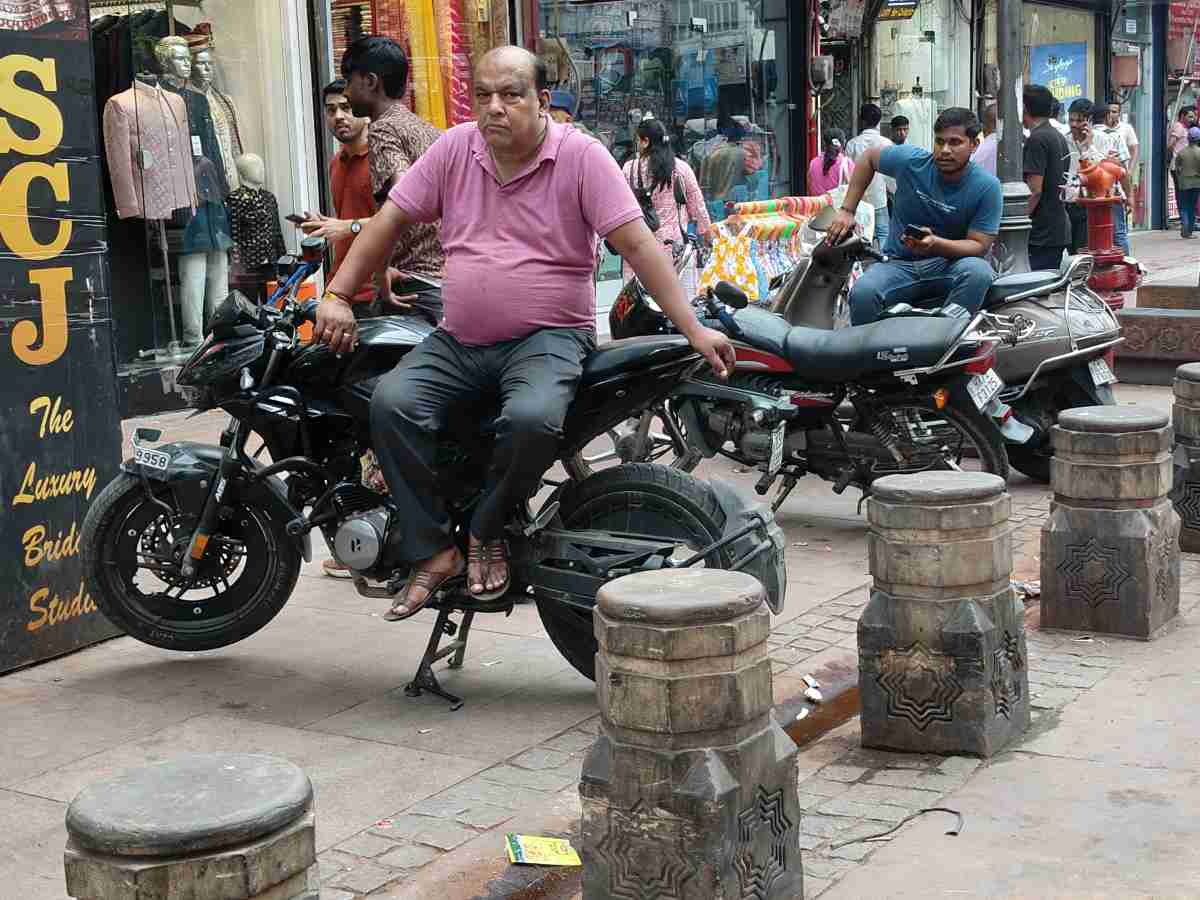
Vehicles illegally parked on graphite footpath
Despite a massive investment in the Chandni Chowk redevelopment project, traders continue to suffer from crumbling infrastructure, severe traffic congestion caused by rickshaws in narrow lanes, poor sanitation, and unhygienic public toilets.
The Aam Aadmi Party-led Delhi government spent Rs 140 crore in 2021 to revamp the historic market. However, traders say the redevelopment has failed to bring meaningful change. Sanjay Bhargava, President of the Chandni Chowk Sarv Vyapar Mandal, called the project “nothing but an eyewash”, emphasising that mere beautification is not a lasting solution. “Policy to maintain the market should be the utmost priority,” he said.
The Shahjahanabad Redevelopment Corporation’s beautification project covered only a 1.3 km stretch—from Red Fort to Fatehpuri Mosque.
Big claims fall short
Despite the hefty expenditure, basic civic amenities in Chandni Chowk remain in disarray. Traders say that the redevelopment plan was poorly implemented, undermining both the market’s commercial activity and its historic character.
A Patriot ground report found that many of the promised features—such as red sandstone and granite pavements, benches, greenery, and pedestrian-friendly access—exist largely on paper. In reality, the red sandstone structures were found broken or damaged, greenery was missing, and several infrastructure problems persisted.
Crumbling infrastructure
Red sandstone fences along the central verge lie broken. Water pipes leak along the stretch. Overflowing drains, tobacco-stained streets, and cracked granite flooring mark the scene—just four years after the project’s completion.
Bhargava said the upkeep of the market should have been prioritised. “It’s been just four years, and the structures built during the previous Delhi government’s tenure are already in a dilapidated condition,” he said. The red sandstone installations, he added, are broken, and green spaces on the central verge are completely missing. Instead, “the area has turned into a dumping ground for garbage”.
Another trader, who runs a bag shop on the revamped stretch, said they were promised world-class infrastructure and a tourist-friendly market. “But what we got instead is damaged footpaths and broken fences,” he said, requesting anonymity. He pointed to the lack of greenery, public toilets, and waste management systems, saying the outcome was “chaos covered with a thin coat of sandstone”.
Aamir Qureshi, a spice trader, recalled how they were told the redevelopment would increase footfall. But the opposite has happened, he said. “When people come here and see the mess—the broken pavements, the leaking water pipes, and the garbage—they don’t want to return.” He argued that it was hurting their business and urged the government to focus on “real work” instead of symbolic ribbon-cutting ceremonies.
Poor sanitation
Sanitation in the market is abysmal, with overflowing dustbins, filthy washrooms, and a broken waste management system.
Bhargava noted that there are four washrooms in the market, “but none of them are usable.” He said hawkers and homeless people now sleep on the central verge, use it as a toilet, and leave the area “reeking and unhygienic”.
Ramesh Gupta, who has run a jewellery shop in the area for over two decades, echoed the sentiment. The dustbins, he said, are perpetually full, and garbage lies scattered across the street. “Nobody comes to clean it regularly,” he said. The stench makes it difficult to sit in the shop for long, and the washrooms are so unhygienic that customers avoid them entirely. “This is not just bad for business—it’s an insult to a place with such a rich history.”
Shazia Parveen, who owns a cosmetic shop near Fatehpuri Masjid, said the waste management system had “completely collapsed”. According to her, there’s no fixed schedule for garbage collection and no accountability from civic agencies. Trash lies next to food stalls, she said, attracting flies and stray animals. “The public toilets are filthy and unusable, especially for women,” she added. “We were promised a clean and modern Chandni Chowk, but what we got is worse than before.”
Hawker encroachment and illegal rickshaws
Shopkeepers allege that hawkers have completely taken over the footpaths, making it hard for customers to navigate the market. Though only 400 rickshaws were permitted, traders estimate that over 4,000 now operate in the narrow lanes, adding to the chaos.
Bhargava said the authorities have failed to implement regulations on the ground, forcing shopkeepers and traders to struggle every day. “The commercial activities of the market have taken a big hit because of the apathy of the government,” he said. “The rickshaw menace still persists in the market. Thousands of rickshaws ply on the revamped stretch.”
He also said that hawkers have taken over almost the entire granite footpath, which was originally designed to allow customers to move freely. Despite several meetings with ministers and officials, he said, the problem remains unresolved.
BJP blames the previous AAP government
The Delhi BJP has criticised the worsening situation in Chandni Chowk, pointing to poor sanitation and widespread encroachments. In a letter to Mayor Raja Iqbal Singh, BJP spokesperson Praveen Shankar Kapoor blamed the beautification project’s failure on the previous Delhi government’s lack of planning.
Kapoor accused the Kejriwal administration of dividing maintenance duties between the Public Works Department and the Municipal Corporation of Delhi without allocating proper funds—leading to a complete breakdown in implementation.
He alleged that key MCD responsibilities—such as regulating rickshaws, constructing pink toilets, clearing encroachments, and maintaining hygiene—have been neglected. “No pink toilets have been constructed, and illegal vendors have taken over the stretch from Red Fort to Fatehpuri Mosque,” he wrote.
Kapoor also said the no-motor zone is now packed with unregulated vehicles, including e-rickshaws and two-wheelers. He noted that garbage often goes uncollected, worsening hygiene conditions.
Mayor Singh acknowledged the issues and told Patriot that sanitation will be improved, encroachments tackled, and monitoring increased. The AAP has not issued a comment, but the BJP has sent the letter to Chief Minister Rekha Gupta and senior party leaders, seeking urgent intervention to protect the area’s heritage.
Delhi High Court raps government on Chandni Chowk maintenance
On May 22, the Delhi High Court criticised the Public Works Department for forming a high-level committee to manage Chandni Chowk’s maintenance without court approval. The bench, comprising Chief Justice DK Upadhyay and Justice Tushar Rao Gedela, said the department’s move violated earlier court directions, which had only requested suggestions—not a new panel.
“We are astonished to note such an order being passed,” the court stated, referring to the PWD’s March 26 notification, which cited the court’s February 18 ruling but ignored the limitation placed on committee formation.
Also Read: Delhi’s decade of infamy: Murders that shook nation’s conscience
Government counsel Sameer Vashisht was directed to explain how the order was issued despite the lack of authorisation.
The court was responding to a petition by the Chandni Chowk Sarv Vyapar Mandal, which flagged deteriorating conditions and unauthorised activity across the redevelopment stretch—from Lal Quila Road (Subhash Marg) to Fatehpuri Masjid, including areas near the Metro station. The petition blamed poor inter-departmental coordination for the mess and cited public inconvenience and the mismanagement of over Rs 140 crore.
Earlier, on February 18, the court had considered creating a multi-agency body, given Chandni Chowk’s heritage value and role as a major tourist destination.
What is the Chandni Chowk redevelopment project?
The Chandni Chowk redevelopment project spans the stretch between Red Fort and Fatehpuri Masjid. It was designed to restore the market’s historic character while improving infrastructure and pedestrian access. Phase one, completed in 2021, introduced broader footpaths, improved public facilities, and designated the area a vehicle-free zone between 9 am and 9 pm, all aimed at enhancing the visitor experience.
At least 50 cases have already been reported this month; NCPCR guidelines mandate help desks,…
DMRC says zero reduction in train trips, attributes decline to security measures and public apprehension…
A Delhi court denied bail to a former DU professor accused of raping a student,…
Delhi Police charged seven dhaba workers in the fatal beating of a Manipuri musician who…
Seven Delhi STPs failed DPCC standards in September, dumping high levels of faecal coliform and…
AISA chief Neha Bora petitioned the Delhi HC against a police notice requiring a peace…

