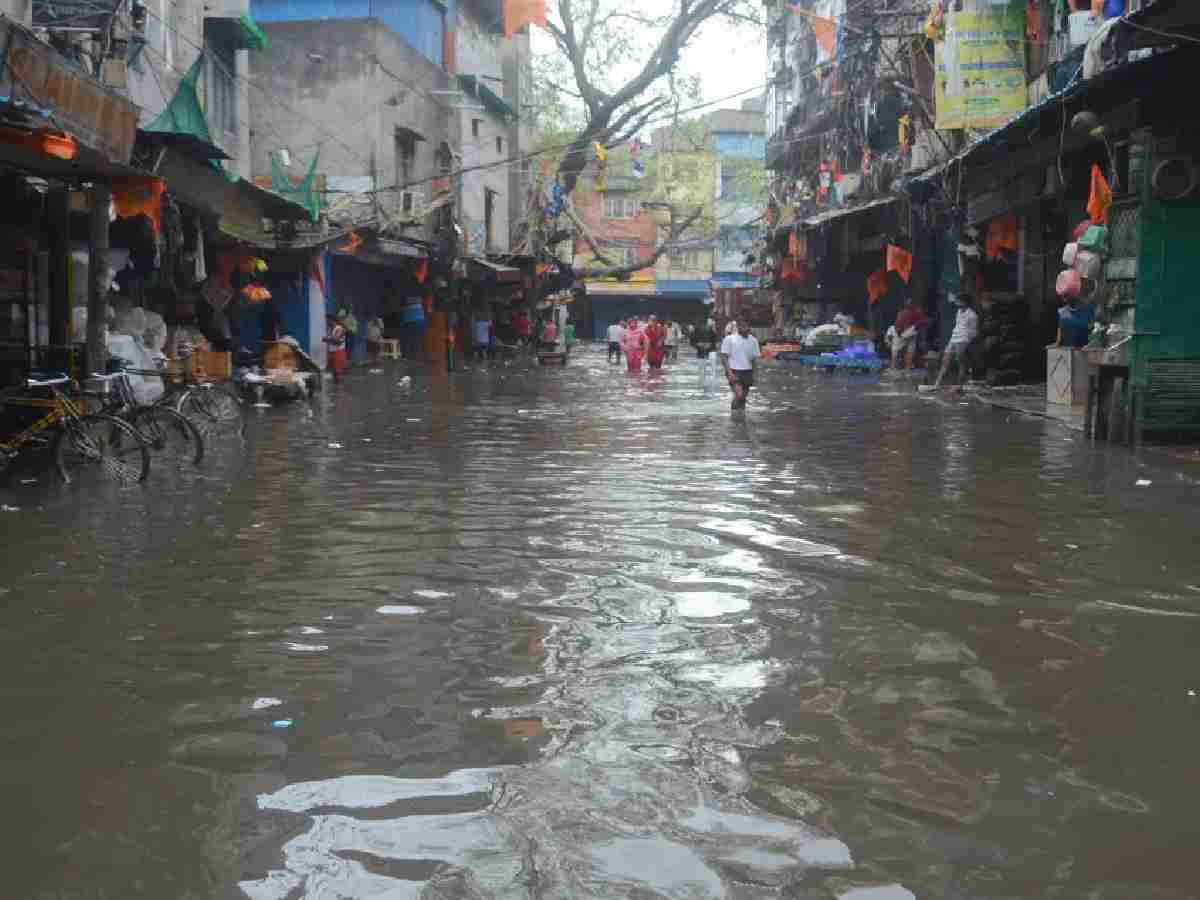
As Delhi braces for a rainy week with cooler winds and cloudy skies, shopkeepers in Sadar Bazaar prepare for a more unpleasant fallout—knee-deep waterlogging that brings business to a standstill, damages goods, and leaves the narrow lanes of one of Asia’s largest wholesale markets submerged under dirty, stagnant water.
Despite being a vital economic hub—especially for small traders and wholesalers—Sadar Bazaar continues to suffer from chronic drainage and infrastructure issues. With every heavy downpour, the area floods, crippling footfall, ruining merchandise, and causing traffic chaos.
Narrow lanes, wide troubles
Already congested with its maze of tight lanes and footpaths overrun with goods and carts, the market becomes almost impassable during monsoon showers. The absence of proper stormwater drainage turns the area into a waterlogged mess.
“We have been facing this problem for years,” says Rakesh Malhotra, who owns a small textile shop near Qutub Road. “Within minutes of heavy rain, water starts gushing into our shops. We lose inventory every monsoon. Even today, several boxes of fabric are completely soaked.”
Imran Ali, a plasticware trader, points out the business impact. “Many of us deal in bulk. Once the water enters, not just goods but our entire day’s business gets wiped out. Customers don’t come in knee-deep water. Who will?”
The visual chaos is telling: vendors stand on stools, plastic sheets collapse under the downpour, carts get stuck mid-lane, and delivery vehicles are turned away. Already wary of the crowded environment, shoppers avoid the market entirely during such episodes.
Commuters left stranded
Waterlogging doesn’t only affect business owners. Commuters and daily wage workers who travel through Sadar Bazaar also face immense hardship.
“I had to wade through dirty water just to reach the main road,” says Neha, a college student from Karol Bagh who had come to pick up parcels for her family’s home business. “My shoes were drenched, and I almost slipped twice. It’s unsafe.”
Also Read: A living museum of threads and tradition
For delivery boys, labourers, and women working in small units, the monsoon brings both physical discomfort and financial distress.
“We get paid for daily delivery and transport of goods. If we cannot do our work due to waterlogged lanes, we don’t get paid,” says Rajesh, a labourer who helps with loading cloth bales.
A recurring problem
According to traders and locals, what makes the situation worse is its predictability. This is no one-off incident—it happens every year, and multiple times during each monsoon.
“We have written letters, filed complaints, and met civic officials. But nothing has changed,” says Praveen Kumar Anand, spokesperson of the Sadar Bazaar Market Association. “Each year, before the monsoon, they send sweepers to clean the drains, but the real problem is the broken and blocked drainage system. What’s the use of cleaning the surface when the water has nowhere to go?”
Anand adds, “The market contributes heavily to Delhi’s economy and should not be neglected like this. It’s shameful that such a significant market does not have basic monsoon management. We don’t even expect luxury—just working drains and timely cleaning.”
Civic inaction or civic overload?
Municipal officials, when contacted, blamed the issue on the city’s ageing drainage infrastructure and ongoing construction in nearby areas that is blocking water flow.
An official from the North Delhi Municipal Corporation (NDMC), speaking on condition of anonymity, said, “We have plans to revamp some parts of the drainage lines, but the process is slow because of overlapping responsibilities between departments. Also, encroachments and illegal constructions make it difficult to access the underground system.”
While the official did not provide a timeline for repairs, traders say they are losing patience.
“We pay taxes, we follow rules, and we keep our businesses going. All we ask for is basic support from the administration,” says Anita Sharma, who runs a small gift shop.
Temporary solutions, long-term need
In the absence of a proper civic response, many shopkeepers have resorted to makeshift measures—raising platforms, sealing doors with cement during monsoons, placing sandbags at the entrance, or simply closing shop early if rain is forecasted.
“These are not solutions, they are survival tactics,” says Ashraf Khan, a garment trader. “How long can we keep doing this? The water sometimes stays for hours. It stinks, mosquitoes breed, and customers stop coming for days.”
The Market Association has proposed a better pumping system and redesigning of drain outlets, especially along the major lanes. But funding and execution remain a hurdle.
The way forward
What Sadar Bazaar needs is not a few cleaning drives or last-minute patch-ups, but a sustained and well-planned civic overhaul.
With its economic significance and massive daily footfall, the market deserves modern planning that ensures both business continuity and public safety during the monsoons.
Until that happens, for traders and customers alike, every rainfall will remain a reminder of drowned promises and lost opportunities.
Elected to the Delhi Golf Club general committee, Mansher Singh says he wants to build…
A $780 million market built on pavements, where the pleasure of reading meets the price…
Supreme Court advocate Abhishek Pawar alleges women were denied washroom access for seven to eight…
Each day of closure costs shops in Khan Market and Connaught Place between Rs 60,000…
Delhi generates nearly 15,000 tonnes of waste daily, prompting the government to deploy 1,000 mechanical…
Delhi Police has issued an NOC for the Congress rally at Ramlila Maidan on November…
