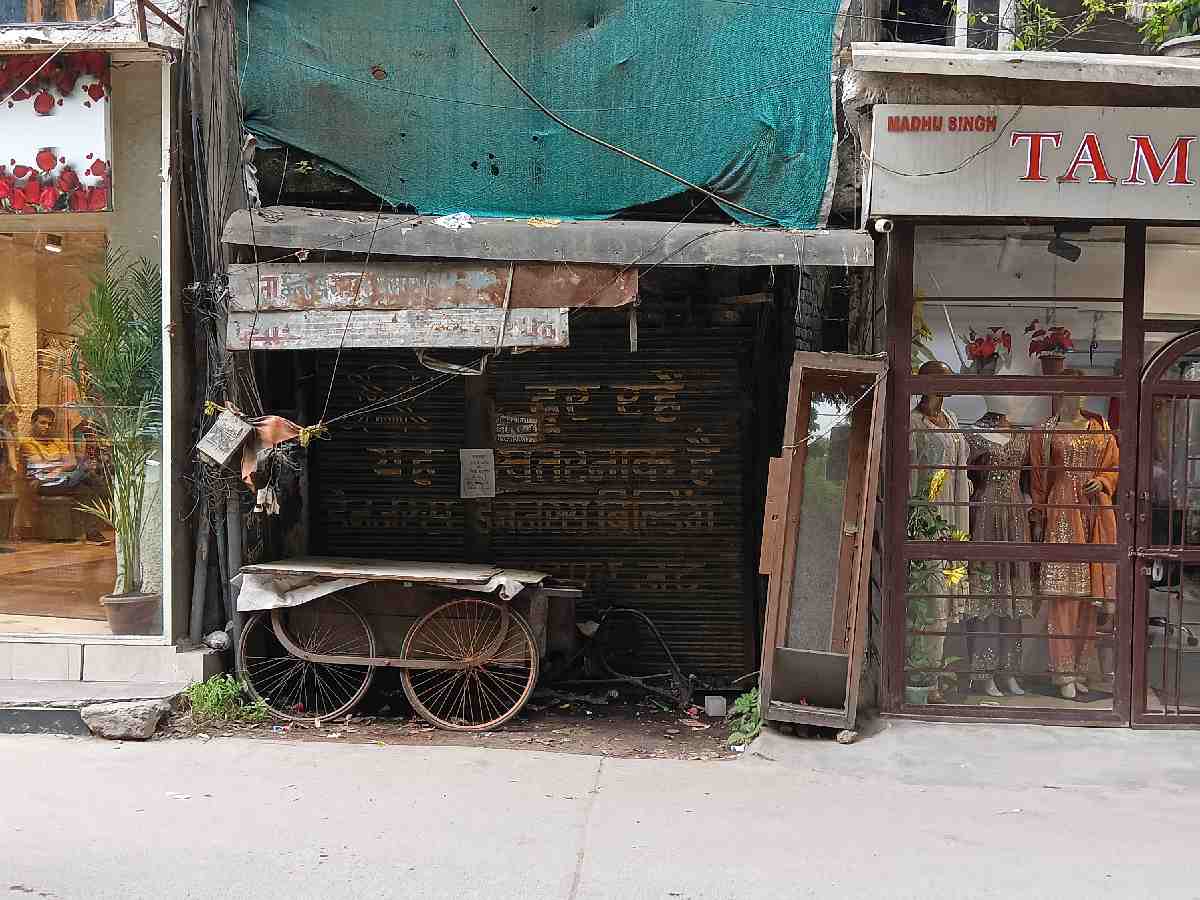
Building at Shahpur Jat marked dangerous
In Shahpur Jat, high-tension wires crisscross the narrow alleyways. One of the city’s oldest villages and an unplanned settlement, the South Delhi suburb has become a fashion enclave in recent years, but its infrastructure has struggled to keep pace with the construction and commercial activity.
The contrast is stark: renovated storefronts and designer outlets stand beside ageing, tightly packed buildings, some of which have acquired additional floors over the years. The settlement was originally residential, but the pressure of commercial activity and unregulated construction has transformed its built environment.
The collapse of a five-storey building housing a paying guest (PG) accommodation in Satya Niketan, which killed seven people, has now prompted the Municipal Corporation of Delhi (MCD) to intensify its crackdown on unauthorised construction. The drive has brought renewed scrutiny to other densely built urban villages, where narrow lanes, vertical extensions and inadequate infrastructure can pose serious safety risks.
Across MCD’s 12 zones, 41 demolition actions and 61 properties were sealed on September 10. The civic body has, till September 15, carried out 213 demolitions from September 1, sealing 109 properties as well, during the same period.
According to Ramesh Pal, a security guard at Shahpur Jat, MCD officials had come down to the urban village two weeks prior to conduct a survey and warn shop owners and residents about the structures being unsafe.
“They had come to warn the owners, but they did not put up any notice on the buildings,” he said.
However, the haphazard and visibly dangerous construction in the area has been common knowledge for decades. The Delhi Development Authority (DDA) conducted an independent survey, published in 2021, of unplanned settlements for Master Plan for Delhi 2041 (MPD-2041).
Lal Dora villages
Many of these settlements are Lal Dora villages, which are located within the traditional residential boundary of a village (abadi). Properties in these areas are largely exempt from standard municipal construction laws and building code approvals.
Presently, there are 357 such villages, of which 309 have been declared urban, making them eligible for structured urban planning and upgraded municipal services, including roads, drainage, sewerage networks, drinking water supply, street lighting and waste management systems. Earlier this year, the MCD approved a proposal to grant urban status to the remaining 48 villages.
The villages identified under the proposal are spread across North, North West, North East, South, South West and South-East Delhi, where development pressure has risen sharply in recent years. Most of these villages are in the South West and North revenue districts, each containing 69 villages.
MPD-2041
The DDA report detailed the infrastructural and safety gaps across selected unplanned settlements in Delhi, based on participatory field surveys by Centre for Urban and Residential Excellence for MPD-2041. Among the surveyed settlements, the authority noted multiple lapses across Dabar Enclave, Rithala, Neelwal, Shahpur Jat and Khichripur.
Dabar Enclave
Dabar Enclave is an unauthorised colony established in 1984 on low-lying ground prone to seasonal waterlogging. The housing stock consists of semi-pucca to pucca structures built between 10 and 50 years ago, with several older properties exhibiting structural weakness.
The survey noted that the roads range from 4 to 6 meters wide, feature unbuffered door openings onto roadways, alongside illegal constructions. These bottlenecks cause emergency vehicle delays of 20 to 30 minutes and prevent full-sized fire tenders from navigating internal streets.
On the other hand, residential units are built near high-tension wires and electrical transformers. Dark spots caused by broken streetlights and reports of illicit liquor trading are present in the area.
Rithala
One of Delhi’s oldest villages that came up in the 12th century, Rithala is a high-density urban village with mixed-use commercial, small-scale industrial, and residential spaces. Unregulated vertical and horizontal expansion has led to spatial congestion and structural vulnerabilities in older buildings.
The survey notes that the street grid consists of narrow lanes with illegal encroachments, low overhead electrical wiring, and on-street vehicular parking. In contrast, several older buildings show significant wear and tear on their exteriors.
Owing to encroachment as well as narrow roads, standard fire engines and ambulances cannot access interior corridors. Industrial units integrated into residential structures create fire safety hazards. Poorly lit interior alleys and industrial nodes present personal safety concerns after dark.
Neelwal
On the other hand, at the peripheries of Delhi, Neelwal remains at the cusp of being urbanised. Retaining much of the agrarian layout, it is now mixed with industrial godowns and dense housing. Ancestral brick homes sit next to newer concrete builds, but older properties lack the load-bearing engineering needed to survive severe stress. The primary threat here is sheer isolation and poor infrastructure.
The survey also notes that due to Inconsistent road widths, dead ends, and a complete absence of pedestrian footpaths, navigating the village gets difficult, while dark spots dominate the rural link roads.
Shahpur Jat
Similarly, Shahpur Jat’s buildings have undergone vertical extensions up to four or five stories without structural auditing or retrofitting, placing additional loads on older foundational walls.
Also Read: Satya Niketan collapse: Families recall last conversations with victims
The settlement’s lanes are choked by commercial encroachments, parked cars, and dangling power lines. Standard fire trucks cannot enter the inner grid, forcing responders to rely on distant hydrants. While constant foot traffic keeps the main thoroughfares safe, dark residential alleys nearby remain vulnerable.
Khichripur
In Khichripur, extreme population density meets severely constrained spatial footprints. The survey notes that multi-storey structures reaching up to four floors sit on tiny plots, have been built without adherence to building bylaws or basic structural support. Many of these unauthorised vertical additions show visible signs of distress, leaving entire blocks in a semi-dilapidated state.
The question now hanging over Shahpur Jat, and other localities where structural issues have been identified, is whether anyone will act on them before another building gives way.
Delhi schools and colleges shifted classes online and postponed exams for Oct 10 due to…
Delhi Police issued an open letter highlighting officers' shared humanity and asking citizens for mutual…
Delhi Police advised journalists covering protests to display valid media IDs and maintain a safe…
The Delhi High Court stayed an order requiring public prosecutors to mark daily attendance via…
Railways cancelled select trains to New Delhi and Nizamuddin on Oct 10, citing road traffic…
Delhi Police registered 25 FIRs regarding SIR protests, naming Rahul and Priyanka Gandhi Vadra over…
