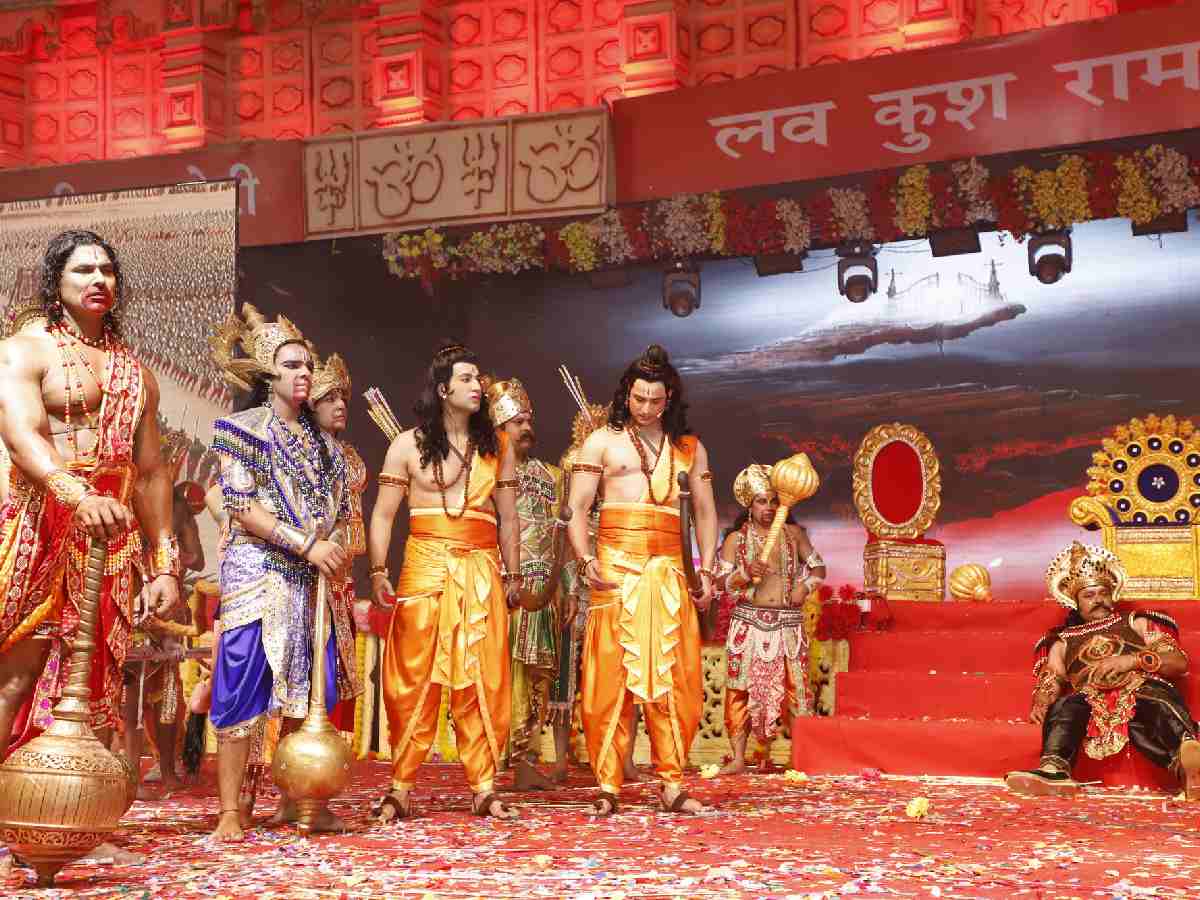
Dussehra has once again transformed Old Delhi’s narrow lanes into a spectacle of lights, sound, and celebration. Near the Red Fort and Ramlila Maidan, carnival rides whirr, tents rise against the night sky, and loudspeakers echo festive tunes. Each year, this centuries-old tradition breathes life into the city’s historic heart.
Among countless celebrations, four Ramlila committees stand out as the oldest and most revered. Each has its own history, struggles, and distinct way of keeping the tradition alive.
Shri Ramlila Committee
The most acclaimed Ramlila in Delhi belongs to the Shri Ramlila Committee. Tracing its origins to the reign of Mughal emperor Bahadur Shah Zafar, it is more than 220 years old. In those days, Hindu soldiers of the Mughal army staged the Ramlila, earning it the name “Mughal-era Ramlila.” After independence, the Shri Dharmik Ramlila Committee was formally established to continue the tradition.
Every year, the Ramlila is staged at Ramlila Maidan. Ajay Agrawal, chairman of the committee, told Patriot, “The tableaux of Shri Ramlila Committee start from Chandni Chowk Cycle Market and travel through Old Delhi before reaching Ramlila Maidan. After the performance, the tableaux return in full grandeur. Thousands line the roads late into the night to witness the jhanki of Lord Ram.”
Also Read: Muzaffar Ali: The poet of cinema who painted Umrao Jaan with patience and pain
Rajesh Khanna, the general secretary and a third-generation member, said, “Our Ramlila Committee has seen the British era, independence, partition, and political ups and downs. It has experienced everything.”
The journey has not been without turbulence. In 1986, clashes broke out over a change in the tableaux route. Tear gas and firing followed, and several were arrested. Then DCP Kiran Bedi was in charge. The matter reached Prime Minister Rajiv Gandhi, who intervened from Germany, leading to Home Minister Buta Singh resolving the issue and allowing the Ramlila to continue.
Ramlila Savari
The Ramlila Savari, a Dussehra tradition, has continued for over 180 years. From Navratri to Dussehra, actors portraying Ram, Lakshman, Sita, and Ravan take part in a three-hour procession from Dauji Temple on Esplanade Road to Ramlila Maidan.
Historian Rana Safvi told Patriot that Bahadur Shah Zafar introduced the Ramlila Savari after ascending the throne in the 1830s. Since then, the Shri Ramlila Committee has overseen it. “It reflects the Mughal custom of celebrating festivals like Diwali, Dussehra, and Holi within the Red Fort,” she said.
Shri Dharmik Ramlila Committee
Formed in 1924, the Shri Dharmik Ramlila Committee is one of the most prestigious. Some records suggest 1923, but after differences among members, the formal committee was set up a year later. Since then, it has staged the Ramlila at Madhavdas Park inside the Red Fort grounds.
The Ramlila here has hosted leaders like Jawaharlal Nehru and Indira Gandhi. Nehru would take young Indira in an open carriage to watch the performances. Today, the fourth generation of founding families remains active.
The event is also a social platform. Families seek marriage alliances, while the festive atmosphere strengthens community bonds.
A troupe of 100 actors, mostly from Moradabad and Bareilly, live together during the festival, following a sattvic lifestyle. Both Valmiki’s Ramayan and Tulsidas’s Ramcharitmanas are performed with emphasis on emotion and expression.
This year’s three- to four-storey stage includes aerial battles, sparks from electronic swords, and grand scenes while preserving the essence of the Treta Yuga.
General secretary Dheeraj Dhar Gupta said, “We work on the gestures and expressions of the actors so that the Ramlila feels real. It is preserved in its traditional form.”
Secretary Pradeep Sharan added, “Thousands attend every night, so we keep a close watch on seating and security. We want the audience to enjoy without discomfort.”
Lav-Kush Ramlila Committee
The Lav-Kush Ramlila Committee, founded in 1979, has grown into one of the largest. Known for high-tech special effects and film celebrity appearances, it draws inspiration from Ramanand Sagar’s television serial Ramayan, making its style familiar to audiences.
Prime Minister Rajiv Gandhi attended its inaugural year, and later Ramanand Sagar himself praised the enthusiasm of Delhi’s crowds.
The Ram Baraat passes through Muslim-majority areas such as Sadar Bazar, Pahari Dheeraj, Khari Baoli, and Fatehpuri. Muslim residents join the festivities, while artisans contribute by making effigies of Ravan and organising fireworks.
The Baraat begins at 5 PM from Daya Basti Road and reaches Red Fort by 10 PM, with a symbolic wedding of Ram and Sita staged at Ghantaghar Chowk.
The committee has 84 members, including 13 women and six makeup artists. During the ten days, actors fast and survive only on fruits.
This year’s budget is Rs 70–80 lakh. Around 20,000 people gather on ordinary days, while Lanka Dahan draws over one lakh.
President Ramkumar Gupta said, “For the youth, being part of such traditions is important for mental growth and moral development.”
General secretary Sukhbir Saran Agrawal recalled, “Despite some opposition from police, we took the tableaux through Muslim-majority areas. Our Muslim brothers welcomed it warmly. It makes us proud that Ramlila is no longer only for the elderly but also for the youth.”
Treasurer Subhash Goel said, “Our aim is to promote secularism through this festival.”
Also Read: Delhi’s Old Secretariat: a witness to India’s political journey
Nav Shri Dharmik Ramlila Committee
Founded in 1958, the Nav Shri Dharmik Ramlila Committee originally staged plays at Gandhi Maidan in Chandni Chowk before shifting to Red Fort Ground in the 1990s.
In its early years, it became famous for revolving stages. Leaders like Lal Bahadur Shastri, Indira Gandhi, and Rajendra Prasad attended its performances.
Press secretary Rahul Sharma recalls early leaders like Lala Prahlad Rai and Babu Ganpat Rai, and how the Parshuram Samvad scene was a highlight.
For nearly 40 years, performers came from Moradabad. In recent years, National School of Drama actors have taken over under the direction of Pandit Amitosh.
From September 29 this year, the committee has been staging not only the birth of Lord Ram but also the birth of Ravan — a first for a Delhi Ramlila.
The committee was born out of a split with Shri Dharmik Ramlila Committee in 1958, leading to two distinct groups.
A living tradition
From the Mughal era to today, these committees have witnessed every turn of Indian history — colonial rule, independence, partition, and political upheavals. Yet each year, they gather to retell the story of Lord Ram in the heart of Delhi.
For the people of Old Delhi, Ramlila is more than performance. It is living history, a reflection of community spirit, and a celebration that unites generations.
A plea in the Supreme Court challenges restrictions on protests at Delhi’s Jantar Mantar and…
Delhi recorded an AQI of 138 in the moderate category on Tuesday, with the minimum…
A 29-year-old driver was allegedly beaten to death by nightclub bouncers in Delhi following a…
Delhi HC to hear pleas seeking regulation of protests in the capital on Tuesday, with…
From a Sikh family in Tilak Nagar performing Shastar Puja to a Malayali household inscribing…
CJP leaders Saurav Das, Ashutosh Ranka and others were detained near Jantar Mantar amid heightened…
