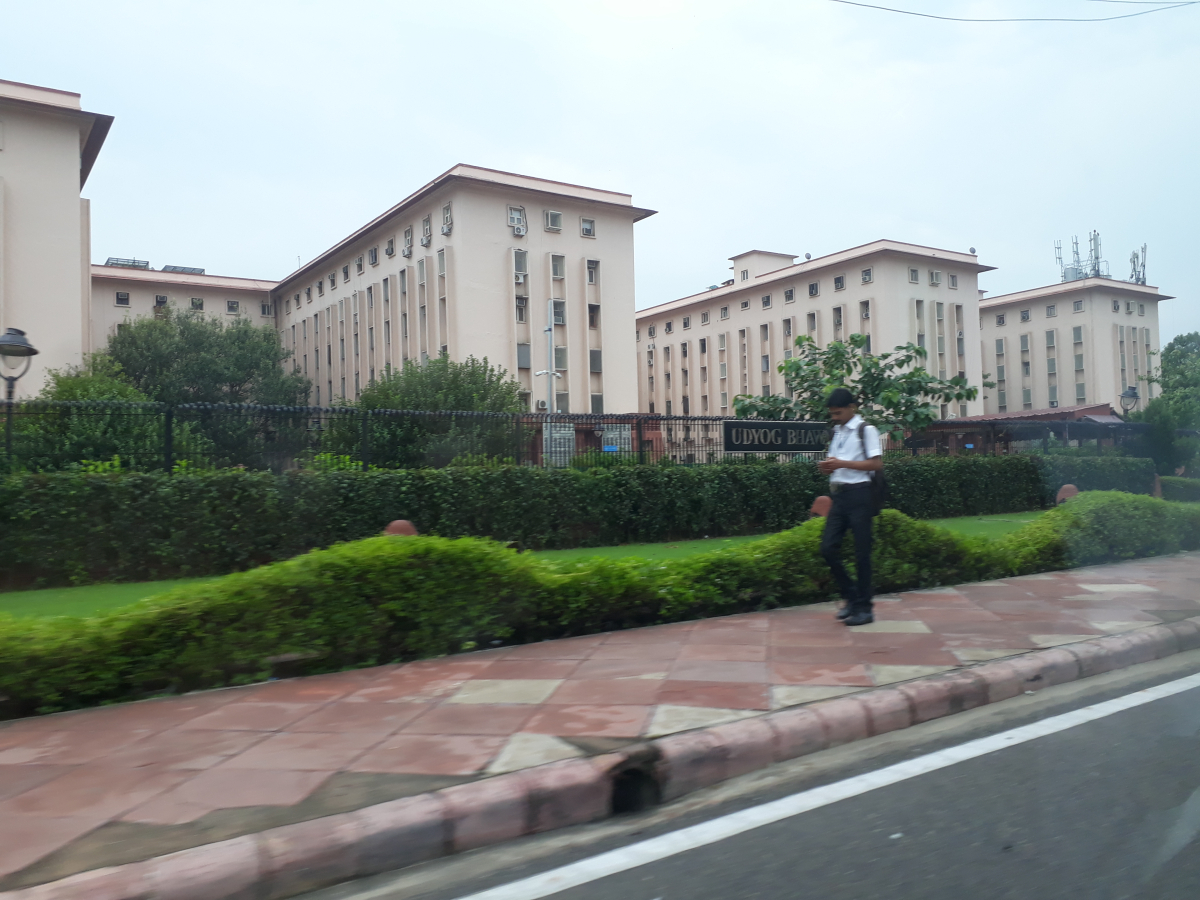
Udyog Bhawan
These are twilight days for Udyog Bhawan.
The iconic building of Delhi is now covered with green and blue plastic sheets, with bulldozers parked at the site. Only its top floors can be seen from the outside. The sounds of files and busy footsteps have given way to the roar of bulldozers, as the structure is being demolished to make way for new buildings under the Central Vista redevelopment plan.
For nearly 70 years, Udyog Bhawan stood as a living symbol of independent India’s ambitions. This is where industrial policies were shaped and business dreams came true.
Hub of industrial planning
Many important ministers worked at Udyog Bhawan. The citadel, now being dismantled, was built in 1957-58 and served as the hub of India’s industrial planning. In the beginning, industry and commerce had separate ministries; they merged in 1999 to form the Ministry of Commerce and Industry.
In the 1960s, leaders such as Manubhai Shah, Lal Bahadur Shastri, Swaran Singh, and Tribhuvan Narayan Singh focused on building heavy industries and implementing Five-Year Plans. In the 1970s, the focus shifted to promoting small industries.
“George Fernandes became Industry minister during the Janata Party government,” recalled Raj Kumar Jain, a friend of George Fernandes.
“Coming from a trade union background, he took a tough stand against foreign companies. He forced IBM and Coca-Cola to leave India because they did not follow the rules. This step showed his socialist thinking and strong views against big multinational companies,” he said.
Fernandes also paid attention to small industries and workers’ rights. “People say that during George Fernandes’ time, anyone could walk into his office at Udyog Bhawan without much difficulty.”
End of ‘License Raj’
In the 1980s and 1990s, ministers such as VP Singh, Pranab Mukherjee, and P Chidambaram worked here. Significant
Later, as heads of the Commerce and Industry Ministry, leaders such as Murasoli Maran, Arun Shourie, Arun Jaitley, Kamal Nath, Anand Sharma, Suresh Prabhu, and Piyush Goyal also worked from here. During Piyush Goyal’s tenure, schemes such as ‘Make in India’ and ‘Startup India’ were launched. These initiatives played a big role in the vision of Atmanirbhar Bharat.
Designed by RI Gehlot
After independence, India needed new government buildings. The old North and South Blocks were not enough. The Central Public Works Department (CPWD) architect RI Gehlot designed Udyog Bhawan. He had also designed the Vigyan Bhawan.
The seven-storey building had a modern look but also included Indian touches, such as large eaves (chhajjas) and small domes. For many decades, top industrialists such as JRD Tata, GD Birla, Keshub Mahindra, and Dhirubhai Ambani came here to meet ministers and discuss business matters.
Policies were made at Udyog Bhawan to support factories, trade, and small businesses. In the spirit of the Swadeshi movement, officials discussed import-export rules, the licensing system, and later, economic reforms.
During the days of the ‘License Raj’, files moved slowly through the corridors. There are many stories of small entrepreneurs waiting for months for approvals. Sometimes, a direct meeting with the minister would solve the problem. Such stories were common. Employees remember the lively atmosphere in the hallways.
Important meetings
Important meetings took place here in the 1970s and ’80s. Plans for heavy industries such as steel, machinery and automobiles were prepared. Udyog Bhawan also played a role in the growth of companies such as Maruti and Hindustan Motors. After the 1991 economic reforms, new policies were made to attract foreign investment, promote exports, and support MSMEs (Micro, Small and Medium Enterprises).
In the mid of all this, there were complaints too, such as those relating to water leaking from roofs during the monsoon.
Advocate and heritage lover Padam Kumar asks whether the old building could have been modernised instead of being demolished. Now that the ball is rolling, one can perhaps hope that at least some of the memories and stories of old Udyog Bhawan are preserved in the new structures. The soul of New Delhi will then remain alive.
Read More: Delhi Police denies permission to continue CJP protest, Dipke says won’t move
Delhi Police seized over 707 kg of illegal firecrackers in Trilokpuri and arrested one person;…
Continuum: Explore 30 years of Asit Kumar Patnaik's artistic evolution celebrating femininity and emotion at…
Protesters marched to ECI headquarters in Delhi against voter roll revision, sparking traffic diversions and…
Three Delhi schools evacuated following bomb threat sent over emails; Delhi police launch search operations
Two arrested in Delhi after a 27-year-old woman died falling from a fair ride operating…
To combat Delhi's mounting water crisis, the MCD looks back 300 years to revive a…
