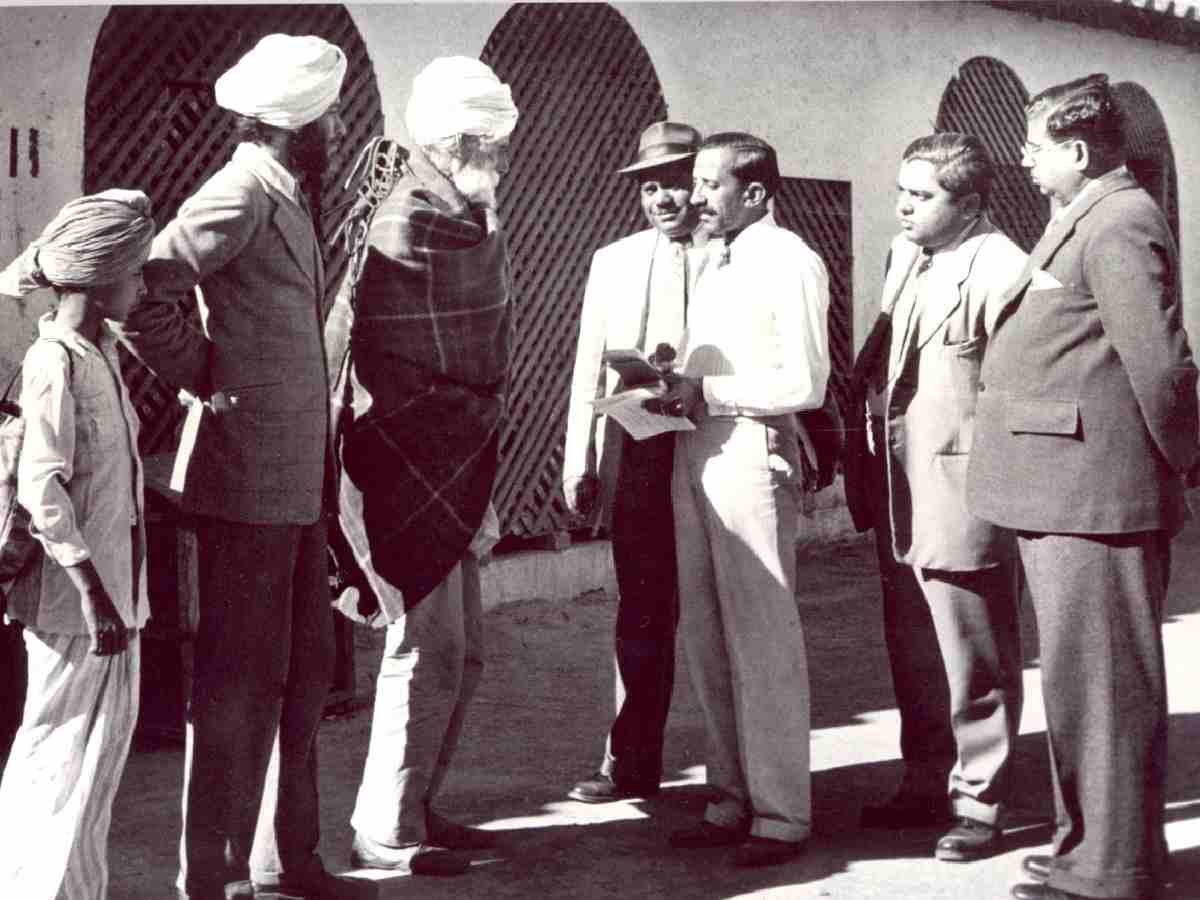
Census being recorded in 1951.Source: Census Library
Dr Harmeet Singh, former Principal of Khalsa College, still remembers the first census of independent India in 1951. He was around ten years old then, living in Paharganj. Now residing in East Patel Nagar, Singh is preparing once again to provide his details as India readies itself for another census after a prolonged gap.
The country’s first census after independence was conducted from February 9 to 28, 1951.
First day of census at Rashtrapati Bhavan
On the very first day, India’s Deputy Census Commissioner Rameshwar Dayal visited Rashtrapati Bhavan to collect details from the then President of India, Dr Rajendra Prasad. He recorded his age as 66, his profession as “President,” and stated that besides Hindi, he was proficient in English and Bengali. Information was also collected from his wife, Rajvanshi Devi.
A special enumeration of homeless individuals, beggars, and others was conducted from the night of February 28 to the morning of March 1. Every individual was asked questions regarding their name, age, gender, religion, marital status (married, unmarried, or divorced), place of birth, mother tongue, other known languages, employment status, business, literacy (read, write, or both), and the highest educational qualification attained.
Delhi’s population: Then and now
According to the 1951 census, Delhi had a total population of 1,744,072. Of these, 1,026,762 people (58.9%) were born outside Delhi, while 717,310 (41.1%) were born within the city. The rise in population was steep compared to the 1941 census, which had recorded Delhi’s population at around 7 lakh. The increase to 17 lakh by 1951 was primarily due to Partition-related migration.
Today, Delhi’s population is estimated to be no less than 2.5 crore. In 1951, the capital mainly comprised rural villages, the Delhi-6 (Old Delhi) area, and New Delhi. The transformation over the decades has been striking.
The shadow of Partition
Partition had a profound impact on Delhi’s demography. A significant number of Hindus and Sikhs migrated from across the newly drawn border, while many Muslims left for Pakistan. A key objective of the 1951 census in Delhi was to enumerate refugees to facilitate their rehabilitation.
After Partition, Delhi came to be known as a “Punjabi city.” Later estimates suggest that Punjabi speakers made up around 35–40% of the population, although many adopted Hindi as their primary language.
Who spoke Urdu before Partition?
Before Partition, Delhi’s population largely comprised Urdu-speaking Muslims, Kayasthas, and Vaishyas. After Partition, the city saw a marked rise in Punjabi- and Hindi-speaking residents.
Noted commentator Ravi Chaturvedi, who lived in Lodhi Colony in the 1950s, disputes the notion that Urdu was exclusively the mother tongue of Muslims. “Even Kayastha and Vaishya Hindus spoke Urdu in those days,” he said.
Also Read: Quest to document a fading heritage of rural Delhi
To carry out the census in Delhi, approximately 8,000 schoolteachers and government employees were deployed.
Comparing the 1941 and 1951 census
Comparing the 1941 and 1951 census results for Delhi is difficult due to limited Delhi-specific data. The 1941 census was affected by World War II, while the 1951 census reflected the demographic upheavals caused by Partition.
Nevertheless, the population of Delhi likely doubled—or more—between 1941 and 1951. This increase was largely due to the mass migration of Hindus and Sikhs from areas that became part of Pakistan.
Demographic composition (religion)
During British rule, Delhi’s religious demographics stood at approximately 62% Hindus and 33% Muslims. By 1951, these figures had shifted dramatically to 88% Hindus and 7% Muslims. The sharp decline in the Muslim population and the corresponding increase in the Hindu population were direct consequences of Partition, which led to significant communal displacement.
As a border region and national capital, Delhi became a major refuge for displaced Hindu and Sikh populations, reshaping its religious landscape. Singh recalls, “I vividly remember that post Partition, our Muslim-dominated Paharganj had changed as almost all the Muslims left and their houses were occupied by refugees coming from Pakistan.”
Sex ratio
Specific sex ratio data for Delhi in 1941 is not available. However, the 1941 national census reported a sex ratio of approximately 945 females per 1,000 males for India. As an urban centre, Delhi likely had a slightly lower ratio—around 900–920 females per 1,000 males—due to male-dominated migration.
Literacy and education
Literacy likely improved between 1941 and 1951 due to Delhi’s growing importance as the capital of independent India and the arrival of educated refugees. However, the Partition disrupted educational infrastructure, which may have tempered the pace of progress.
Naresh Kaushik, a former schoolteacher, says many refugees arriving from across the border established schools in the capital despite being in great distress. “They knew that only through education they could survive in an alien city,” he said. Kaushik’s father, Pandit Bishamber Dayal Santoshi, was among those collecting census information in the Shahdara area.
The 1941 census—conducted during British rule and wartime—was less comprehensive due to global conflict. In contrast, the 1951 census, conducted under the 1948 Census of India Act, was more systematic and captured the massive demographic shifts that followed independence and Partition.
Delhi recorded its coldest night of the month so far, with the minimum temperature dropping…
Elected to the Delhi Golf Club general committee, Mansher Singh says he wants to build…
A $780 million market built on pavements, where the pleasure of reading meets the price…
Supreme Court advocate Abhishek Pawar alleges women were denied washroom access for seven to eight…
Each day of closure costs shops in Khan Market and Connaught Place between Rs 60,000…
Delhi generates nearly 15,000 tonnes of waste daily, prompting the government to deploy 1,000 mechanical…

