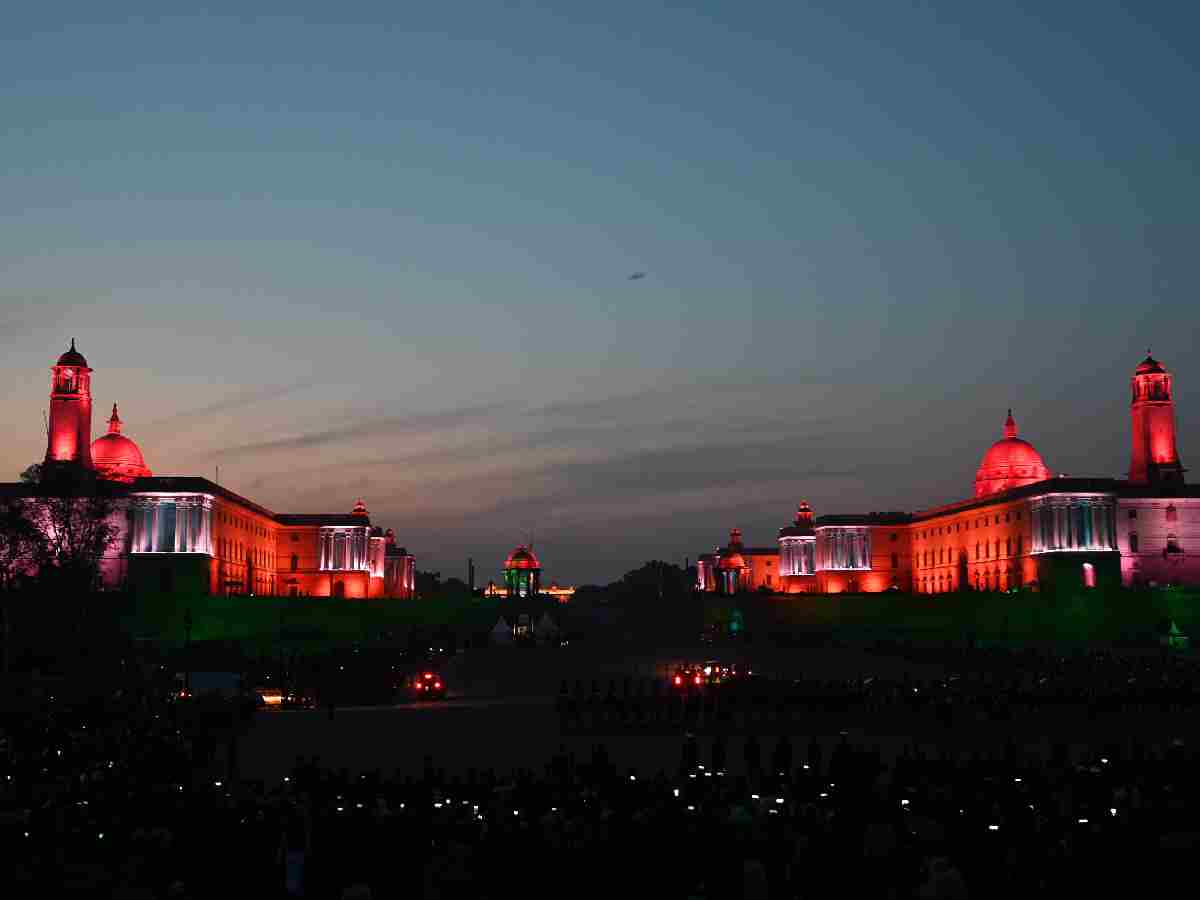
As Independence approached in August 1947, the lights in the Herbert Baker–designed South and North Blocks burned late into the night. Prime Minister Pandit Jawaharlal Nehru worked with his staff around the clock in his South Block office to finalise the process of independence and partition, while Home Minister Sardar Vallabhbhai Patel laboured in North Block to ensure the smooth integration of more than 562 princely states into the Indian Union.
In their celebrated book Freedom at Midnight, Larry Collins and Dominique Lapierre captured the intensity of those days within the two Secretariat buildings.
Shifting out of Raisina Hill
Situated on Raisina Hill, the North and South Blocks have been pivotal to India’s governance since their completion in 1931. They have housed the administrative nerve centres of the government, symbolising authority and continuity from the colonial to the independent eras.
Now, both buildings will soon be vacated. The Prime Minister’s Office is expected to shift from South Block to the newly constructed Executive Enclave-I, located just a few hundred metres away, by September 2025. The Ministry of Home Affairs and the Ministry of Personnel have nearly completed their move to Kartavya Bhawan-3, inaugurated by Prime Minister Narendra Modi earlier this month.
“The North and South Blocks have remained central to India’s governance due to their role as the administrative heart of the nation,” said noted journalist Trilokdeep, who often visited the buildings in his reporting years.
He explained that South Block houses the Prime Minister’s Office, the Ministry of Defence, and the Ministry of External Affairs, while North Block accommodates the Ministries of Home Affairs and Finance. These institutions oversee critical aspects of governance, from internal security to economic planning, making the structures indispensable.
Nerve centre in times of war
Old-timers recall that during the 1971 war against Pakistan, South Block became the nation’s war hub. A ‘War Room’ was set up where the entire strategy and monitoring were conducted.
It was here that Prime Minister Indira Gandhi held crucial meetings with Field Marshal Sam Manekshaw and senior military officials. Gandhi’s resolute leadership and Manekshaw’s candid military advice echoed in its rooms, as every order and every report of victory first reached this War Room.
Even recently, during Operation Sindoor, Prime Minister Narendra Modi met the top brass of the defence forces in his South Block office.
Lutyens versus Baker
Architectural history reveals sharp differences between Edwin Lutyens and Herbert Baker. Robert Grant Ewing, in Indian Summer: Lutyens, Baker and Imperial Delhi, noted that Lutyens was “very annoyed” with Baker over the gradient and positioning of the buildings, which, in his view, obstructed the line of sight to his Viceroy’s House (now Rashtrapati Bhavan).
Lutyens accused Baker of sabotaging his design, bitterly referring to the episode as his “Bakerloo”—a pun on Baker’s name and London’s Bakerloo line. Baker, however, defended the gradient on practical and aesthetic grounds, and historical records suggest that Lutyens had initially approved the plans.
Witness to history
Built originally to house the British bureaucracy after the Capital shifted from Calcutta to Delhi in 1911, the two blocks seamlessly transitioned into the seat of power for independent India in 1947.
The annual Beating Retreat ceremony at Vijay Chowk, held between them, further underlines their cultural and national importance. Under the Central Vista redevelopment plan, the buildings are set to be repurposed as museums by the end of 2025.
The North Block’s inscription—“Liberty will not descend to a people: a people must raise themselves to liberty”—remains a stirring call to democratic ideals.
Sanjaya Baru, in The Accidental Prime Minister, recalled how in 1991, amid a severe economic crisis, Prime Minister PV Narasimha Rao and Finance Minister Manmohan Singh crafted a historic budget in North Block. Great secrecy surrounded the process, and when Singh concluded his speech in Parliament, he quoted Victor Hugo: “No power on earth can stop an idea whose time has come.”
Architectural grandeur
The construction of the Secretariat buildings was completed in 1929 at a cost of Rs 17.5 million. Contracts were awarded to multiple builders, including Sir Sobha Singh.
Each block, four storeys high with about 1,000 rooms, was built using cream and red Dholpur sandstone—the red forming the base and cream adorning the walls and domes. The architecture blends classical European designs with Indian elements such as Mughal-inspired gateways, jaali, chajjas, and chhatris. Lotus and elephant motifs further highlight Rajputana and Mughal influences, adapted to India’s climate.
Monkeys and ministries
For decades, employees have shared the North and South Blocks with a persistent nuisance: monkeys. They are known to snatch food and even run off with files.
Authorities tried various measures. At one point, langurs were brought in to scare them away. When this was stopped over animal rights concerns, staff were hired to mimic langur calls to drive the monkeys out.
Ultimately, the North and South Blocks are not just structures of stone and brick. They are silent witnesses to India’s triumphs and trials, from independence to war, economic transformation, and everyday governance.
An FIR over Jamia protests alleges Congress MPs Imran Pratapgarhi and Imran Masood unlawfully entered…
Delhi's 'Namo Yamuna River Safari' cruise will launch before Chhath, offering 40-minute family trips between…
Delhi's Old RTR flyover reopens for light vehicles today after repair work following road cracks,…
Visits to Govindpuri, Jangpura, Saket and Mayur Vihar show unlabelled corrosive substances sold for Rs…
Rescue teams recovered two bodies from the debris of a collapsed under-construction house in northeast…
Built on Jawaharlal Nehru’s vision, the Delhi landmark has witnessed the evolution of a young…
