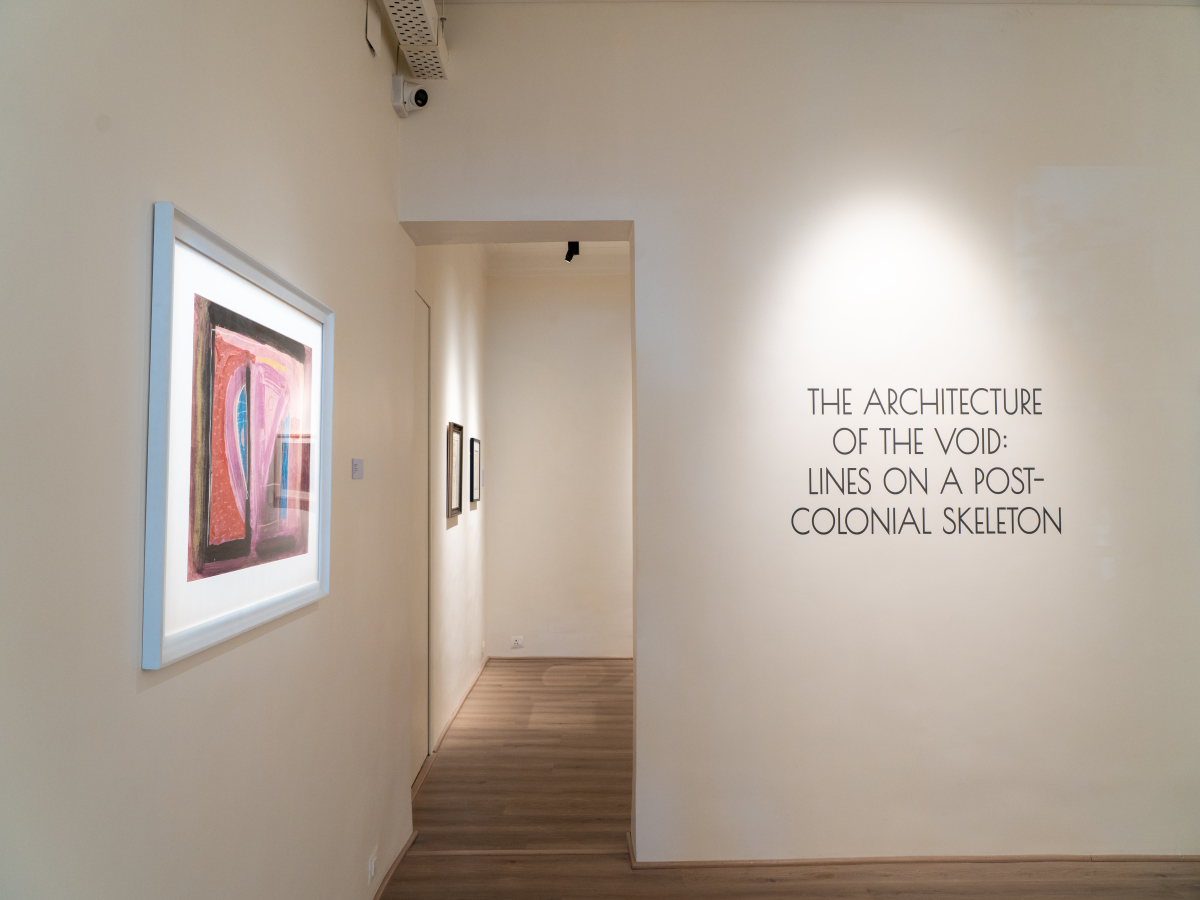
Exhibition at Gallery Dotwalk
As visitors walk into Gallery Dotwalk in Defence Colony, the scale is immediately striking—not because of large canvases, but because of the intimacy of the works on display. The Architecture of the Void: Lines on a Postcolonial Skeleton brings together a range of drawings and works on paper, shifting focus to a quieter, often overlooked aspect of modern Indian art.
Featuring works by artists such as FN Souza, Bhupen Khakhar, Ram Kumar, Jogen Chowdhury and Meera Mukherjee, among others, the exhibition brings together drawings, watercolours and etchings that reflect a formative moment in India’s artistic history. On view until May 30, the show situates these works within the turbulent years surrounding Independence and Partition, when artists grappled with questions of identity, displacement and belonging.
According to Associate Director Shilpa Rangnekar, the exhibition marks a shift in the gallery’s curatorial approach. “Dotwalk has always focused on curating different art experiences, and this show brings a sharper curatorial direction,” she said. “In the past, Dotwalk has curated some ambitious survey shows specific to mediums, and these shows have been crucial in setting up the path for the ongoing show as well as the upcoming exhibition on a survey of drawings.”
“With this show, we are looking back at our histories and remembering how they have brought us here. The show, in a way, acknowledges the fragility and dynamics of paper as a medium and the lines that were drawn on them in the wake of Independence in postcolonial India,” she added. “The exhibition becomes a lens to understand how modernism has played an important role in India and how it continues to shape our contemporary practices.”
Also Read: From 200 cars to crores on Delhi’s roads
Exploring the language of the line
Rather than organising the show by movements or regions, the curatorial approach follows the “line” itself—tracing how it transforms across artists and contexts. Lines in these works appear wounded, architectural, mythic and intimate, forging unexpected connections between artists rarely seen together.
Rangnekar explained that this shift allows for a more intuitive reading of modernism. “Instead of grouping the artists by movements or styles, we focused on paper as a medium and line as a form that allowed us to trace a more intuitive approach,” she said. “When you look at the works of Jogen Chowdhury, K K Hebbar, and Prabhakar Barwe, these lines reveal shared sensibilities—tension, flow, assertiveness—that go beyond geography or school of thought.”
She added that the exhibition unfolds through three overlapping passages: City in Shards: The Geometry of Alienation, Tender Wounds: The Vulnerable Flesh, and Rhythm, Myth, and the Infinite, each prompting viewers to rethink how modernity is experienced through paper.
The emphasis on paper, she noted, is equally deliberate. “Paper as a medium is quite dynamic. It’s fragile and perishable but at the same time has memory and absorbs gestures,” she said. “When we thought of focusing on how the postcolonial turmoils of India affected the psychological landscape, instead of large-scale canvases we turned to the more intimate yet profound medium of paper.”
“These works bring you closer to the thought and the process of the artists, which is crucial to understanding that period,” she added.
Echoes of a fractured history
While the exhibition does not depict Partition directly, its emotional aftermath runs through the works. Broken forms, restless marks and layered textures reflect a psychological landscape shaped by upheaval.
“These works don’t reflect Partition directly but they do reflect the psychological mindset of the country,” Rangnekar said. “One can clearly see displacement, restlessness and the search for a new identity through the broken forms, assertive marks and restless lines.”
Artists like Souza and Khakhar, known for confronting questions of identity and social norms, continue to resonate today. “Both artists were deeply engaged with questions of identity, sexuality and social norms,” she said. “Their works still feel urgent because they confront discomfort directly.”
Voices from the exhibition
Visitors to the show described it as both introspective and revealing.
Ritika Sharma, an art student from Delhi University, said, “Seeing these works on paper feels very different from looking at large canvases. You can sense the hesitation and emotion in every line—it makes the experience more personal and immediate.”
She added that “the exhibition brings together artists we usually see in isolation”. Here, she said, “their works speak to each other, and you begin to understand modern Indian art as a shared conversation rather than separate movements.”
For practising artist Neha Verma, the show offers contemporary relevance. “What struck me is how current these works feel. The themes of identity and uncertainty are still very much part of our reality today,” she said.
“By focusing on paper, the exhibition highlights a crucial but often ignored aspect of modernism,” she added. “These are not just preparatory works—they are complete, powerful expressions in their own right.”
A continuing dialogue
The Architecture of the Void is not positioned as a retrospective alone but as an ongoing conversation between past and present. For Gallery Dotwalk, it signals an effort to deepen engagement with modern Indian art while maintaining its focus on contemporary practices and experimental formats.
“Moving into Defence Colony has allowed us to slow down and look again at how modernism in India first wrote itself into being,” says Sreejith C N, Founder-Director of Gallery Dotwalk. “With The Architecture of the Void, we wanted our second show in this space to honour the fragility and courage of those gestures on paper, lines drawn in the wake of Independence and Partition, on surfaces that could tear or vanish. Bringing these works into dialogue with our contemporary programme is, for us, a way of acknowledging that the questions modern artists asked in the postcolonial moment are still alive in the room today.”
Open Monday to Saturday from 11 am to 7 pm, the exhibition offers viewers a chance to engage with a quieter, more reflective side of Indian modernism—one where the simplest of lines carries the weight of history.
Read More: Unchanging addresses in a changing Delhi
Delhi Capitals ( DC ) player, Lungi Ngidi, landed on his back and the back…
The official statement read that the centre, set up in the Swami Dayanand Hospital's OPD…
Officials said major improvements were seen in several traffic circles in Central, with Kotwali and…
According to the prosecution, it was alleged that Rohit stabbed his brother, Yash, with scissors…
After receiving a call regarding a road accident at east Delhi's Shakarpur police station, a…
A PCR call was received regarding the accident, following which local police reached the spot…

