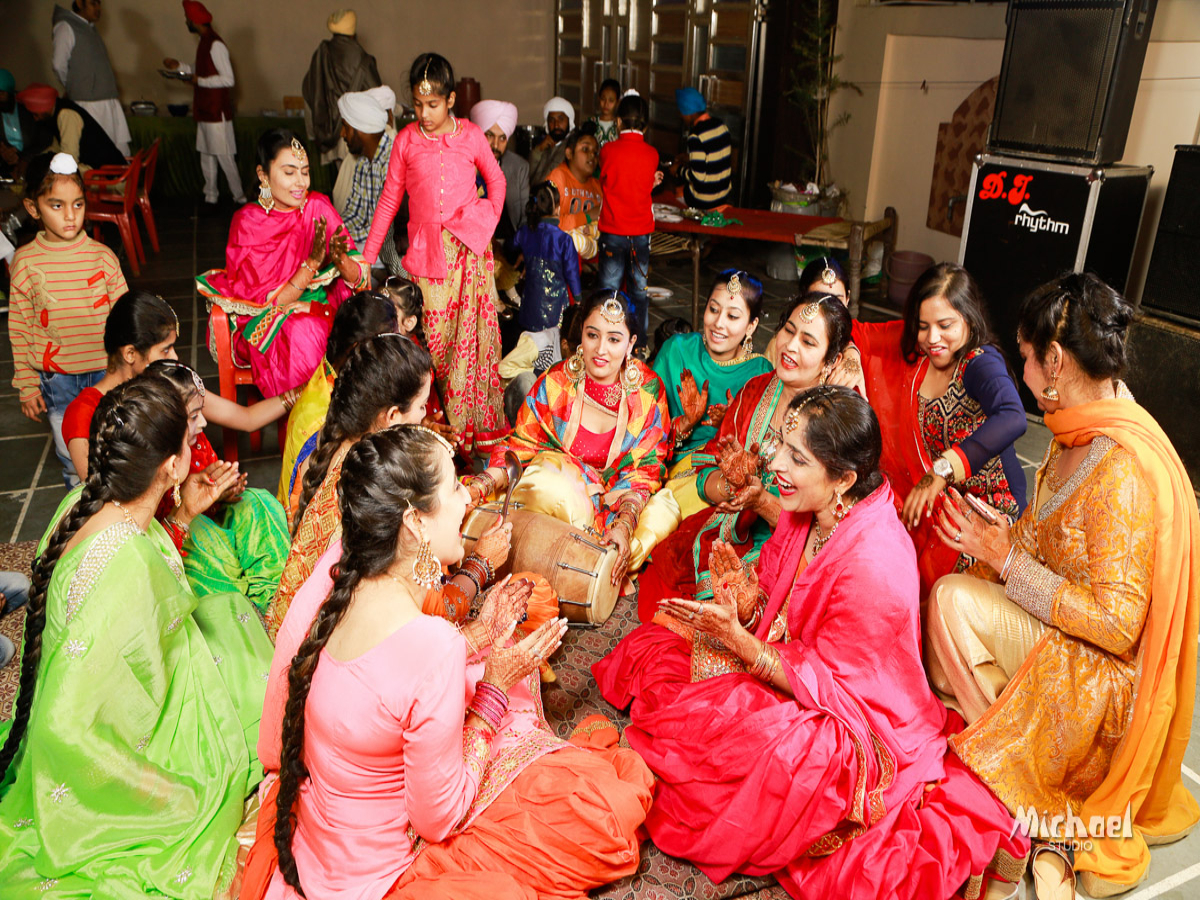
Women at a Punjabi Wedding in Delhi
The rhythmic beats of the dholak filled the air as women sang beloved old Punjabi folk songs at the IP Extension home of Roopam Sehgal on the eve of his son’s recent wedding. Just like in any traditional Punjabi household, the ladies joyfully performed classics such as ‘Kala Doriya Kunde Naal’, ‘Lathe Di Chadar Utte Saleti Rang Mahiya’, and ‘Sadda Chiriya Da Chamba Re Asi Udd Jaana Re’. What makes this truly remarkable is that the very same melodies had guests dancing across the border in Lahore during the recent wedding festivities of Punjab Chief Minister Maryam Nawaz’s son. The songs bridged the divide effortlessly, proving their timeless appeal.
Well, no marriage in Delhi’s Punjabi families is complete without these songs during the wedding time. As the wedding season arrives each year, the same cherished folk tunes echo through Punjabi homes in Kalkaji, Patel Nagar, Rajinder Nagar, and Karol Bagh. On the other side of the border, Punjabis in Lahore sway and dance to the identical rhythms. “Political borders may carve up the land, but these songs remain unbound by lines on a map—they embody the very soul of Punjab, holding its people together even decades after the trauma of Partition,” says JS Shunty, noted social worker of the capital who has recently became the member of the Punjab State Human Rights Commission.
In Delhi, the arrival of the marriage season instantly revives these melodies. Their tunes drift through bustling markets, family courtyards, and grand marriage palaces alike. The legendary folk singer Surinder Kaur lent these songs an eternal sweetness with her voice—often compared to mishri (rock candy) for its pure, delightful charm. That voice still resonates in the hearts of Punjabis, stretching from Delhi to Toronto and beyond.
Surinder Kaur originally belonged to Lahore. After her marriage to Dr Joginder Singh Sodhi, a respected professor at Khalsa College, she made her home in Delhi’s Roop Nagar. Over the years, she graced countless joyous occasions in Punjabi families with her soulful renditions of folk songs. Her exceptional singing raised these traditional melodies to new artistic heights. One unforgettable memory is the ladies’ sangeet organised by the Anand family just before Maneka Gandhi’s wedding to Sanjay Gandhi. They arranged a special mehfil featuring Surinder Kaur and her sister Mahendra Kaur. The highlight was the masterful performance by Kesar Singh Narula, widely regarded as one of the greatest exponents of Punjabi folk singing. That all-night gathering in Greater Kailash remains etched in the memories of many attendees to this day.
For decades, Kesar Singh Narula and his wife Mohini enchanted Delhi audiences with their captivating voices at weddings and community events. Their performances carried an almost magical quality—listeners would remain spellbound for hours, lost in the beauty of the music. “Although Surinder Kaur and Narula sahab are no longer among us, the folk songs they popularised continue to be sung at every wedding. It was largely through their efforts that these melodies reached the common people and became truly beloved across communities,” says SK Gambhir, an Income Tax consultant and active member of the Multan Biradari of Delhi.
It is sometimes astonishing to observe that, while the younger generation of Punjabis in Delhi may speak less Punjabi in everyday conversation, they still derive immense pleasure from listening to and humming these folk songs. The melodies serve as a powerful link to their cultural roots, stirring deep emotions. Visit any wedding home in the city, and you will see Punjabi men and women—from those in their twenties to their seventies—singing old and new Punjabi songs with equal enthusiasm. As they dance to the lively beats of the dholki, surrounded by laughter and playful banter, the songs come alive once more, filling the atmosphere with warmth and nostalgia.
Also Read: Awadhi flavours take centre stage at Delhi Aerocity
Weddings bring a special delight through the tradition of tappe. These are short poetic compositions, typically consisting of one-and-a-half lines: the first line remains incomplete, while the second completes the thought. Widely known as “Balo-Mahiya tappe,” they often narrate the romantic tale of two idealised lovers. Elegantly dressed women begin singing tappe a day or two before the main wedding ceremonies, infusing the environment with excitement and playful energy.
Here is a classic example: “Bage vich aaya karo, jado Ali son jaaye, tusi makhihaan udaya karo ( Come to the garden when Ali is asleep, and you keep shooing away the flies).”
Another favourite sung at weddings: “Kothe te aa mahiya, milna ta mil aake nai te khasma nu kha mahiya (come to the rooftop, my beloved; if you come to meet, fine—otherwise, you are damned).”
Such tappe brim with humour, affection, and gentle satire. They make listeners burst into laughter while also prompting deeper reflection on love, relationships, and life.
Whether in Delhi or Lahore, Toronto or Amritsar—Punjabis everywhere respond instinctively to the rhythm of these folk songs. They transcend mere entertainment; they form the core of our shared cultural identity. Partition may have physically separated communities, but these enduring melodies continue to bind us. “When someone begins Kala Doriya, a Punjabi in Delhi naturally joins in humming, just as one in Lahore does the same. This is the true strength of these songs—they are immortal precisely because they live deep within the soul of Punjab,” Tariq Jatala, a teacher and scholar of Punjabi based in Lahore, once said.
Read More: From Madras Hotel to Annapurna Bhandar: another Delhi culinary legacy fades
A Delhi court denied bail to a former DU professor accused of raping a student,…
Delhi Police charged seven dhaba workers in the fatal beating of a Manipuri musician who…
Seven Delhi STPs failed DPCC standards in September, dumping high levels of faecal coliform and…
AISA chief Neha Bora petitioned the Delhi HC against a police notice requiring a peace…
Average AQI of 171 in the first week of this month; falling temperatures and stubble…
Delhi Police dismissed claims of disrupting CR Park Durga Puja, stating actions strictly enforced court-mandated…

