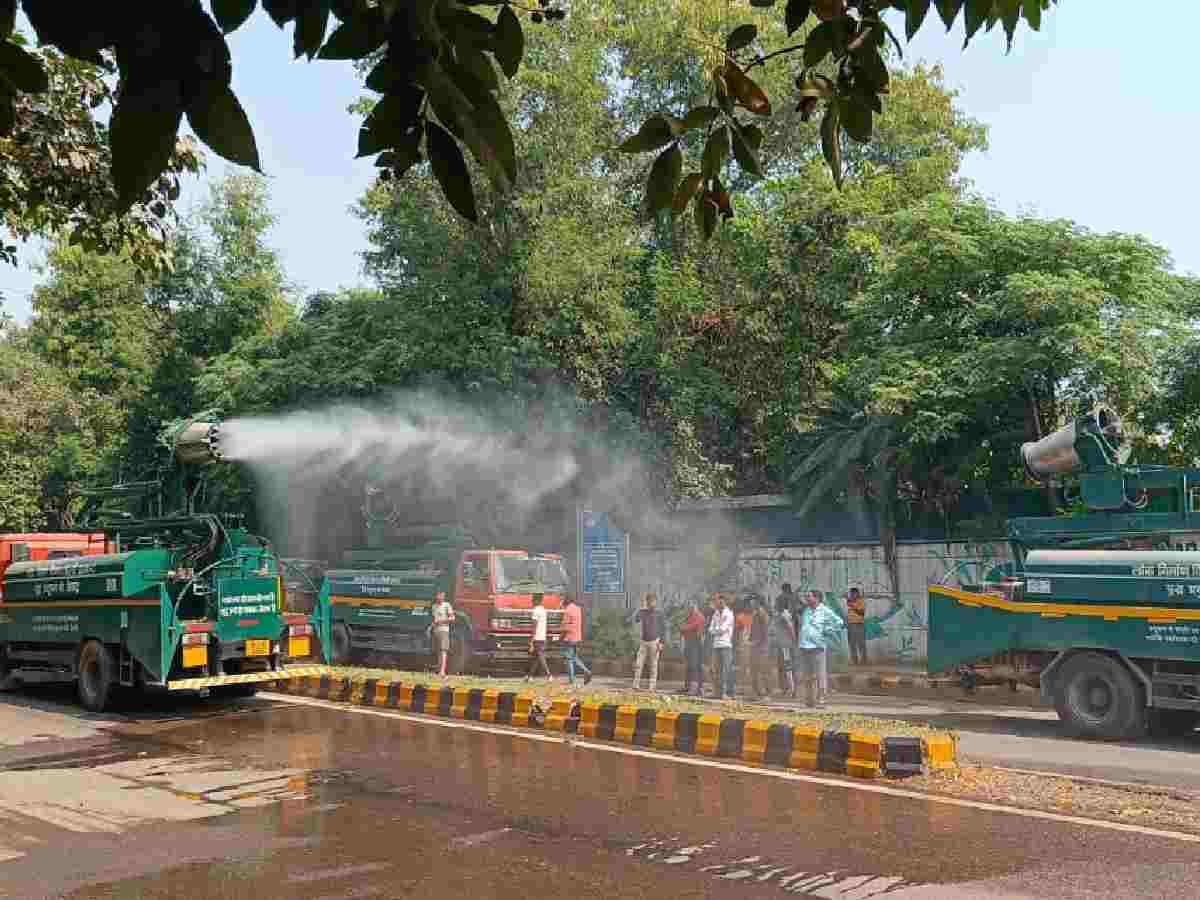
MEASURES KICK IN: NDMC water sprinklers in action to curb dust pollution
On October 14, the Commission for Air Quality Management (CAQM) enforced Stage II of the Graded Response Action Plan (GRAP) in Delhi and the NCR after air quality turned “very poor”. The India Meteorological Department (IMD) predicts persistently poor air quality.
GRAP, applied annually, categorises air quality into four stages — Stage I (Poor, AQI 201–300), Stage II (Very Poor, 301–400), Stage III (Severe, 401–450), and Stage IV (Severe Plus, above 450).
Preventive measures
Stage II of GRAP mandates 27 preventive measures, including mechanical road sweeping and daily water sprinkling on roads with dust suppressants to reduce road dust. Construction and demolition sites face stricter monitoring to ensure dust-control norms are followed, with penalties for violators.
The use of diesel generator (DG) sets is banned, except for essential and emergency services, while an uninterrupted power supply is ensured to minimise DG use. Public transport services such as buses and metro trains are increased to discourage private vehicle usage, and parking fees are hiked to deter car use. Entry of inter-state diesel buses into Delhi is restricted unless they are BS-VI compliant, CNG, or electric.
Residents and RWAs are advised to provide electric heaters for security and maintenance staff to prevent open burning of waste or biomass. Citizens are urged to use public transport, avoid outdoor burning, maintain vehicles properly, and reduce dust-generating activities. Schools are advised to limit outdoor sports and assemblies to protect children’s health during high pollution levels.
Surge in fines
The Transport Department has issued nearly 1.63 lakh PUC penalties in 2025 till July 27, reflecting a surge of over 300% in the monthly average compared to the previous year, according to data. Officials attribute the sharp increase in penalties to the installation of Automatic Number Plate Recognition (ANPR) cameras, a renewed enforcement drive, and the government’s growing reliance on digital tools such as API-based PUC verification linked to the national Vahan database to track and fine offenders.
ANPR cameras have been installed at approximately 300 fuel stations across the city. “High-resolution ANPR cameras capture the number plate details of vehicles when they arrive for refuelling. These details are cross-checked in real time with the central vehicle database via the mParivahan API to verify valid PUC certification. If a vehicle is found to have an expired or missing PUC certificate and it is not renewed within one hour of detection, the system automatically generates an e-penalty,” explained a department official. Vehicle owners receive the PUC penalty via text message on their registered mobile number.
PUC checks
Delhi has 966 PUC testing centres where vehicle tailpipe emissions can be checked for a nominal fee. As of January 2025, of the 8.2 million active vehicles in the city, nearly 2.6 million lack a valid PUC certificate — either expired or never issued. Section 190(2) of the Motor Vehicles Act mandates that vehicles must have a valid PUC certificate.
Owners of vehicles operating without one face prosecution, which may result in imprisonment of up to three months, a fine of up to Rs 10,000, or both. “In addition to digital measures, eight to ten enforcement teams from the Transport Department are deployed daily at various locations across the city to conduct random checks for PUC certificates,” said another official. A breakdown of online versus manual penalties was not immediately available.
Winter crackdown
From October 1 to November 7, 2024, a crackdown under the Delhi government’s Winter Action Plan, aimed at curbing air pollution, resulted in the seizure of 4,286 vehicles. Additionally, escalating pollution levels led to a surge in fines for vehicles lacking valid PUC certificates. By November 7, a total of 3.19 lakh fines had been issued, with 1.15 lakh during the Winter Action Plan period.
Efforts by the Transport Department and Delhi Police represent a significant increase compared to 2022 and 2023, when the number of impounded and fined vehicles was notably lower. In 2022, 1.64 lakh vehicles were fined for missing PUC certificates, and 1,147 older vehicles were impounded. In 2023, fines for PUC violations rose to 2.32 lakh, with only 528 older vehicles seized. Officials attribute the rise in fines and vehicle seizures to a more rigorous, year-long enforcement campaign.
“The Winter Action Plan has enabled us to clamp down on as many vehicles as possible. We anticipate seizing even more vehicles by the end of December,” said a Transport Department official. Joint Commissioner of Police (Traffic) Kime Kaming emphasised the effectiveness of coordinated enforcement. “We launched our crackdown in October as part of the Winter Action Plan. Before that, we carried out periodic vehicle checks across the capital. Now, we hold regular meetings with the Transport Department to plan further. We are primarily identifying older vehicles using the list of registered vehicles, while vehicles lacking valid PUC certificates are typically detected in traffic. This has significantly impacted pollution levels in the capital,” he said.
Heavier fines
Vehicles without a valid PUC certificate are instructed to renew it and face a Rs 2,000 fine. If black smoke is observed from the exhaust, an additional Rs 10,000 fine is imposed. Of the total violators, 1,025 vehicles were subject to this additional penalty, reflecting a stricter approach towards the most polluting vehicles.
This year has also seen a crackdown on the dumping of construction and demolition (C&D) waste. On October 10, the Urban Development Department announced that the Ministry of Housing and Urban Affairs (MoHUA) had set an annual target of 9.8 lakh metric tonnes (MT) for the use of recycled C&D waste products by various agencies in Delhi for 2025–26.
This initiative aims to contribute to a pollution-free environment. The MoHUA has set targets for agencies, including the Municipal Corporation of Delhi (MCD), New Delhi Municipal Council (NDMC), Delhi State Industrial and Infrastructure Development Corporation (DSIIDC), Public Works Department (PWD), Delhi Jal Board (DJB), Delhi Urban Shelter Improvement Board (DUSIB), Delhi Transport Corporation (DTC), Irrigation and Flood Control Department (I&FC), Tata Power, BSES Rajdhani, and BSES Yamuna, among others.
Also Read: Delhi: Floods expose cracks in Yamuna rejuvenation projects
Presently, according to the Urban Development Department, only 52,000 MT of processed C&D waste is being utilised, against the annual target of 9.8 lakh MT. In 2024, by November 7, authorities had issued penalties in 1,334 cases for transporting uncovered C&D waste, with 793 of these recorded during the Winter Action Plan period.
In comparison, offenders fined for C&D waste violations were 779 in 2023 and 405 in 2022, reflecting a steep increase in enforcement efforts.
Each day of closure costs shops in Khan Market and Connaught Place between Rs 60,000…
Delhi generates nearly 15,000 tonnes of waste daily, prompting the government to deploy 1,000 mechanical…
Delhi Police has issued an NOC for the Congress rally at Ramlila Maidan on November…
CJP chief Abhijeet Dipke received conditional bail following his arrest for participating in a Connaught…
The DPCC has floated ₹104 crore tenders to test pilot pollution-control technologies across 40 key…
MCD pushes Bhalswa cleanup to Feb 2027 due to agency transition, leaving over 10 lakh…
