The recent floods that engulfed the Yamuna floodplains in Delhi have reignited debate over how the city manages its most vital natural asset. Environmental experts and the river advocacy body South Asia Network on Dams, Rivers and People (SANDRP) are demanding accountability from the Delhi Development Authority (DDA) after crores of rupees spent on so-called rejuvenation projects were wiped out in the deluge.
What was projected as an ambitious ecological restoration drive has, in the wake of the 2025 floods, been exposed as a glaring example of poor planning, disregard for hydrology, and misuse of public funds.
The price of a misguided vision
Over the past decade, the DDA has poured hundreds of crores into what it termed “Yamuna Rejuvenation Projects.” These included developments such as Asita East, Kalindi Aviral, and Yamuna Vatika — sprawling across nearly 1,500 hectares of floodplain land. The projects were billed as efforts to revive biodiversity, improve water quality, and create eco-parks for public recreation. Together, they represented a public expenditure of around Rs 800 crore.
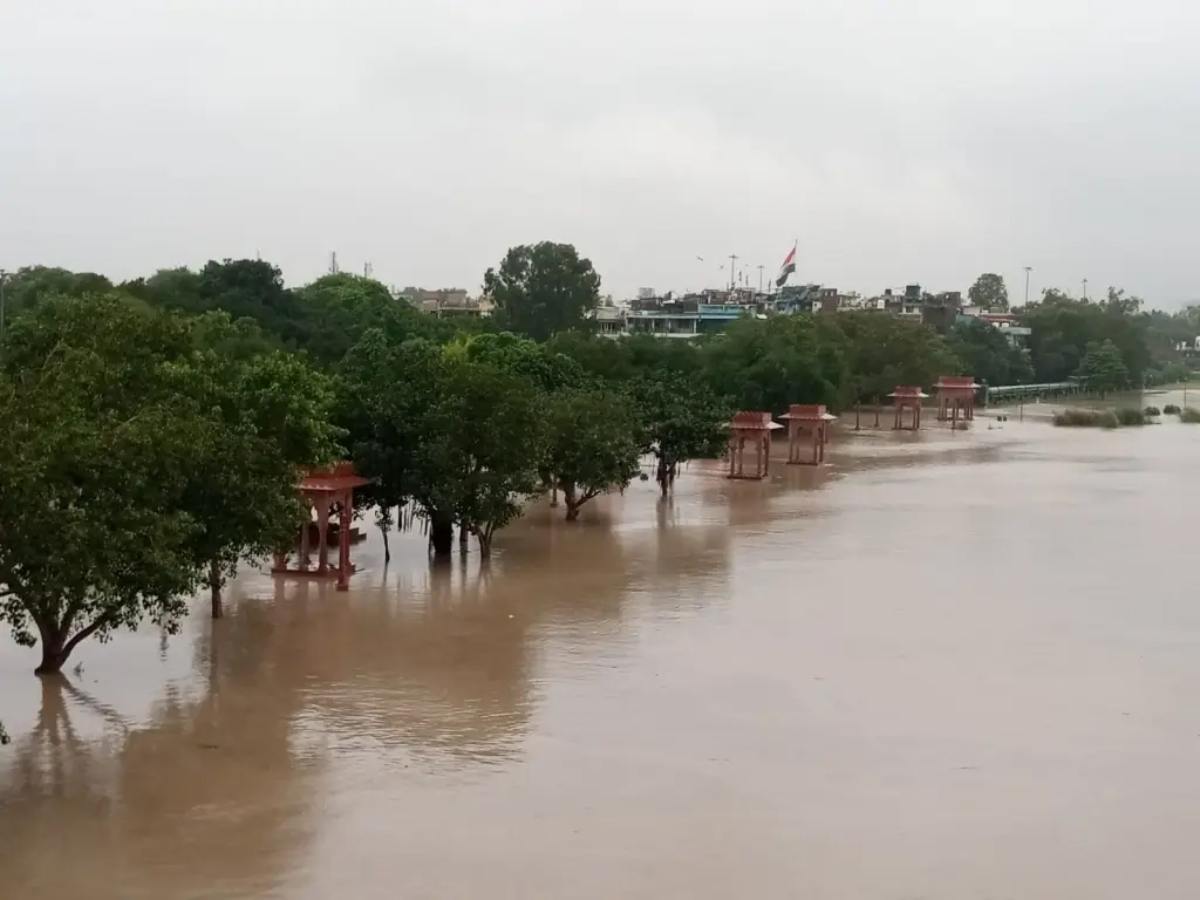
Yet the floods of September 2025 undid years of work within days. As the river swelled beyond its danger mark, water swept through the newly landscaped floodplains, submerging lawns, washing away plantations, eroding embankments, and damaging the concrete and stone structures built along the river’s edge. Photographs from the sites show twisted metal railings, uprooted trees, and thick silt covering what were manicured pathways only weeks earlier.
Experts say the flood merely exposed the inevitable — that a river like the Yamuna cannot be domesticated.
Also Read: Delhi’s missing children: trafficking, neglect and poverty fuel a deepening crisis
Ignored warnings and a flawed approach
Environmentalists have long argued that the DDA’s conception of “rejuvenation” was fundamentally misguided. Rather than restoring the river’s floodplain to its natural state, the agency opted for beautification — raising land levels through soil dumping, constructing embankments, and laying concrete walkways and ornamental gardens.
“The Yamuna floodplain is part of the river ecosystem, not a construction site,” said Bhim Singh Rawat, Associate Coordinator, SANDRP. “By flattening and attempting to beautify it, the DDA destroyed the very features that make it resilient to floods.”
Rawat urged the DDA to adopt a nature-based, ecosystem- and hydrology-driven approach rather than an engineer-centric model of riverfront development. He explained that a functioning river requires longitudinal (upstream-downstream), lateral (with floodplains), and vertical (with groundwater) connectivities — all of which are worsening under current DDA plans.
“The Yamuna riverbed within Delhi is silted up, the riverbed is going up, and its carrying capacity is reducing, but there is neither assessment of this nor discussion about it. It is economically unviable to desilt a river like the Yamuna once silted up. The attention has to be on facilitating the functioning of the river to carry forward the debris, but all the beautification work is worsening the situation,” Rawat said.
Floodplains are meant to hold, temporarily store, recharge, and slow down excess water during the monsoon. When the terrain is artificially raised and concretised, water has nowhere to go except outward — amplifying the damage during floods. Experts noted that the 2025 flood, which was moderate compared to past extremes, became catastrophic for the very infrastructure meant to “save” the river.
Secrecy and lack of public oversight
Beyond ecological misjudgement, experts are also flagging the lack of transparency and accountability that has characterised the Yamuna projects from the start.
According to SANDRP, there is no publicly available documentation of detailed project reports, feasibility studies, or flood-risk assessments for most of the DDA’s riverfront works. Nor is there information about the decision-making process — which agency cleared the proposals, through what process, and who is accountable.
“These are projects of experimentation, not rejuvenation,” SANDRP’s analysis published in September 2025 observed. “Each new phase is announced with grand promises but without any disclosure of the decision-making process or what went wrong in the previous ones.”
The report also noted that the DDA never shared environmental impact assessments or hydrological models to justify construction inside an active floodplain — a zone where permanent structures are restricted by the National Green Tribunal (NGT).
Environmentalist Pankaj Kumar, popularly known as the “Oxygen Man,” termed the projects a “bureaucratic illusion of progress.” He argued that the DDA, a land-owning agency, has treated the floodplain as real estate rather than a public ecological common.
“The authority has acted as though it owns the river, not as its custodian. That mindset is the root of the problem,” he said.
Environmental activist Diwan Singh added, “The DDA has the mindset to exploit and conquer nature. It has already done so in large parts of Delhi on its agricultural lands and the Ridge forest areas. Nature is our lifeline and we need to respect it and let it heal without making artificial interventions. By constructing and planting non-native species, the DDA has disrespected the ecology and integrity of the floodplains.”
“River Yamuna and its floodplains are the natural heritage of this city, damaged by human invasion in the form of encroachments, dumping of sewage, and ecologically harmful activities. It needs to be conserved and allowed to heal in its natural manner,” Singh said.
Floods lay bare the myth of ‘rejuvenation’
The 2025 floods proved the fragility of DDA’s riverfront works. In areas like Asita East and Kalindi Aviral, the inundation washed away new vegetation, left debris piled high, and damaged several built features.
The so-called eco-restoration zones are now waterlogged patches of mud and concrete fragments. Experts say this outcome was entirely predictable because the projects were conceived in defiance of the river’s natural rhythms.
“If your rejuvenation can’t survive a normal monsoon flood, it’s not rejuvenation,” said Himanshu Thakkar, Coordinator, SANDRP. “Floodplains are meant to flood. When you convert them into parks, you are setting yourself up for failure.”
The irony, experts note, is that the DDA’s stated goal was to protect and revive the Yamuna. Instead, by narrowing the floodplain and disturbing its sediment balance, the projects have degraded its resilience and increased long-term flood risk.
A costly lesson in accountability
With several projects in ruins, the financial losses are now under scrutiny. According to estimates, at least Rs 40 crore worth of work across three flagship projects has been severely damaged. Activists are demanding a forensic financial and technical audit to establish the extent of the loss and identify those responsible.
“The DDA must answer who approved these designs and why hydrological experts were ignored,” Kumar said. “This is not just administrative failure — it’s a breach of public trust. Crores have been washed away, and the taxpayer has a right to know who will be held accountable.”
Calls are growing for the Comptroller and Auditor General (CAG) to initiate an independent audit and for the Delhi government to commission an inquiry into whether NGT’s no-construction norms were violated. Experts also emphasise that accountability must extend to decision makers, consultants, and contractors who executed projects without ensuring flood resilience.
The politics behind the projects
Observers see the Yamuna episode as part of a wider urban trend — the drive to “beautify” cities through visible but ecologically unsound projects. From riverfront promenades to ornamental wetlands, the emphasis has often been on optics rather than genuine environmental recovery.
“The Yamuna seems to have become a canvas for political visibility,” said a SANDRP representative. “What gets rewarded are ribbon-cuttings, not results. Real rejuvenation is slow, invisible work — restoring wetlands, reviving local biodiversity, improving groundwater recharge. Yamuna Biodiversity Park is an example. None of these lend themselves to quick photo-ops.
Experts warn that this prioritisation of form over function risks turning environmental policy into a cycle of failure, where each flood erases the last round of “restoration” and paves the way for the next expensive announcement.
Lessons the city must learn
The floods of 2025, many say, should serve as a turning point. Experts urge the DDA and the Delhi government to move away from concrete-driven projects and adopt nature-based solutions that work with the river rather than against it. Wetland restoration, native vegetation, and removal of encroachments are key to reviving the floodplain’s natural buffering capacity.
They also emphasise the need for transparency, accountability, and public participation. The floodplain, they argue, is a shared ecological resource, and decisions about its future must involve not only engineers and planners but also scientists, local communities, and citizens. Without this shift, Delhi risks repeating its mistakes every monsoon.
Also Read: Delhi government targets 13 pollution hotspots with action plan
A river that refuses to be tamed
As the waters recede, what remains on the Yamuna’s banks is both a physical and moral reckoning. The floods have exposed not only the fragility of Delhi’s floodplain engineering but also the deeper institutional neglect of ecological science in urban planning.
Experts say this disaster should finally end the illusion that a river can be controlled through beautification. There must be an independent assessment of what happened around the Yamuna this monsoon, who played what role, and how accountability can be fixed.
“The Yamuna will always reclaim its space,” Rawat said. “You can’t build over a river and call it rejuvenation. The river has just reminded us who’s really in charge — it will keep doing that.”
For now, the cost of this lesson will be borne by the public — not only in crores lost from the exchequer but in the continuing degradation of Delhi’s lifeline. Unless accountability is fixed and the city’s approach to its river fundamentally changes, the story of the Yamuna’s “rejuvenation” will remain one of money sunk, disasters foretold, and nature ignored.