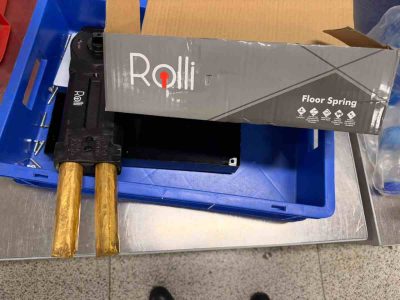
On February 13, Delhi Police officers placed an order for a ‘Stanley’ knife via quick commerce app Blinkit. The knife was delivered within 15 minutes.
Upon examination, the item was identified as a manually operated folding knife that exceeded the maximum blade dimensions permitted under government regulations.
According to the police, the blade measured eight cm in length and 2.5 cm in width.
“When we questioned the courier, it was revealed that these knives, which are prohibited under the Arms Act, were being held in stock at Blinkit’s warehouse in Khyala,” a police officer said.
Consequently, a case was registered on February 14 under Sections 25/54/59 of the Arms Act at Khyala Police Station.
The police subsequently conducted multiple raids on Blinkit’s storage facilities. On February 15, officers recovered 16 knives from various Blinkit outlets across Delhi. The following day, a further 32 illegal knives were seized from a warehouse in Farrukhnagar, Gurgaon.
In total, 50 prohibited knives have been recovered so far. Authorities confirmed that further investigations into the supply chain and the individuals responsible for stocking and distributing these items are under way.
What the Arms Act prohibits
The Arms Act, 1959, read alongside the Arms Rules, 2016, establishes a comprehensive legal framework for the regulation of knives and other bladed instruments in India.
While the Act is widely known for its control over firearms, it explicitly classifies certain sharp-edged objects as “arms” if they are designed as weapons or exceed specific physical dimensions. Under Section 4 of the Act, the Central or State Governments have the authority to regulate the possession, sale and manufacture of knives in specific “notified” areas.
Generally, a knife falls under these legal restrictions if its blade length exceeds nine inches or its width exceeds two inches.
Beyond dimensions, the Act also regulates the mechanical nature of such instruments.
Prohibited items typically include flick knives, spring-actuated knives or any bladed object that can be opened automatically by a button or spring mechanism. Similarly, double-edged daggers and instruments designed to be easily concealed for offensive purposes are heavily regulated.
While the law provides exemptions for bona fide domestic, agricultural or industrial tools such as kitchen knives or sickles, carrying an instrument that meets the “prohibited” criteria in a public place without a valid licence is a criminal offence.
The legal responsibility for compliance extends beyond the individual to the entire supply chain. Under Section 5, it is illegal to manufacture, sell or even stock any regulated knife without a specific government-issued licence.
This places a significant burden of due diligence on retail and e-commerce platforms to ensure that their inventory does not bypass dimension limits or include prohibited mechanisms.
Violations of these provisions are dealt with under Section 25, which carries a penalty of two to five years’ imprisonment, while Sections 54 and 59 grant the police the power to arrest offenders and seize illegal weaponry without a warrant.
E-commerce platforms and the grey zone
However, multiple e-commerce platforms such as Etsy and Amazon continue to operate in what police describe as a commercial grey area, selling such items under the guise of tools, including kitchen knives.
Some brands list instruments that remain 0.1 inch or slightly below the legal threshold at which blades become illegal, thereby staying technically within the bounds of the law while skirting its intent.
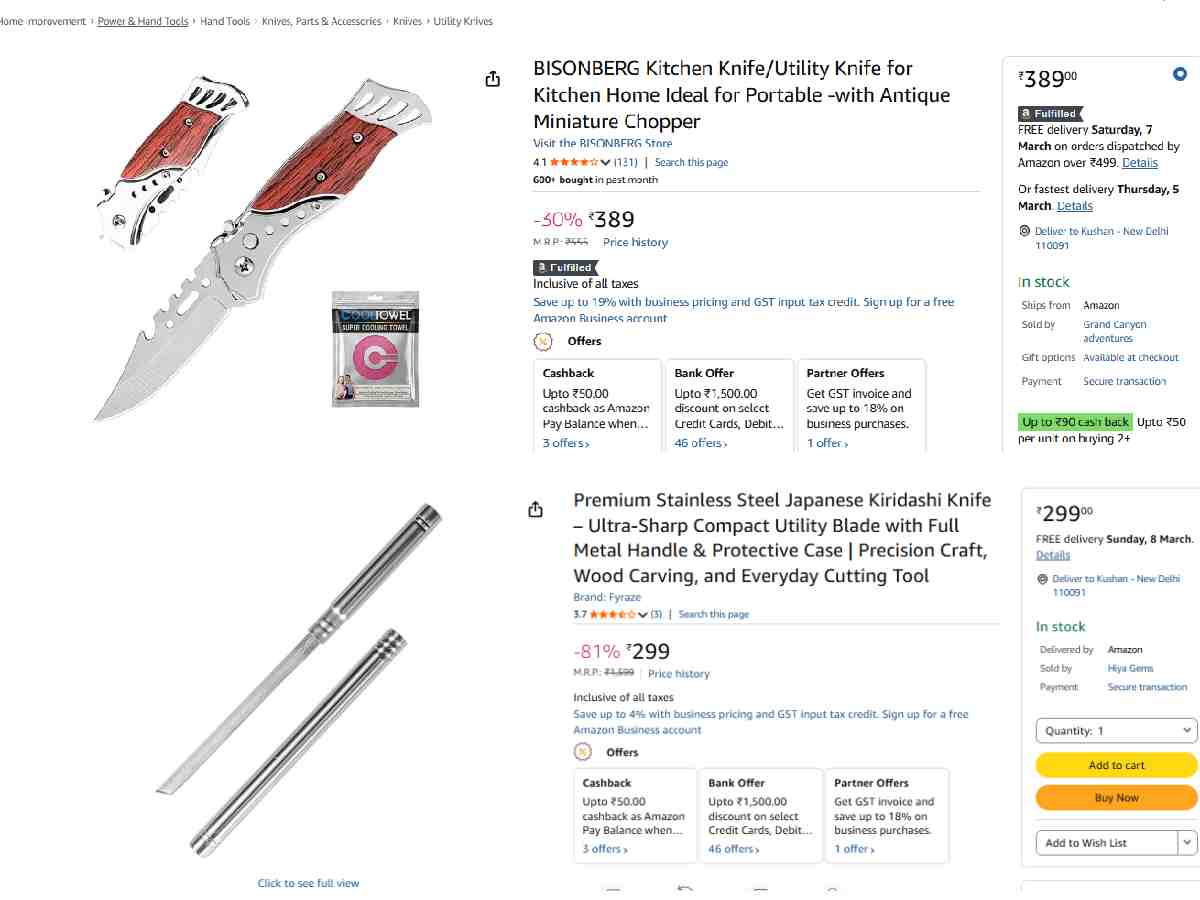
Among these is Bisonberg’s Kitchen/Utility knife, which features a push button that activates a spring, allowing the blade to extend from the top opening. According to reviewers, the product is described as a “perfect switchblade” for “self defence”, with some claiming it would be efficient in close-range combat.
Similarly, Six Sigma, a utility brand that markets itself as a provider of kitchen knives, offers a range of curved and regular blades. By keeping knife lengths just below the permitted limit and supplying sheathes, sellers continue to market these items as legitimate utility tools.
Another example is the Kiridashi knife sold by a brand called Fyraze. Traditionally associated with Japanese carving techniques, the knife is marketed for craft purposes. However, police note that such items can also be misused, particularly when sold with personalised covers.
According to police officers, enforcement becomes difficult because there are limited specific prohibitions for utility blades.
“If they say that these are utility knives such as kitchen, camping, and such others, then they are technically functioning on legal technicalities,” a police officer said.
Police frequently see sellers bypassing platform filters by listing illegal weapons as “camping gear” or “survival tools”, he said, noting that a contentious technical distinction is often made between fully automatic knives and spring-assisted models to evade the law.
Despite periodic enforcement drives and seizures, he added, the constantly shifting volume of online inventory makes a total ban a persistent challenge.
“We remain clear,” he said, “if a blade opens automatically or exceeds permissible limits, it is an illegal weapon, not a utility tool.”
Rising concern over juvenile stabbings
Senior officers said the easy availability of knives has contributed to a surge in stabbings carried out by juveniles in Delhi.
In January 2026, an 18-year-old boy was allegedly lured to a public park in Rohini through a fake social media profile and stabbed to death in broad daylight. Police said the murder was orchestrated by the minor brother of a girl with whom the victim was in a relationship, leading to the apprehension of five juveniles.
That same month, a group of minors and a Delhi University student allegedly stabbed a 25-year-old man in Northwest Delhi during a sudden attack.
The violence continued into February 2026. In one case in the Mangolpuri area, a 17-year-old boy who had moved from Bihar a fortnight earlier to work at a food stall was stabbed to death by three teenagers. The altercation reportedly began over a dispute after the victim refused to give cigarettes to the group.
These recurring incidents have intensified scrutiny over the availability of such knives on e-commerce and quick commerce platforms. A blade can be purchased for just over Rs 90, excluding shipping, from online marketplaces.