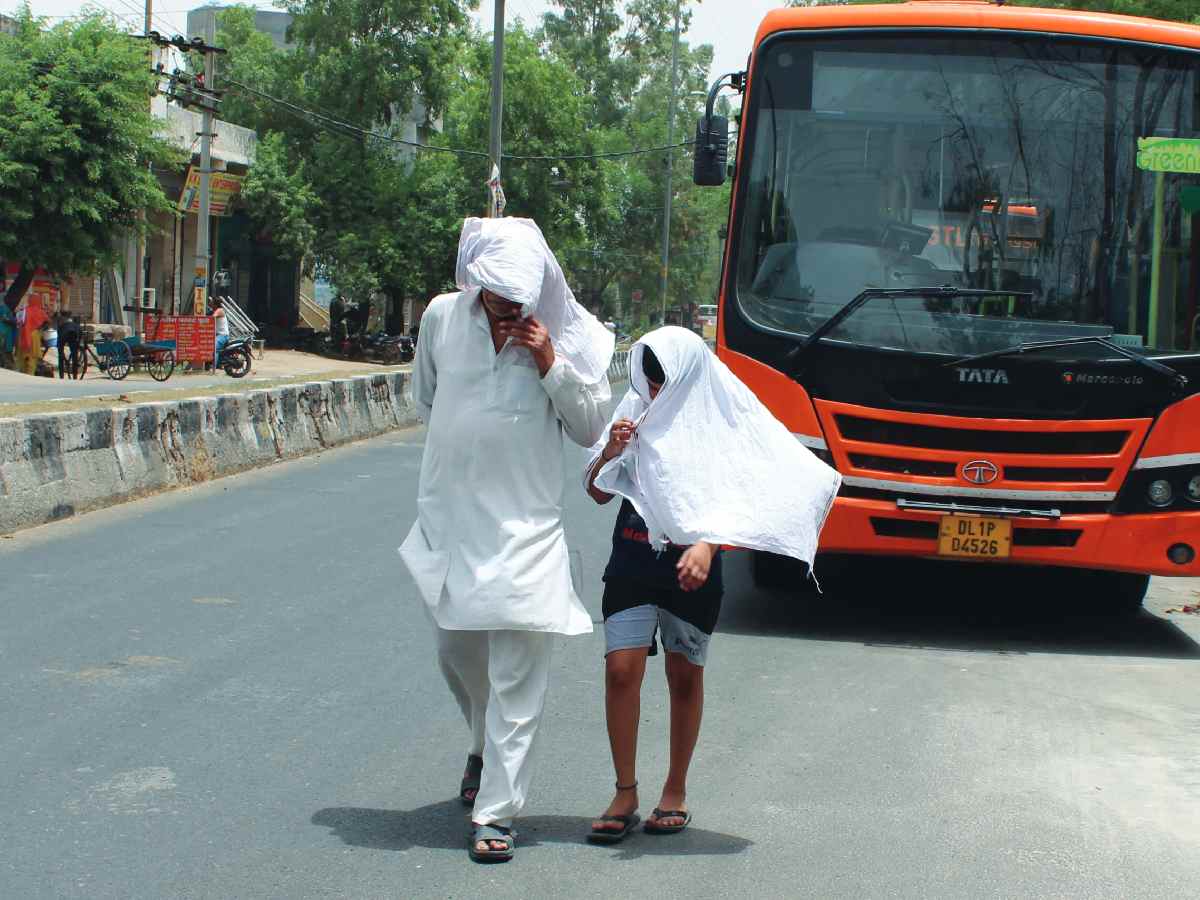
In recent years, Delhi has been reeling under relentless heatwaves, with temperatures breaking historical records and drawing attention to the escalating climate emergency.
Among the city’s many localities, Mungeshpur, the Ridge area, and Ayanagar have emerged as the capital’s hottest zones—each exhibiting extreme weather patterns shaped by a mix of climate change, deforestation, urban sprawl, and industrial growth.
Mungeshpur, in northwestern Delhi, made headlines in May 2024 when it reportedly recorded a temperature of 52.9°C. Though later revised by the India Meteorological Department (IMD) to 49.9°C due to a sensor error, the reading still ranks among the highest ever noted in Delhi.
Ayanagar, on the southern edge of the city, registered 47.6°C during the same period. Even the Ridge, historically known for its dense tree cover, had reached 47.9°C back in June 2019.
Rising discomfort across localities
Despite their distinct profiles, all three areas have experienced a steady increase in heat-related distress.
Mungeshpur, though lacking detailed public data, likely shares characteristics with other peri-urban villages—such as informal housing, mixed land use, and small-scale agricultural or trade-based occupations. Urbanisation has played a major role in making it one of Delhi’s hottest pockets.
Ayanagar, near the Haryana border in South Delhi, has transitioned from an unauthorised colony into a semi-urban settlement with a growing population. The local economy remains informal, centred around construction, services, and small-scale commerce.
The Ridge, part of the Aravalli Range and often described as Delhi’s “green lungs”, is ecologically significant. Divided into four zones—Northern, Central, South-Central, and Southern—it plays a crucial role in pollution control and biodiversity preservation, even though it is sparsely populated and non-industrial.
“Even nights offer no relief”
Residents across these areas report that the intense heat is now a constant, not a seasonal occurrence.
Ravi Kumar, a 60-year-old from Mungeshpur, recalled how summers a decade ago were hot but manageable. He said people once enjoyed sitting outside in the evenings, but now even nighttime offers no relief. Fans and coolers run continuously, but “nothing helps,” he said. The absence of natural shade and breezes has made the heat feel like a permanent presence, disturbing sleep and daily routines.
In the Ridge area, 40-year-old schoolteacher Sunita Sharma said the thinning green canopy has intensified the heat. She noted that the trees used to act as a buffer, keeping the area relatively cool. Now, with fewer of them, the sun feels harsher, and even students complain of frequent headaches and fatigue. “It never used to be this bad,” she said.
Amit Verma, a 43-year-old shop owner in Ayanagar, pointed out how seasonal patterns have changed. He said they never needed coolers in April before, but now even ceiling fans are ineffective. His shop’s metal shutters heat up so much that they are untouchable during midday. “Business slows down because no one wants to venture out,” he added.
Rohit Meena, a 50-year-old farmer in Mungeshpur, said his crops can no longer survive the heat. The soil itself feels scorching, he said, and walking across the fields is like stepping on a frying pan. He fears that without irrigation support, farming may soon become unviable in the region.
Also Read: Delhi: The Shahdara colony, which saw a murder over water in 2024, remains on the edge
In Ayanagar, 35-year-old Meera Devi, a homemaker, said that once-abundant neem and peepal trees are now gone, leaving families exposed to direct sun. Children, she said, are forced to stay indoors all day. More people are falling ill during summers than ever before, she observed.
Rajinder Singh, 65, who lives near the Ridge, remembered when the forest was so thick that sunlight barely reached the ground. Now, he said, it resembles a park more than a forest. “We’ve lost the wild cooling system that once protected us,” he remarked, adding that summer today feels more like a punishment than a season.
Younger residents are also alarmed. Tanya Malik, a college student from the Ridge area, said the changes are hard to ignore. “We learn about climate change in class, but we’re living it every summer,” she said. Frequent power cuts and extreme heat make it hard to concentrate or study. Her grandparents once described the Ridge as an escape from Delhi’s heat—an escape that no longer exists.
What’s driving the heat
The rise in local temperatures is closely linked to environmental degradation. In Mungeshpur, industrial growth and the loss of farmland have led to more concrete surfaces, which trap and radiate heat. The area’s location, directly exposed to the hot, dry winds (loo) from Haryana and Rajasthan, worsens the situation.
The Ridge has experienced patchy deforestation from infrastructure expansion and encroachments, weakening its ability to regulate temperature. Ayanagar, too, has seen rapid construction that has stripped away natural vegetation.
Environmental activist Bhavreen Kandhari said Mungeshpur often records the city’s highest temperatures due to its unique geographic and environmental factors. Its open, barren landscape and the loss of agricultural land to concrete and industrial development have significantly reduced natural cooling.
“While last year’s reading of 52.9°C was later attributed to a sensor error, the consistent trend of extreme heat in Mungeshpur stresses the urgent need for better climate adaptive planning and protection and restoration of trees and green spaces,” she said.
Health and infrastructure under pressure
The soaring temperatures are not just statistical outliers—they have direct consequences for public health and infrastructure. Hospitals in Delhi report rising cases of heatstroke, dehydration, and respiratory distress, particularly among the elderly, children, and outdoor workers.
Water scarcity worsens as evaporation rates rise, and the city’s power grid struggles to meet the demand from cooling appliances, leading to more frequent outages.
How the city can respond
Experts say that mitigation efforts must be both ecological and structural. The preservation and reforestation of green belts—especially around the Ridge—are essential. Rooftop gardens, reflective building materials, and widespread adoption of rainwater harvesting could help reduce the urban heat island effect.
In Mungeshpur and Ayanagar, zoning regulations need urgent revision to curb unplanned industrial expansion and incentivise climate-conscious development.
Community participation is equally important. Awareness campaigns can inform residents about the benefits of tree cover, discourage waste burning, and promote water conservation. Schools and local institutions could lead plantation drives and incorporate sustainability practices into daily life. Long-term urban planning should include provisions for public heat shelters and water reserves.
A cautionary tale for the future
As Delhi continues to grapple with the effects of a changing climate, the experiences of Mungeshpur, Ayanagar, and the Ridge offer a warning. The extreme temperatures are not isolated anomalies—they are part of a larger pattern shaped by human choices. If left unchecked, the city’s transformation may soon outpace its ability to protect its most vulnerable communities from the heat.
Delhi inaugurates the 70th National School Games, hosting over 14,000 participants in 14 sports across…
Delhi High Court asked "Doosra" filmmakers to respond to Sourav Ganguly's plea over alleged violation…
Delhi L-G appointed Paralympian Suvarna Raj as State Commissioner for PwDs following her gold win…
DDA is planning Delhi's longest 24-km cycling track along the Yamuna floodplain, linking key eco-projects…
Police detained several anti-SIR protesters heading to the ECI headquarters in Delhi as mass gatherings…
An exhibition that revisits the significance of Indian Modernism through works from earlier and defining…
