Trees at religious places become an integral part of devotees’ lives. They are seen as sacred, with spiritual and medicinal benefits.
At times, they are believed to have human traits, watching over dargahs and temples, witnessing history as it passes. This is exactly how a khirni tree at Chirag Delhi Dargah is looked at.
Locals say that it is one of the oldest trees of Delhi, and claim that it has always served as a shade to the dargah. It is said that Hazrat Makhdoom Jahania Jhangast, a sufi saint, had planted this tree in the 14th century. Arguably the oldest tree in Delhi, it is loved among the locals, and both Hindu and Muslim residents of Chirag Delhi village see it as a part of their identity.
“This tree holds special significance for the dargah. It gives us shade, and I believe that a lot of good spirits live on it,” says Sameer Khan, a visitor at the dargah.
While the khirni at Chirag Delhi dargah is huge, with branches spread out over the courtyard, the one at Qutbuddin Bakhtiar Kaki’s dargah is almost dead. Located in the astana (abode of the holy man), the tree is at its final stage. It has only a few branches left, and much of the trunk seems to have become hollow.
Khirni trees, believed to live for long, are considered locally extinct and are a “possible candidate for Delhi’s oldest living tree”, according to Pradip Krishen’s Trees of Delhi.
Tree heritage walker Chandan Tiwary informs that khirnis are lined on Maulana Azad Road.
While khirnis are considered to be the oldest trees, those included in the list of ‘natural heritage’ or ‘heritage trees’ by Delhi government are Imli, Pilkhan, Salvadora, Banyan, Jamun, Neem, Arjuna, Ashoka, Maharukh, among others.
In the quaint campus of Nehru Park, a Maharukh tree does not only offer shade to visitors, but is also thought to be an abode for owls. Famously called ullu ka ped, the tree is believed to be in the list of oldest ones among the locals. According to the security guards, the tree has also hosted many events under it.
The tree is often confused with neem because its leaves look exactly like that of neem, but only bigger. This is also the reason why the tree is called mahaneem. Included in the list of heritage trees, Maharukh trees are spread over Nehru Place with benches placed below them.
The magnificent Imli, lined up at roads like Tilak Marg and Akbar Road, welcome visitors at Hauz Khas fort with all their glory. Located in the central courtyard of the complex, the twin trees overlook the Hauz Khas lake. The one at the entrance stands near the tomb of Feroze Shah Tughlaq, while the other just outside what used to be a mosque and madrasa.
When Patriot visited the place, many visitors were resting under the trees, with lovers holding hands on a bench facing the lake. Some of them, who could recognise the tree, ate its leaves that have a sour taste. Their fruits are largely eaten by animals and birds.
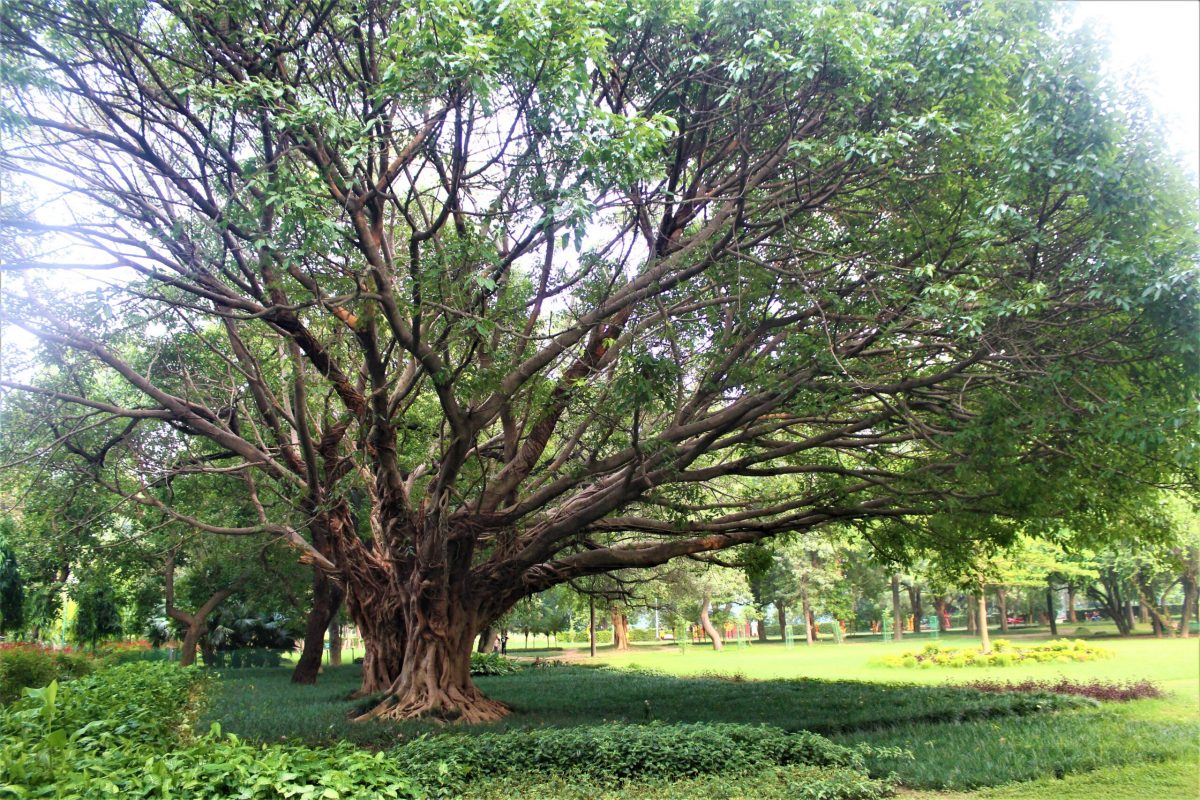
One sight that fills the viewers with wonder is the Pilkhan tree. Adorning roads such as Dr Zakir Hussain Marg, Bhagwan Das Road, and Balwant Rai Mehta Lane, the trees have thick trunks with branches spread wide. If deer in Deer Park are loved by the regular visitors, Pilkhan, sprawled in the park like silent inhabitants, are loved by tree enthusiasts.
What really intrigues the visitors about these trees are their trunks, as many say that the wrapped-up roots fill them with fascination.
However, they practice caution as the trees are enormous and could be full of insects, especially snakes.
While the famous trees have their special locations, where they can be found in abundance, a mere sight of them at any random location should not surprise you. However, what is sad is the lack of awareness among people about their historical significance. Many of them do not even have a signboard, thus creating difficulties for locals to recognise them.
At least 50 cases have already been reported this month; NCPCR guidelines mandate help desks,…
DMRC says zero reduction in train trips, attributes decline to security measures and public apprehension…
A Delhi court denied bail to a former DU professor accused of raping a student,…
Delhi Police charged seven dhaba workers in the fatal beating of a Manipuri musician who…
Seven Delhi STPs failed DPCC standards in September, dumping high levels of faecal coliform and…
AISA chief Neha Bora petitioned the Delhi HC against a police notice requiring a peace…

