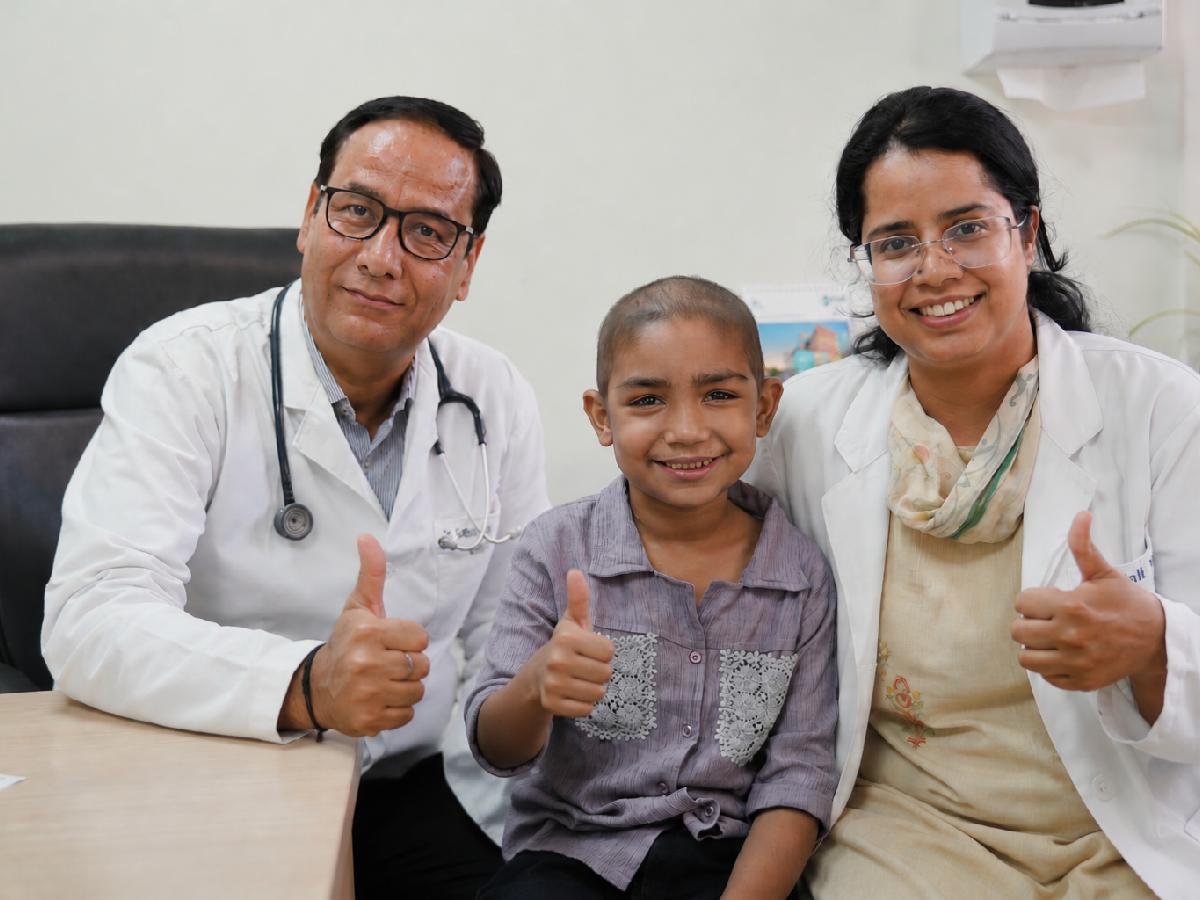
In a significant medical achievement, Max Super Speciality Hospital in Patparganj, New Delhi, has successfully cured a five-year-old girl suffering from Thalassemia Major through a complex haploidentical bone marrow transplant, offering her a life free from regular blood transfusions and prolonged hospital visits.
For Zehra, a child from Jaipur, life had revolved around hospitals since infancy. Diagnosed with Thalassemia Major at an early age, she required frequent blood transfusions to survive, leaving her physically weak and dependent on continuous medical care. Her family’s daily life was shaped by uncertainty, emotional stress, and the exhausting routine of long-term treatment.
The possibility of a cure emerged through a bone marrow transplant. However, the challenge was that Zehra did not have a fully matched donor in the family — usually considered the ideal option for such procedures. Doctors at Max Hospital proceeded with a 50 per cent HLA-matched, or haploidentical, transplant using a partially matched family donor, a procedure historically associated with greater medical risks.
The transplant was led by Dr Satyendra Katewa, Director of Pediatric Hemato-Oncology and Bone Marrow Transplant at Max Super Speciality Hospital, Patparganj. According to the hospital, Zehra responded well to treatment, remained under close medical supervision during recovery, and was discharged within 28 days of the procedure.
“In bone marrow transplantation, doctors generally look for a fully matched HLA donor, often a sibling, where genetic markers align closely between donor and patient,” said Dr Katewa. “However, many patients do not have such a match. A haploidentical transplant involves a donor, usually a parent or sibling, who shares around 50 per cent of HLA markers.”
He explained that while such transplants were once considered highly risky because of complications like graft rejection and infections, advancements in transplant protocols, conditioning regimens, and post-transplant care had significantly improved outcomes.
“These developments have made haploidentical transplants a safe and increasingly effective option, greatly expanding access to curative treatment,” Dr Katewa said.
Thalassemia Major is a hereditary blood disorder in which the body cannot produce enough healthy haemoglobin, often forcing patients to undergo lifelong blood transfusions and iron-chelation therapy. The disease places considerable physical, emotional, and financial strain on families, particularly in countries like India where thalassemia cases remain high.
Speaking on the significance of the case ahead of World Thalassemia Day, Dr Katewa said greater awareness about curative treatments such as bone marrow transplantation was essential.
Also Read: 24-hour-old newborn undergoes life-saving heart surgery in Delhi
“Thalassemia often requires lifelong management through regular transfusions, which can take a significant toll on children and their families,” he said. “With advancements in transplant techniques, even children without fully matched donors can now be offered a curative pathway. Timely intervention and the right clinical approach can help children lead healthy, transfusion-free lives.”
The successful transplant also reflects a broader shift in paediatric blood disorder treatment, where improved transplant technologies and multidisciplinary care are transforming conditions once considered lifelong into curable diseases.
While long-term follow-up and broader clinical data remain important in assessing outcomes, Zehra’s recovery marks a hopeful milestone for families battling thalassemia — and highlights the growing capabilities of advanced paediatric transplant care in India.
Supreme Court advocate Abhishek Pawar alleges women were denied washroom access for seven to eight…
Each day of closure costs shops in Khan Market and Connaught Place between Rs 60,000…
Delhi generates nearly 15,000 tonnes of waste daily, prompting the government to deploy 1,000 mechanical…
Delhi Police has issued an NOC for the Congress rally at Ramlila Maidan on November…
CJP chief Abhijeet Dipke received conditional bail following his arrest for participating in a Connaught…
The DPCC has floated ₹104 crore tenders to test pilot pollution-control technologies across 40 key…
