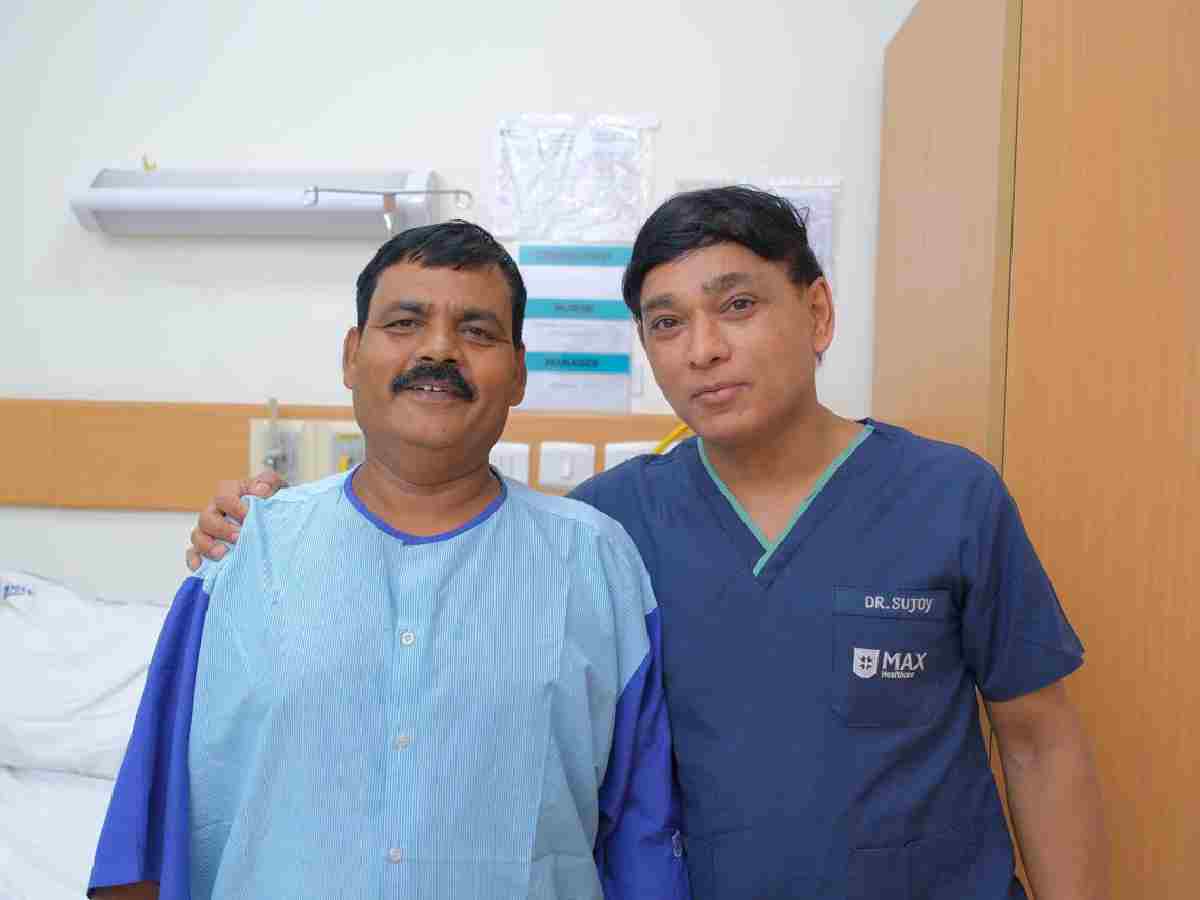
In a landmark medical advancement, Max Super Speciality Hospital in Saket, New Delhi, has successfully performed what it claims is the world’s first robotic-assisted cementless medial pivot knee replacement. The breakthrough surgery was conducted on a 54-year-old man from Dhanbad, Jharkhand, who had endured nearly a decade of severe osteoarthritis and complex knee deformities.
The procedure was led by Dr Sujoy Bhattacharjee, Chairman of the Max Institute of Robotic Joint Replacement, using the CUVIS robotic system and a cementless, cruciate-retaining medial pivot implant. Unlike traditional knee replacements that rely on bone cement, the cementless technique enables natural bone growth around the implant, potentially increasing its lifespan and ensuring better integration with the body.
“The patient had advanced osteoarthritis in both knees, along with varus (bow-legged) and flexion (bent-knee) deformities,” said Dr Bhattacharjee. “He could barely walk short distances without support. To see his recovery just days after surgery was remarkable.”
The medial pivot implant design aims to replicate the natural movement of the knee joint more closely. Combined with robotic assistance, it allows for highly precise alignment and positioning—factors critical for both faster rehabilitation and improved long-term outcomes.
Dr Bhattacharjee described the operation as a “global-first” in joint replacement surgery. He said it reflected what was possible when “cutting-edge robotic precision is combined with advanced implant technology and patient-centric care.” He added that it marked India’s growing leadership in outcomes-driven orthopaedic innovation.
In a related case, a 57-year-old professional from Jharkhand underwent a cemented total knee replacement using a gold-coated medial pivot implant, also guided by the CUVIS robotic system. The gold coating—made from titanium-niobium-nitrate—is designed to offer improved wear resistance and better compatibility with human tissue.
Both procedures highlight a growing trend in orthopaedic surgery: the use of robotic assistance, personalised implant design, and biocompatible materials to deliver superior patient outcomes. While cementless knee replacements are not entirely new, their integration with robotic guidance and the medial pivot concept appears to be a novel advancement.
Max Healthcare, which runs the Saket facility, has positioned itself as a leading centre for robotic joint replacement in India. According to the hospital, technologies like the CUVIS system are enabling quicker recovery times and more natural joint function, helping patients return to normal life faster.
Though broader clinical studies and peer-reviewed data will be required to validate long-term success, the procedure represents a promising step forward in joint replacement surgery—and a moment of pride for India’s rapidly advancing medical technology sector.
Delhi Police books journalist under SC/ST Act for casteist remarks against ACP during a Jantar…
Hindu College staff protests against principal, demanding DU takeover over financial and admission irregularities and…
Delhi Cabinet approves Industrial Policy 2026 with Rs 1,000 crore for top sectors to turn…
Delhi launches DJB command centre with GPS tanker tracking and AI tools to manage water…
ABVP protests at JNU against Congress MP Akoijam over sexual harassment claims, demanding the party…
DU officials oppose HEFA loans for hostel expansion, warning repayment could raise student fees and…
