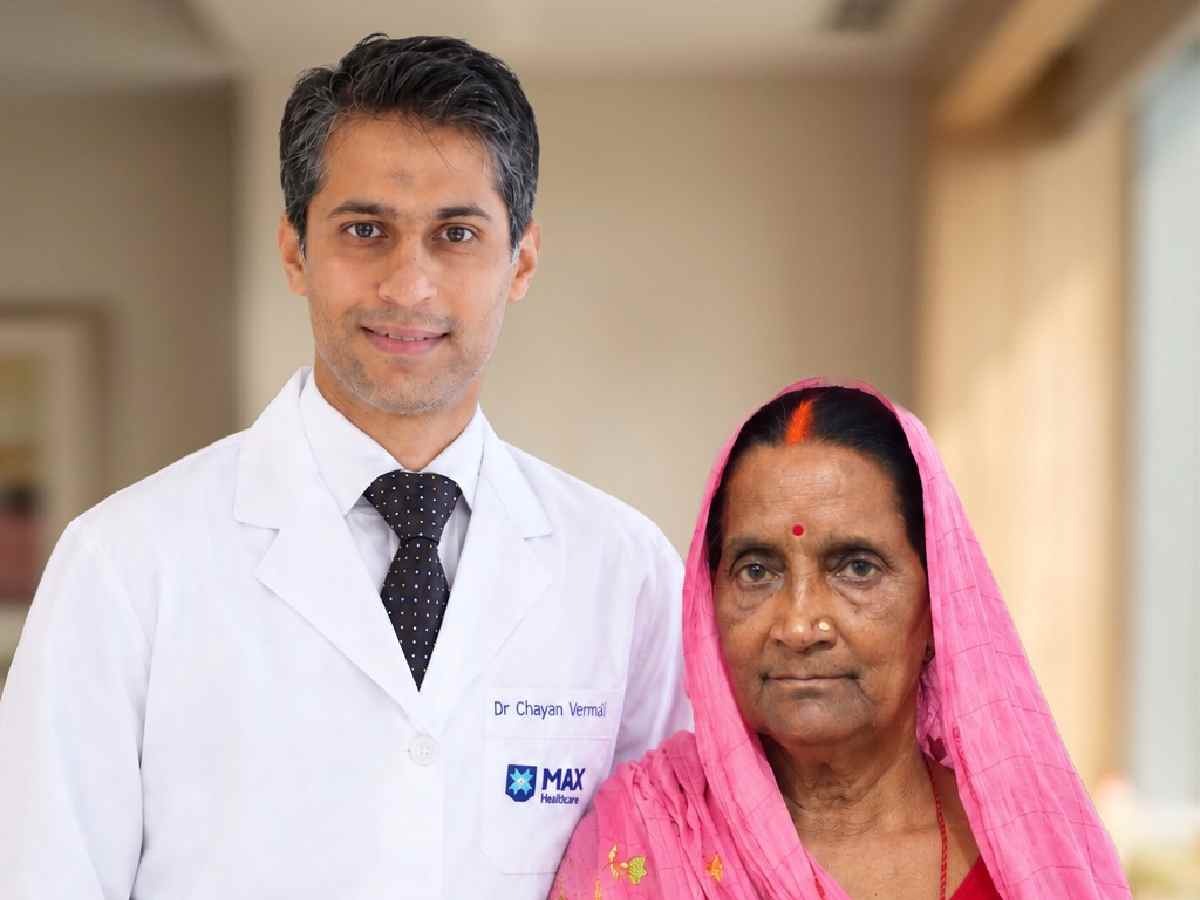
Dr Chayan Vermani with Sitapati Devi
Doctors at Max Super Speciality Hospital, Patparganj, have successfully treated a 69-year-old woman who developed repeated infections following two conventional pacemaker procedures, using an advanced dual-chamber leadless pacemaker.
The patient, Sitapati Devi from Bihar, was diagnosed with complete heart block around six months ago and underwent a dual-chamber pacemaker implantation in March. The device had to be removed after she developed an infection at the implantation site, leaving her dependent on a temporary pacemaker.
A second conventional pacemaker was implanted on the right side of her chest in July. However, she again developed an infection, with pus discharge and a persistent opening at the site. She subsequently travelled to Max Patparganj for further treatment.
At the hospital, she reported dizziness, intermittent fever, uneasiness and pain around the pacemaker site. Given her history of recurrent infections, the cardiology team led by Dr Chayan Vermani, Senior Consultant, Cardiology, opted for a dual-chamber leadless pacemaker.
“This was a challenging case as the patient had developed infections after two conventional pacemaker procedures within a few months,” said Dr Vermani. “With recurrent infections, another conventional pacemaker implantation would have presented further challenges.”
Unlike conventional pacemakers, which are placed under the skin below the collarbone and connected to the heart through wires, a leadless pacemaker is implanted directly inside the heart through a vein accessed from the groin. It does not require a surgical pocket in the chest or wires running from the device into the heart.
Dr Vermani said this approach can be particularly useful in selected patients with repeated pacemaker-related infections because it removes the components most commonly associated with infection, including the chest pocket and transvenous leads.
The dual-chamber system used in the procedure involves two small devices placed in different chambers of the heart. The devices communicate wirelessly to coordinate the heart’s rhythm. Unlike single-chamber leadless pacemakers, dual-chamber implantation requires precise positioning of both devices and specialised expertise.
Also Read: Fatty liver now affects 38.6% of Indian adults
The procedure was completed successfully and the patient’s recovery was uneventful. She was discharged in a stable condition two days after the procedure.
The case highlights the growing role of leadless pacing technology in patients who face complications with conventional pacemakers. While leadless pacemakers are increasingly being used, dual-chamber systems remain a more specialised approach and are particularly relevant in selected patients requiring coordinated pacing of the heart’s chambers.
Supreme Court advocate Abhishek Pawar alleges women were denied washroom access for seven to eight…
Each day of closure costs shops in Khan Market and Connaught Place between Rs 60,000…
Delhi generates nearly 15,000 tonnes of waste daily, prompting the government to deploy 1,000 mechanical…
Delhi Police has issued an NOC for the Congress rally at Ramlila Maidan on November…
CJP chief Abhijeet Dipke received conditional bail following his arrest for participating in a Connaught…
The DPCC has floated ₹104 crore tenders to test pilot pollution-control technologies across 40 key…
