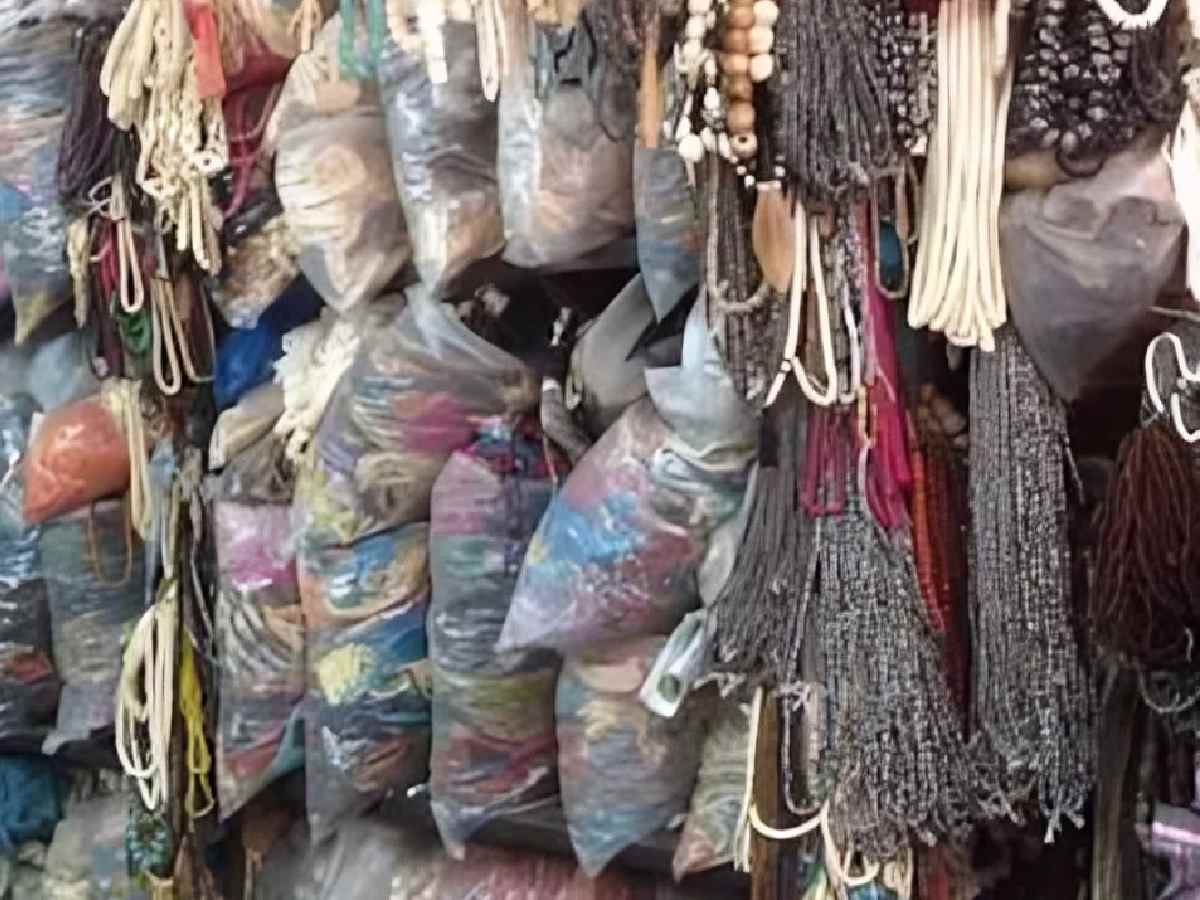
All types of raw material, jewellery and artefacts are available in the market
The first thing one notices at Turkman Gate is movement. Rickshaws squeeze through narrow lanes, motorcycles weave past pedestrians, tea sellers push through crowded stretches balancing kettles, and shopkeepers call out over the constant noise of Old Delhi. Standing amid all the motion is the historic structure itself, one of the four surviving gateways of the seventeenth-century walled city of Shahjahanabad. Built in 1658 and named after the revered Sufi saint Shah Turkman Bayabani, the structure has stood through centuries of Delhi’s transformation.
A short walk from the gateway leads into Mohalla Bulbulikhana, a dense neighbourhood within Turkman Gate known for its handicraft and bead market. The lanes here are packed with shops displaying colourful strings of beads made from bone, brass, metals, semi-precious stones, wood, seeds, glass, and ceramic materials. Decorative items hang from ceilings while small workshops operate from behind storefronts, continuing practices that once defined the economic identity of this area.
For decades, Mohalla Bulbulikhana functioned as a thriving craft ecosystem where artisans, traders, and families depended on handicrafts for their livelihood. The area had a steady rhythm of buyers and sellers, and the market remained active throughout the day, especially during wedding and festive seasons when demand for handmade jewellery and decorative items was at its peak.
Today, those who remain in the trade say the ecosystem has weakened significantly.
Inside a small shop lined with bead strings and unfinished decorative items, Mohammad Salim sits surrounded by tools and half-completed work. He says there is a common misunderstanding about how business in this area actually functions.
“People think this market survived only on retail customers buying things from shops, but that was never the main system here,” he says. “Retail customers did come, and they were important, but the real livelihood came from wholesale trade and larger buyers. Traders used to come here in bulk, purchase goods, and supply them further. Products travelled outside Delhi and even outside India. That is how families sustained themselves for years.”
Fading footfall
Salim says retail demand once existed alongside strong wholesale networks. He recalls a time when the lanes of Bulbulikhana remained crowded from morning till evening.
“Earlier, the market used to remain busy throughout the day. Girls from nearby neighbourhoods and different parts of Delhi came here regularly to buy handmade jewellery and decorative items. During weddings and festivals, there was so much rush that sometimes it was difficult to even walk through the lanes. People specifically came here because they wanted handmade products, and they knew they would get variety and craftsmanship in one place.”
Nearby bead seller Imran Khan says the visible decline in footfall began gradually over the last 10 to 15 years.
Also Read: Fewer pagdis, less Punjabi, still Karol Bagh
“You will not see these shops buzzing anymore,” he says. “Earlier, from morning till evening, there was continuous movement. Shopkeepers barely had time to sit because customers kept coming. Now there are days when we just wait for buyers.”
He says the change is not only in numbers but also in customer behaviour.
“Earlier, even residents of this area used to buy and wear handmade jewellery and decorative items. Now that connection is missing. People prefer ready-made products from bigger markets.”
Another trader, Shahid Ali, says even residents of Mohalla Bulbulikhana have moved away from traditional handicrafts.
“People from this very mohalla have forgotten handicrafts,” he says. “Earlier, girls from nearby homes used to wear handmade jewellery and regularly visit these shops. Now, even local families prefer ready-made items from markets such as Janpath. Sometimes children growing up here do not even know these products are made in their own neighbourhood.”
Changing markets
Traders say several factors have contributed to this decline. Machine-made products entered the market at lower prices, consumer preferences changed over time, and commercial shopping destinations such as Janpath and other city markets became more popular for quick and ready-made purchases.
“People want things quickly now,” says Nadeem Khan. “Earlier customers came here because they wanted something handmade and different. Bright colours and multiple types of beads used to be preferred by college girls. They would often come here and get their jewellery customised according to their sarees or outfits. Now they prefer products that are already available, cheaper, and easier to buy.”
As retail demand declined, the structure of business in Mohalla Bulbulikhana also shifted. Salim says the market now depends largely on bulk orders and external trade networks.
“Earlier, retail and wholesale worked together,” he says. “Now nearly 90% of the work depends on import and export or bulk buyers because local retail demand has reduced significantly.”
However, traders say even this system is under pressure.
“Import and export are also facing problems now,” says Imran Khan. “Earlier, if local sales slowed down, bulk orders still supported the business. But now uncertainty exists everywhere. Orders are irregular, and business has become unpredictable. Everyone in the market will say the same thing: we don’t know what’s next.”
“I personally used to send artefacts and jewellery to Iran, but it hasn’t happened for the last few months. We also suffered during America’s tariff hikes. As for Indian exhibitions or fairs, there is a lot of competition. It is difficult to earn much after paying hefty amounts for stalls.”
Inside several workshops, finished goods often remain packed for weeks as artisans wait for buyers. Many say production has slowed because demand no longer matches earlier levels.
A changing inheritance
But the most significant change, artisans say, is not only economic but social.
For generations, handicraft work in Mohalla Bulbulikhana moved naturally from fathers to sons. Children grew up inside workshops, learning the craft through observation and practice. Continuing the profession was never formally decided; it was assumed as part of family life.
Today, traders say that the pattern has broken.
“No parent wants all their children entering this profession anymore,” says Mohammad Salim. “People have seen uncertainty, and they are worried. Those who studied moved into private jobs or offices because families want stability and regular income.”
He adds that others shifted away from craft entirely.
“Many who did not continue studies opened food shops, hotels, and bawarchikhanas,” he says. “People feel food businesses give quicker returns and more certainty.”
CTI chairman Brijesh Goyal said the Rahul Gandhi rally could affect wholesale and retail markets…
Established to mark the university’s 25 years, Jubilee Hall has witnessed generations of student life.…
Delhi inaugurates the 70th National School Games, hosting over 14,000 participants in 14 sports across…
Delhi High Court asked "Doosra" filmmakers to respond to Sourav Ganguly's plea over alleged violation…
Delhi L-G appointed Paralympian Suvarna Raj as State Commissioner for PwDs following her gold win…
DDA is planning Delhi's longest 24-km cycling track along the Yamuna floodplain, linking key eco-projects…

