SONY DSC
Does the road wind up-hill all the way?
Yes, to the very end.
— Christina Rossetti
You reach Dehradun and if, perchance, you have read Ruskin Bond avidly, you are disappointed. Instead of the pure green trees enveloped by clouds, there are tall buildings and shopping malls. You ask locals, and they only talk about Mussoorie (up there!); and soon you find yourself winding round the hills on a narrow two-way road.
Strolling around Mall Road, you will see several stalls selling Maggie, corn — roasted and sweet — and tea. People, notwithstanding their age, using umbrellas as walking sticks, a crowd of youngsters from Delhi vacationing as usual, shops selling 100% pure Pashmina shawls and game stalls, where you get a packet of biscuits as prize if you make all the five cans fall bicycles on rent, countless hotels and food joints selling paranthas.
But this is the side that everybody knows. Hidden from most people’s eyes, is the other side of Mussoorie ♠— one that the British left behind.
When the scorching heat of North Indian plains used to become unbearable for the British, they would find their way up to the hills for some respite.
As the time passed, some of them settled there permanently. They built small cottages, churches, and libraries on the edge of mountains, which had striking similarities to the architecture of England, Scotland or Ireland.
Even after 71 years of independence, we can see glimpses of the British empire in many hill stations of India, especially in Mussoorie.
If the people around didn’t speak in Hindi, you would certainly mistake it for a part of London or Scotland. The Mall Road, which runs for some two km, looks very English with vintage street lamps pointing out the direction, say to Kempty Falls or to Satsang Beas. Three-seater benches are placed on both sides of the road, adding to its Englishness. with the road as clean as the air―perhaps, the most even road in India, a country where people die because of potholes. Strolling on the Mall Road these colonial relics would make you think that you are in some other era.
Somewhere on the Mall Road is the Wall of Goodwill, which says: ‘Pick up what you need. Leave here what you want to give’. You can see the warm clothes that someone left as charity through the glass.
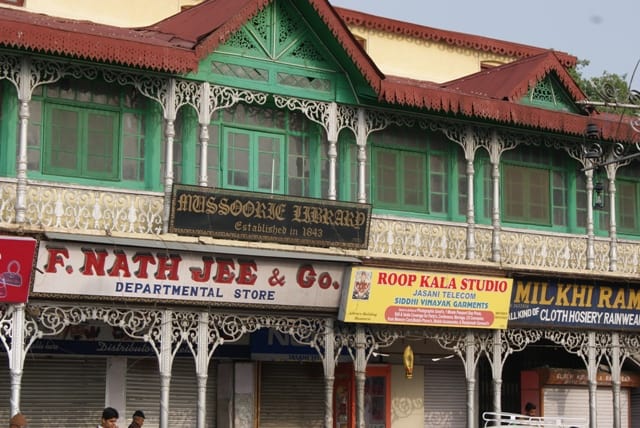
The small church on Camel’s Back road, the huge and quiet post office, and the Mussoorie Library that stands grandly on iron pillars, are all pieces of architecture from the colonial world, reflecting the legacy of the Raj.
The names of the streets and places — Sessions House, Landour, Gun Hill, Company Garden, Cloud’s End — also serve as reminders of the time when Britons used to live here.
Picture Palace, which was the first cinema hall in Northern India to run on electricity and was also the first cinema in Mussoorie, opened in 1912, long before India’s independence. There were seven cinema halls on the Mall Road, and people visiting Mussoorie in summer, looked forward to watching movies in these splendid cinema halls.
Cycling on Camel’s Back road in the evening, when the mist collects on your hair and clothes, you can see the hills looking endless in the mist. It feels like a ride to the past. The years roll back…
The writers are students of English Literature at Jamia Milia Islamia
After 12 years in theatre, the actor makes his international film debut with a role…
Protester alleges Delhi Police assaulted detainees, deleted phone videos, and detained minors during anti-CEC protest…
Shifting protests away from Jantar Mantar weakens democratic visibility and access to political power, an…
CM Rekha Gupta defends SIR and EC integrity, saying democracy can't be held hostage to…
AISA students march to Supreme Court over 'vote chori' claims against CEC, as police barricade…
DMRC extends closure of six central Delhi metro station gates until 5 pm citing security…

