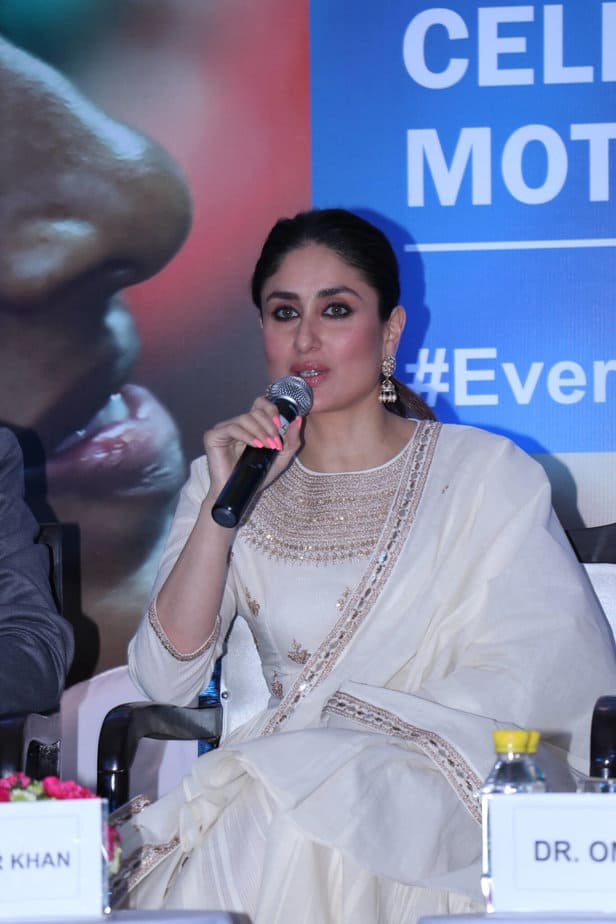
Kareena Kapoor was no doubt chosen as a celebrity advocate by Unicef as the actor has a massive follower base within the country, especially among adolescents and youth in the age group of 13-29 years. She is also keen to leverage her standing as a role model to influence social change.
Unicef initiated engagement with her in 2013 and since then she has done field visits to over five states and interacted with children, adolescents, young mothers, frontline workers and other community members. She also finds sometime to support the education of poor children.
For Mother’s Day, Unicef organised a panel discussion in Delhi to highlight the importance of celebrating mothers and their newborns. She joined the discussion with Henriette Ahrens, deputy representative of Unicef. Other important panelists were Uma Devi (ASHA worker), Dr Gagan Gupta, Dr Hota and Mohammad Sheikh among others. They all shared their personal experience with the media. It’s interesting that she spent the whole day highlighting menstrual hygiene and breast-feeding.
Kareena talked about menstrual hygiene and shared her personal experience while undergoing pregnancy. She said, “Your first pregnancy is always an overwhelming experience. I was fortunate to have my husband by my side. My parents too were there. A woman’s body undergoes many changes. There was a time after Taimur’s delivery when I was so weak I could not even hold him. My family’s unconditional support gave me the courage to get back to normal life.”
She said that basic facilities for pregnancy and childbirth are not privileges but every woman’s right. She highlighted the need for gender equity, as this is crucial for a newborn’s survival. “We need to look after our girls just as well as we look after our boys. It is incredibly sad that baby girls do not always get the same care that boys do. If your baby girl becomes unwell, get help for them just as quickly as you would do for a boy,” she urged the audience.
Unicef’s focus on Mother’s Day was to narrow the gap between the rich and the poor worldwide.
In India, breastfeeding is a cultural norm and 95 per cent children at some point are breast-fed in their early years. However, while 79 per cent of women deliver in a health institution, less than half of those women (41.6 per cent) are breastfed within the first hour of life. It has to be ensured that all children benefit from early breastfeeding — a life-saving intervention to ensure children who are not breastfed within one hour of birth have 33 per cent higher risk of neo-natal mortality.
Unicef India Representative Dr Yasmin Ali Haque said, “Breastfeeding gives all girls and boys the healthiest start in life. It stimulates brain development, boosts their immune systems and helps protect them from chronic conditions later in life.”
Reinforcing this message, Kareena also pointed out that education plays a very important role being a mother, daughter and wife. She said that the right guidance should be given to every expecting mother.
Hopefully, this Bollywood celebrity’s advocacy will help the social cause, as star power means the ability to reach millions of people across the globe.
An FIR over Jamia protests alleges Congress MPs Imran Pratapgarhi and Imran Masood unlawfully entered…
Delhi's 'Namo Yamuna River Safari' cruise will launch before Chhath, offering 40-minute family trips between…
Delhi's Old RTR flyover reopens for light vehicles today after repair work following road cracks,…
Visits to Govindpuri, Jangpura, Saket and Mayur Vihar show unlabelled corrosive substances sold for Rs…
Rescue teams recovered two bodies from the debris of a collapsed under-construction house in northeast…
Built on Jawaharlal Nehru’s vision, the Delhi landmark has witnessed the evolution of a young…
