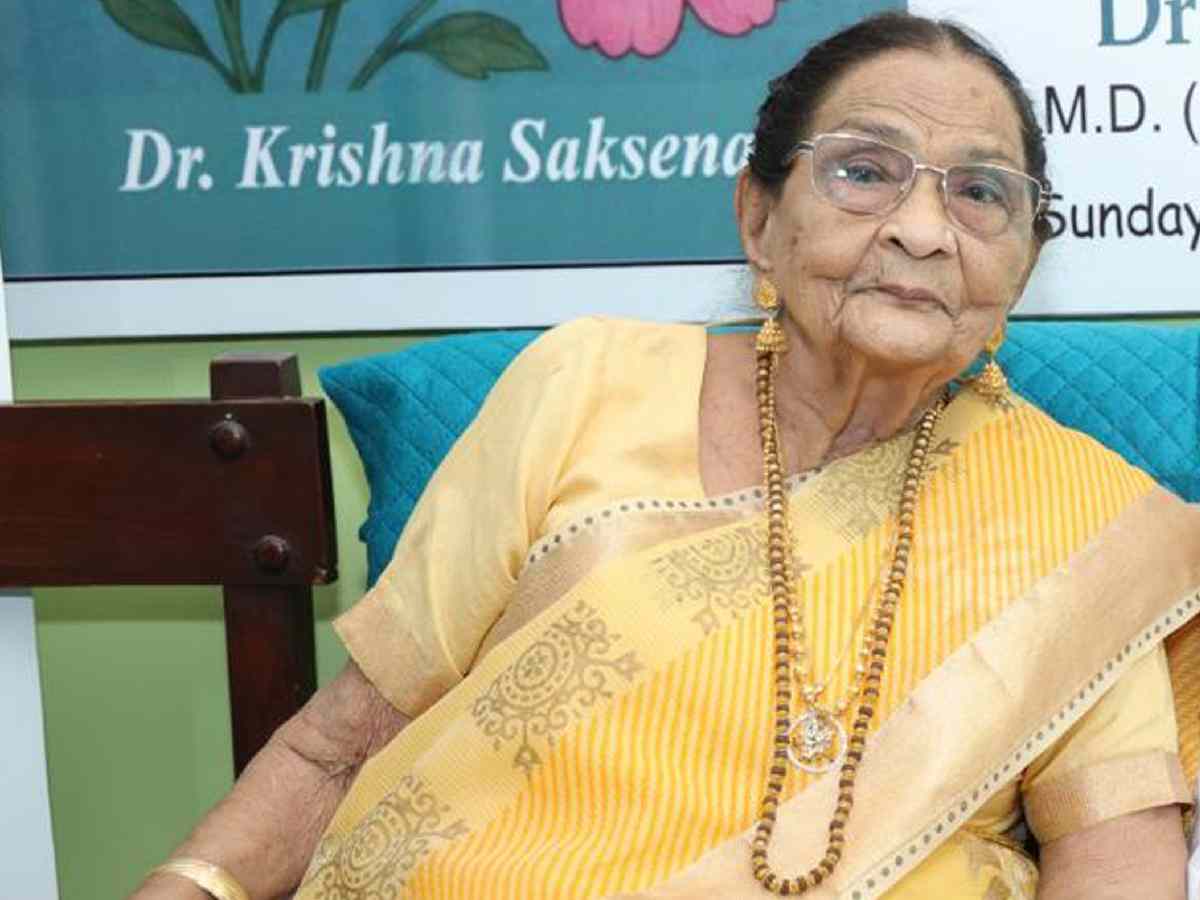
At 97, Krishna Saksena is many things at once — scholar, teacher, author, social reformer, and a woman of deep spirituality. She is also a proud and affectionate Delhiite, with memories of the city stretching back more than seven decades. With a gentle smile and a still-sharp mind, she reflects on her long journey with humility and humour, describing herself as “an ocean of faults” even as she continues to inspire readers and students alike.
Born in British-ruled India and raised in a traditional yet progressive household, Saksena became the first woman in Uttar Pradesh to earn a PhD in English Literature.
“In those days, women were not expected to study much,” she says. “Many discouraged me saying that being more educated would make it difficult for me to find a suitable husband. Others were concerned that as I put my marriage on hold for my PhD, I would become too old to marry. However, my love for English literature, the support of my relatives and getting a great PhD guide helped me persevere. And I also ended up getting a great husband!”
Behind this quiet personal revolution stood her father — an educator with vision and resolve. “I was fortunate to have a father who was ahead of his times,” says Saksena. “Being an educator himself, he strongly believed in the value of education for all his children, boys or girls.”
She recalls how the family included six sisters and two brothers, and among the eight siblings, five went on to earn PhDs — four daughters and one son. “My father actively encouraged us to follow our passions — whether it was for academics or domestic,” she adds. “So, a truly remarkable man and father. I owe a lot to him.”
Also read: Anurag Anand blends art, writing and corporate creativity
Her doctoral thesis, William Cowper: His Poetry and Personality, earned praise from both Indian and international examiners, including Professor Ifar Evans from London. She credits her simple yet forceful writing style to her mentor Professor Siddhanta, and her multilingual fluency — in French, Urdu, and Hindi — to an education that crossed languages and cultures. “This helps me in mixing with various kinds of people,” she says.
Teaching as purpose
Saksena’s academic career took off at Delhi University, where she taught for 25 years at Lakshmibai College. Even as a student, she had a passion for teaching, especially those in need. “Even today, I have a dream of building up a school one day, and bringing it up according to my norms,” she says.
Her devotion to service extended far beyond the classroom. She worked with underprivileged children, volunteered in youth prisons, and supported those with disabilities.
“I worked with children who literally had nothing — no hope, no support and no means,” she recalls. “Seeing them take to education and developing hope and self-reliance was one of the most rewarding experiences in my life.”
She adds that her experiences also exposed her to the hidden cruelty within society. “I also realised that there is so much evil around, sitting well hidden in so-called decent, upright members of the society. While it did disillusion me to some extent, it also inspired me to fight against it with the only tool that I had – education.”
This twin commitment — to spiritual evolution and social service — defines much of her writing. Her first book, Gita As I Understand, emerged from her personal faith.
“If my academics was my walking stick, my faith is my umbrella,” she says. “I was very much surprised at the overwhelmingly positive response to this humble offering. I then thought that if I can reach and help others by my writing, I should do so as a service to them and my Mother Divine.”
Faith in adversity
Saksena’s life has not been without trials. She was widowed young, became the sole caregiver to a mentally handicapped son, and endured financial struggles.
“But it was my faith in my Mother Divine that kept me going,” she says. “She spoke to me words of reassurance and I persevered. Today I am old, my body in great pain and bed-ridden. But I am still cheerful because that is the desire of Mother Divine.”
Delhi, then and now
For someone who has witnessed Delhi’s evolution over nearly eight decades, the city remains an essential part of Saksena’s identity.
“It has changed a lot in some ways and in many ways, it is still the same,” she says. “It was and continues to be a city of netas and babus. People love to discuss politics and policies”.
She observes that while Delhi has grown significantly, it has also become crowded and chaotic. “In the early days, we would go to various markets to window-shop or eat and have fun. Now they are all so crowded, the traffic is terrible, the pollution is getting worse by the day, and the people impatient. But for all its faults, it is my city and I love it!”
One place in particular holds a sacred place in her heart. “The Kali Mandir on Mandir Marga has been very special to me,” she says. “Back in the 1970s we lived close to the temple and as soon as the evening arati conch would blow, we left everything and rushed to the temple. Now I live far away, but still try and go there as often as I can. The deity of my Mother Divine always greets me with so much love and patience, that it fills my heart with gratitude and bliss.”
Her voice brightens further when asked about memories of Delhi in the 1950s and ’60s.
“Oh, so many memories!” she exclaims. “Going to CP to eat ice-creams. Sitting under India Gate for a picnic. Rushing to Regal or Rivoli to catch a movie. Sitting in the BCL (British Council Library) in earnest discussions about the writing of Shakespeare and Bacon. Watching the Independence Day parade from our house balcony. I could go on! It’s been more than four decades, but I savour them as if they are yesterday’s memories!”
Still writing, still inspiring
Even today, Saksena continues to write. Her latest book, Her Flowers Bloom, was released in June.
“As soon as I finish a book, I start thinking of the topics for my next one,” she says. “And then there is my worship, which I do whenever my health permits. I am still mentally very agile. Sometimes, it becomes difficult for those around me — much younger than me — to keep up with me!”
Saksena is just as candid about her faults. “There is only one perfect person in this creation, and He carries a flute and has a peacock feather on His head, and His name is Krishna!” she laughs. “Everyone else has faults and I know for sure I am an ocean of faults.”
She explains, “For instance, I know I am impatient, but I carefully try and control it rather than hurt other people. The second aspect is to be ready to apologise. Despite my awareness, I still succumb to my faults. As soon as I see that happen, I quickly and transparently apologise to the person I hurt, regardless of his relative standing. Believe me, a sincere apology is a great way to turn enemies into friends.”
Also read: Tracing the Dalai Lama’s enduring imprint on Delhi
A message for the next generation
Saksena’s philosophy is rooted in quiet regulation and selfless action. “A life well-lived is a life of regulation and service. I don’t count success by the size of the bank account but by the number of people who are your well-wishers,” she says. “Even an animal can take care of itself very well. It takes a special soul to live for the service of others, without expecting anything in return.”
Asked how she hopes to be remembered, she responds simply: “As a teacher, writer, reformer, mother, human being — one who tried to serve to the best of her ability. But mostly, I hope I will be remembered with love and compassion.”
And her message to today’s youth — especially women — is clear: “First make yourself strong and independent and only then lean on others. Youth, beauty, looks will inevitably go with time. Why obsess over something so transient? Your character, education, dignity and values will grow with time. Invest in them. Respect yourself and the world will respect you.”
DMRC says zero reduction in train trips, attributes decline to security measures and public apprehension…
A Delhi court denied bail to a former DU professor accused of raping a student,…
Delhi Police charged seven dhaba workers in the fatal beating of a Manipuri musician who…
Seven Delhi STPs failed DPCC standards in September, dumping high levels of faecal coliform and…
AISA chief Neha Bora petitioned the Delhi HC against a police notice requiring a peace…
Average AQI of 171 in the first week of this month; falling temperatures and stubble…
