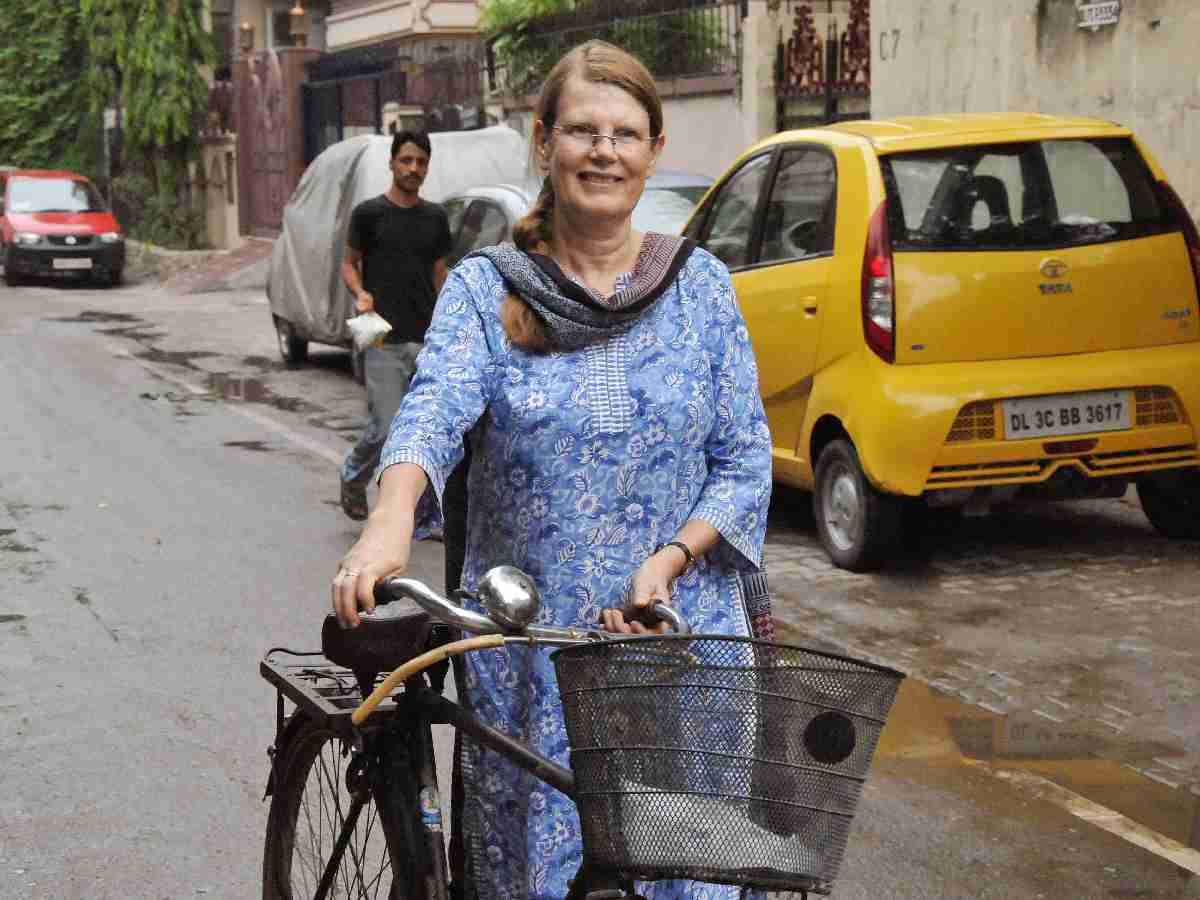
Gillian Wright
In the narrow lanes of Nizamuddin West, a white-haired woman haggles in Hindi with vegetable vendors, her fluency drawing surprised glances from passers-by. She smiles—she enjoys bargaining, after all. Few realise that this unassuming figure is Gillian Wright, the British-born translator who brought Raag Darbari and Aadha Gaon to English readers with remarkable finesse.
Wright, who first arrived in Delhi in 1977, has spent nearly five decades observing and loving the city—its streets, its birds, its buildings, and its layered history. “I am Indian,” she says. “I pay my income tax here.” And she means it. Now a citizen, she calls herself a true Delhiite—one who not only speaks fluent Hindustani but also fights for Delhi’s trees, mourns the Yamuna’s decline, and cannot imagine living anywhere else.
Translating a literary legacy
Hailing from Britain, Wright has translated several celebrated Hindi-Urdu novels into English, including Aadha Gaon by Rahi Masoom Raza and Raag Darbari by Shrilal Shukla. Her immersion into these texts was far from superficial. To better understand the atmosphere and language of Aadha Gaon, she met Raza’s family members, visited Imambaras, and observed Marsiya ceremonies—experiences that deeply informed her translation.
Among her favourites is also Raag Darbari. “There was never a book like Raag Darbari in English, nor is there one now,” she says. “Shrilal Shukla was an ideal writer for a translator. Raag Darbari contains so many stories that one could narrate them for an entire month.”
She has also translated stories by Bhisham Sahni, with Amritsar Aa Gaya Hai holding a special place in her heart.
A home in Nizamuddin
Wright previously worked at the BBC in London, but her love for Hindi and India brought her to Delhi, where she now lives in Nizamuddin West with her friend and fellow journalist Mark Tully. After Delhi, she feels a deep connection to Uttar Pradesh. “How can someone who has translated Aadha Gaon and Raag Darbari stay far from Uttar Pradesh?” she asks with a smile.
In her daily life, Wright navigates Delhi’s streets with ease. She bargains in Hindi, chats with vendors, and blends into the rhythm of the neighbourhood. “I enjoy bargaining,” she admits. It often surprises people when they hear her speak fluent Hindustani—but it shouldn’t. After all, how many foreigners not only speak the language fluently but also take Indian citizenship?
A shared journey
Mark Tully is often part of the conversation when one speaks with Wright. He, too, is fluent in Hindustani and shares her deep emotional connection with India.
“I believe India has made me its own. I consider it fate. When the BBC sent me to India, I became a part of this country,” says Tully. “After retiring from the BBC in 1994, I decided to stay here. By then, India’s colours had seeped so deeply into me that leaving was unthinkable. I made so many friends here whose love made it impossible for me to leave. Even if I had left, their memories would have called me back.”
Tully reflects on the changes he has seen in India over the past two decades. “The weather has changed. If you talk about Delhi, the winters here are no longer as romantic as they used to be. The summers have become harsher. Crowds are everywhere. But yes, job opportunities have increased.”
The tree lover and river mourner
Like many who have made Delhi their home, Wright is troubled by the city’s environmental degradation. She is particularly pained by the cutting of trees and the pollution of the Yamuna.
A few years ago, when dozens of trees were cut down along Sunder Nagar and Mathura Road, she joined other residents in protest. “They didn’t even consult us,” she says. Among the felled were neem trees more than 70 years old, which had long provided shade and beauty to the area. The Delhi government removed them for an upcoming project, prompting a protest march along Mathura Road. Wright participated at the request of Nizamuddin-based social activist Farhad Suri.
She is equally disturbed by what she sees along the Yamuna. “In the mornings, I see people stop their cars and throw puja materials into the river, with no one to stop them,” she says. For Wright, this casual pollution is not just a civic failure—it is a loss of something personal. “The white cats that used to roam near the Yamuna are no longer seen,” she adds with quiet sadness.
No room left for cyclists
Delhi today feels drastically different from the city Wright first encountered in 1977. “When I came here 40 years ago, this city was very green,” she says. “Since then, trees have been cut in the name of development, and greenery has diminished. Now, this city feels like a concrete jungle. I no longer see the birds that were once abundant. I can’t even cycle on the roads anymore—there’s no space left for cyclists.”
Also Read: The fall of a White Mughal: Story of a murder and a lost grave in Delhi
Her concerns point to a larger urban planning issue. Cyclists and pedestrians have been pushed off the roads, sacrificed at the altar of speed and sprawl.
A love that endures
Despite the changes, Wright remains fiercely devoted to Delhi. The idea of returning to Britain holds no appeal for her. “Honestly, you’re never bored in Delhi,” she says. “Friends keep meeting and connecting with you. We, too, love meeting our friends. These qualities are not found in European societies.”
She may have come from London, but Gillian Wright belongs to Delhi now—not just in residence, but in spirit, speech, and soul.
Fire breaks out at DUSU office in Delhi University’s North Campus, damaging furniture; no casualties…
Delhi records minimum temperature of 25°C, 2.7 degrees above normal, while air quality remains in…
Owners get 3 to 7 days to produce approved plans and five to 15 days…
Delhi court granted bail to 17 protesters while ordering a report on allegations of police…
Police have launched a manhunt for a man who allegedly attacked his former live-in partner…
Delhi High Court declares Nehru Place a no-vending zone, allowing MCD to remove unauthorized hawkers…
