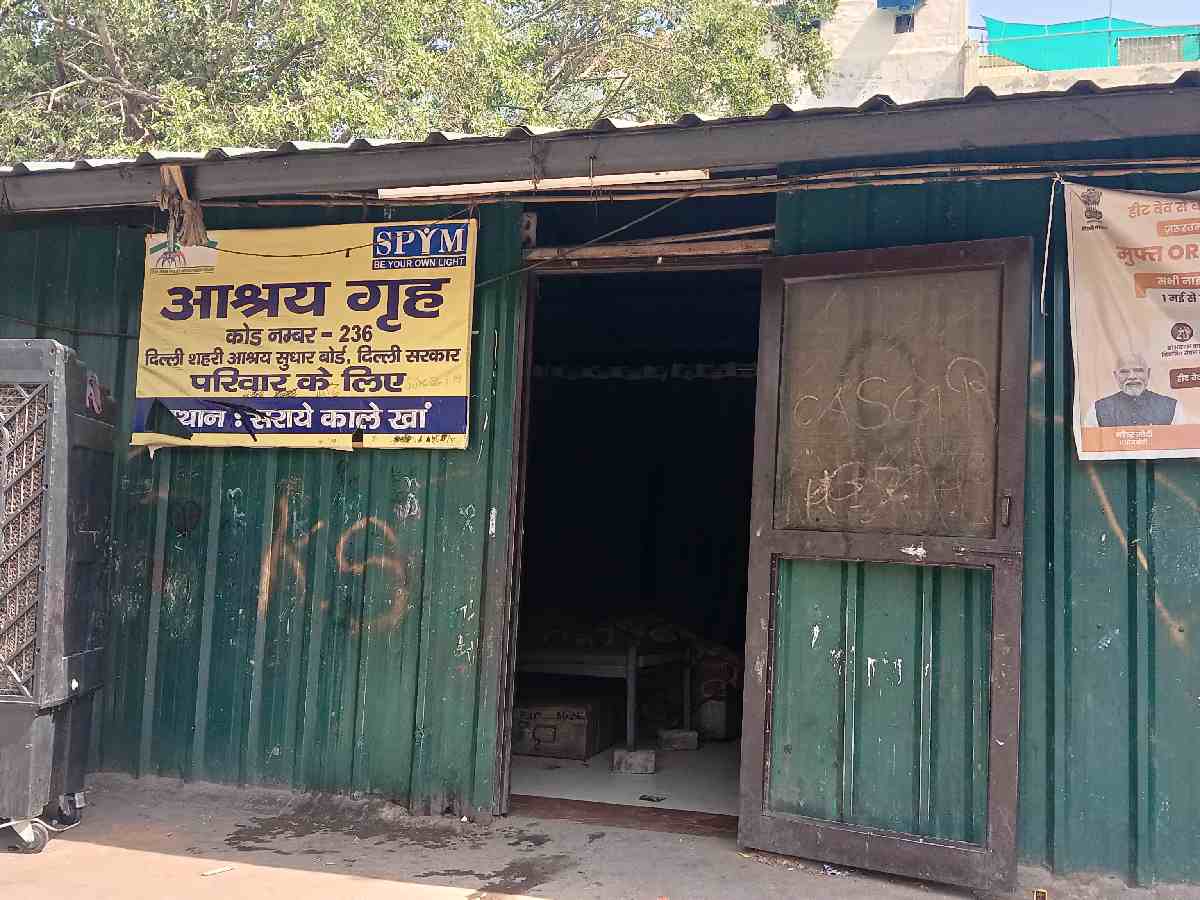
Sarai Kale Khan's night shelter has been Sonia's abode for the past two years
Lying on one of the many beds at the Sarai Kale Khan night shelter, Sonia and her 17-year-old son reminisce about the old days. Once a member of the Delhi Commission for Women (DCW), Sonia has nothing but memories to hold on to.
“Every day, my former colleagues and I think about our next step. We have all been talking about restarting the DCW, but no authority has given us any hope [about it],” she says. For the past two and a half years, the DCW has been largely dysfunctional.
Sonia still remembers the hustle of answering calls to the commission helpline. “We were all really excited, being more than what we were. We would get calls from every nook and cranny of Delhi. It was a somewhat intimidating task at first, but we later realised that it was not about us but the brave women who would be courageous enough to call.”
‘No funds’
Sonia’s brave exterior soon cracks as her thoughts return to the present. She is now unemployed.
She had earlier been residing in a rented room in Old Delhi with her family — her husband and her son. In 2023, her husband breathed his last, and coincidentally, the coffers of the DCW began to dry up. Salaries became more inconsistent from month to month for contractual and outsourced workers. The salary dues soon became another obstacle to overcome.
“My landlord had had enough by then and asked me to leave. I tried looking for a cheaper place to stay in, but after a couple of months, I did not have the funds to sustain that either. So, at the beginning of 2024, I was left without a house.”
The only proof of her association with the commission is a WhatsApp group of former colleagues who continue to anguish over the commission’s fate while hoping for its revival. The commission was not only a space for volunteers to provide support to aggrieved female survivors of harassment and violence but also a primary source of income for many.
“It was the only source of income that my household had, and now, there is no work around me, especially because I am a woman, and women from night shelters are offered only manual labour work,” Sonia remarks.
Degree gathering dust
Pointing to her Bachelor of Commerce degree that she always keeps on her bed, she says, “I have not been able to use it for the past three years. I would never have thought that I would be unemployed to this extent.”
Her son has been attending a computer training programme for the past three months. “I just passed my 12th. My mother thought it was better to stay here than to compromise on my education,” he says.
The duo stand out among the residents of the night shelter. But that does not bother them. “The only thing that I am concerned about is if I will ever be able to return to the commission. They have been talking about restarting it but they have stopped updating us about it as well,” Sonia says.
No permanent chairperson
In February, the Delhi High Court pulled up the Delhi government for the dysfunctional nature of the Delhi Commission for Protection of Child Rights (DCPCR) and the DCW, since they were ‘functioning’ without chairpersons.
The DCPCR has an interim chairperson, IAS officer Rashmi Singh, who is also Secretary in the Women and Child Development department. However, a permanent chairperson has yet to be appointed. The DCW has not had a chairperson since January 2024, when Rajya Sabha member Swati Maliwal stepped down from the post.
Also Read: Delhi: 5,000 cases in labour courts, one widow still waiting
Many of the workers with the commission are widows, survivors of abusive households, sexual assault, and acid attacks. Most of them were employed by the commission because of a lack of jobs, without anyone to fend for them. The DCW was their only hope in dark times.
The commission also served as a lifeline for the many survivors of abuse across the national capital. In the face of a dwindling workforce and an ever-decreasing budget, however, there was no one left to listen to the plight of women.
According to reports, the DCW’s key initiatives – such as its Rape Crisis Cell (RCC), Sahyogini, and Crisis Intervention Cell (CIC) – have recorded a slump in cases. The RCC and CIC dealt with about 950 cases between March and August in 2024, against an average of 1,100 cases in the corresponding months last year. The number of women assisted through the mobile helpline also decreased: only 12,549 women of the 26,046 who placed distress calls between March and August were assisted.
The phone calls to the helpline go unanswered. The helpline stopped working after the workers were forced to leave. A lock hangs from the gate that leads to the offices of the commission. A dingy corridor remains of the commission, once thronged by women seeking to have their pleas heard and their complaints filed.
Each day of closure costs shops in Khan Market and Connaught Place between Rs 60,000…
Delhi generates nearly 15,000 tonnes of waste daily, prompting the government to deploy 1,000 mechanical…
Delhi Police has issued an NOC for the Congress rally at Ramlila Maidan on November…
CJP chief Abhijeet Dipke received conditional bail following his arrest for participating in a Connaught…
The DPCC has floated ₹104 crore tenders to test pilot pollution-control technologies across 40 key…
MCD pushes Bhalswa cleanup to Feb 2027 due to agency transition, leaving over 10 lakh…
