Moth-eaten files, repeated adjournments, and the prolonged absence of follow-ups from litigants and advocates alike have contributed to a steady pile-up of cases in Delhi’s labour courts, with no immediate resolution in sight. Courtrooms and record rooms remain filled with files dating back years, reflecting the slow pace of labour dispute resolution in the capital.
According to the National Judicial Data Grid (NJDG), 3,897 cases are currently pending before Delhi’s labour courts. These cases are listed under the Presiding Officer Industrial Tribunal (POIT) and Presiding Officer Labour Court (POLC) courts at the Rouse Avenue Court Complex.
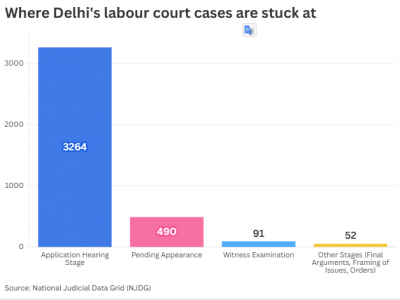
Of the pending matters, 3,264 remain at the application hearing stage, while 490 are pending appearance, 91 are at witness examination, and the rest remain stuck at stages such as final arguments, framing of issues, and orders.
While the NJDG data reflects cases filed till July 2025, a similar pattern continues in 2026. According to the Rouse Avenue Court Complex dashboard, 2,268 Labour Court Application (LCA) matters were filed in 2026. Of these, more than 600 remain pending within the first five months of the year, while several others were disposed of through mediation, settlement, or other means.
Taken together, the total number of pending matters before Delhi’s labour courts is estimated to be around 5,000.
Cases stretching across decades
While many of these cases were filed in 2024 and 2025, some disputes date back much further. In several matters, hearings have been repeatedly delayed because of the absence of advocates, litigants, or court staff, including stenographers.
One such case dates back to 2013 and is presently listed for final arguments on July 16, with the previous hearing having taken place on May 18.
The matter concerns Saroj Devi, who is pursuing a long-running compensation case involving Delhi Cloth Mills (DCM) on behalf of her deceased husband, Sant Kumar.
According to the plea, Kumar had been employed as a weaver at DCM since October 17, 1973. He took sanctioned leave from September 8, 1981, to November 13, 1981, and travelled to his native village, where he later fell ill.
He subsequently sent a leave application seeking an extension of one month. However, when he returned to work with a fitness certificate, he was allegedly informed that his services had been terminated with effect from November 23, 1981.
Kumar had argued that he had neither been served a formal termination letter nor paid retrenchment compensation or notice pay.
During the course of litigation, the DCM factory at Bara Hindu Rao in North Delhi shut down.
While the labour court initially held that Kumar was entitled to reinstatement, the closure of the mill shifted the matter towards compensation.
“In view of the above, I hold the workman entitled for reinstatement but for closure of the mill w.e.f. 1.1.1989. Since the termination of the workman is illegal and unconstitutional, he is entitled to back wages till closure of the mill of the management,” the labour court order stated.
However, the award was later challenged by DCM, and Kumar died during the proceedings. Saroj Devi is now continuing the case.
Endless litigation
Although the Delhi High Court directed the company to pay Kumar’s dues, Saroj alleges the full payment was never made, forcing her to return to court again.
“It has been over a decade. I have been contesting and fighting against them, but I don’t know how long I will be able to keep it up,” she said.
“Days have turned into months and months into years. There is just no end in sight, even though they keep telling me that this is the final lap.”
Another labour dispute that began in 2012 concluded only in 2025, though not with the outcome petitioner Basti Ram Mathur had initially sought.
Mathur had filed a plea against the erstwhile North Delhi Municipal Corporation, claiming that his pension payments had been delayed following the trifurcation of the Municipal Corporation of Delhi (MCD).
According to the final court order, the civic body eventually released part of the pension dues during the proceedings.
“The applicant also submits that the matter be disposed of as settled as he has received some payment from the MCD after filing of this case and he is satisfied with the calculation explained to him by the management, due to which he does not wish to pursue this case,” the order stated.
However, Mathur maintained that the amount released did not cover his entire pension dues.
“I just wanted to get done with the court process. It was almost a decade-and-a-half-long process. That is too long a time to sit through,” he said.
“Although I have suffered many financial setbacks during the course of the hearings, the portion of the pension will be enough.”
Wage disputes continue
Azad Mehra, field assistant with the Delhi Jal Board (DJB) and a union leader associated with the Centre of Indian Trade Unions (CITU), said delayed and irregular wage payments remain among the most common labour disputes reaching courts.
“While contractual workers have been provided certain safeguards, these often come at the cost of their security and stability,” he said.
Mehra alleged that under newer labour arrangements, payments are increasingly calculated on a per-day or output basis, leading to disputes over recorded work hours.
“Sometimes supervisors do not log the number of hours worked and only record the work once a project is completed,” he said.
“If one studies the pattern of cases before labour courts, it becomes fairly clear.”
He argued that such practices effectively reduce wages to output-based payments rather than compensation for hours worked.
“That comes close to bonded labour, where workers are effectively paid only for the final output instead of the labour they put in every day,” he said.
Mehra added that labour unions had repeatedly urged the labour department to revise minimum wages in line with inflation, but no major revision had yet taken place.
According to a recent media report, more than 1.14 lakh labour and industrial dispute cases are currently pending before Labour Courts and Industrial Tribunals across India, including over 70,000 labour disputes and more than 44,000 industrial matters.