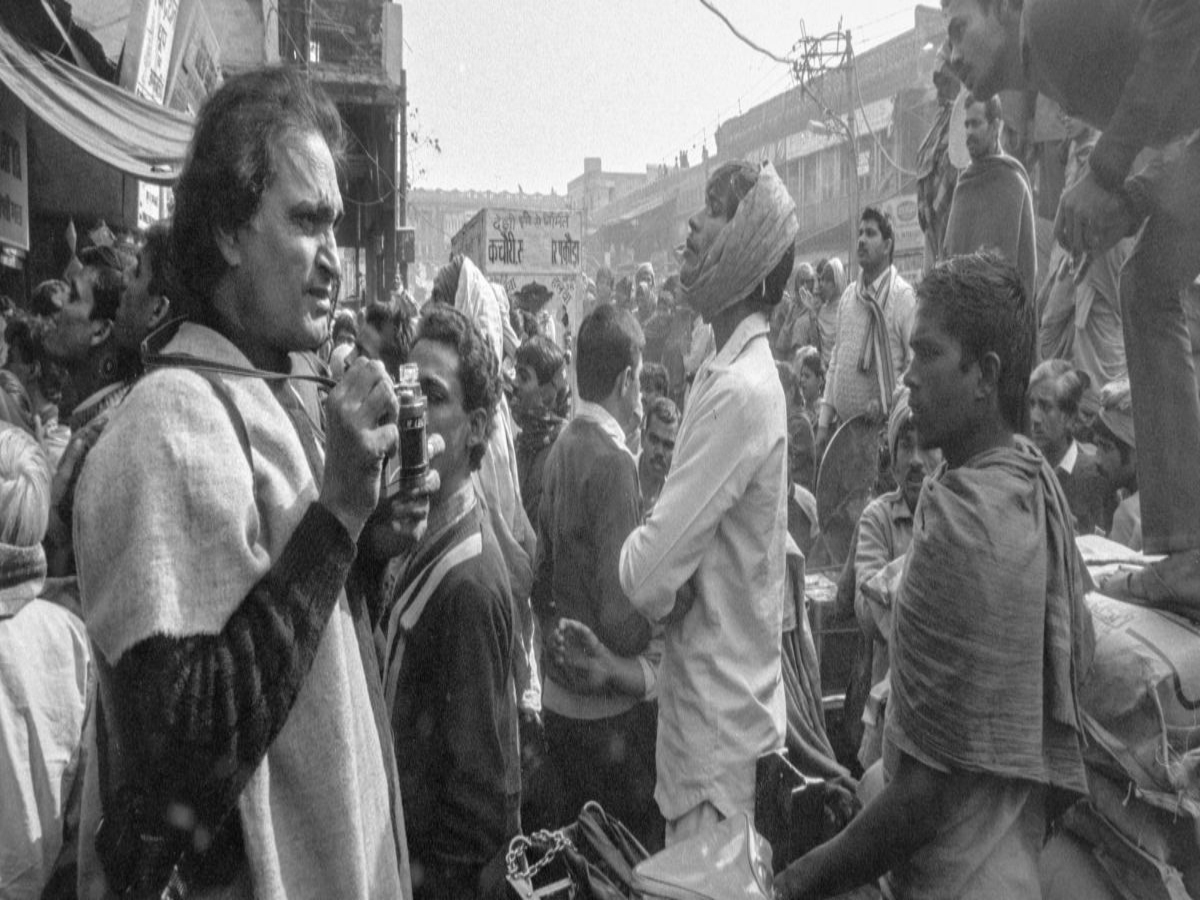
Raghu Rai while taking photographs on a winter morning at Khari Baoli areas in Old Delhi, January 11, 1992
Those were the years when he explored ancient, medieval, and modern Delhi. It was during this time that he developed an abiding fondness for the city that would infuse his entire career. Delhi became his home, his studio, and his enduring subject. In the later part of his life, he lived in Mehrauli amid ancient ruins and forests, yet he repeatedly returned to Old Delhi’s narrow lanes, embracing its chaos, resilience, and layered history. As recently as a couple of years ago, he could still be spotted in Delhi-6 or among the ruins of Mehrauli with his Nikon.
Mistress and mirror
His matchless prose celebrated the city’s contrasts: the grandeur of Lutyens’ bungalows versus the teeming bazaars of Shahjahanabad, the quiet of Lodi Gardens against the frenzy of Chandni Chowk. Singh wrote with malice toward none. Rai’s breathtaking images formed the visual heartbeat of the book. Far from mere illustrations, they captured places, people, and historic sites with profound depth. His black-and-white photograph of Jama Masjid’s soaring domes and minarets rising above rooftops, where kites danced in the late summer skies, was striking.
Chawri Bazar came alive with artisans hammering metal, their faces etched by centuries of craft. Humayun’s Tomb stood serene, while the Qutub Minar pierced the horizon near bustling villages. Rai photographed labourers pushing overloaded carts through Chandni Chowk’s narrow lanes, street vendors haggling amid spice-scented air, devotees at prayer, children playing cricket beside Mughal ruins, and women balancing water pots near historic havelis.
These scenes emphasised Delhi’s living heritage, where monuments were not isolated relics but stages for human drama. Indeed, it is perhaps the best book on the life and times of Delhi by two legends. Together, they created a portrait that was both intimate and panoramic. The book reveals Delhi’s grit, poverty, overcrowding, and the constant push-pull of old and new, while celebrating its irrepressible vibrancy.
His passion for Delhi did not end with the 1983 volume. In the 1990s, he produced his solo book Raghu Rai’s Delhi. Spanning more than forty years of photography, this book chronicled the city’s relentless transformation. Rai revisited Old Delhi’s streets, documenting how globalisation layered new commerce atop Mughal-era rhythms. He captured metro construction slicing through historic neighbourhoods, high-rises casting shadows on centuries-old mosques, and migrants flooding markets in search of opportunity.
Yet his lens remained affectionate: labourers still pushed carts in Chawri Bazar, prayers still rose from Jama Masjid at dusk, and the city’s resilient people endured. Rai also showcased his Delhi-centric work in exhibitions, photo essays, and retrospectives. As chief photographer for The Statesman in Delhi from 1966, and later a key contributor to India Today, he chronicled political upheavals, cultural festivals, and social shifts while always returning to the streets.
“His archives were full of images from Rashtrapati Bhavan ceremonies, Lodi-era tombs at twilight, and Mehrauli’s Qutub-adjacent villages,” says Naresh Sharma, former senior photo editor at The Indian Express. Delhi offered endless frames: a flute player in a crowded gali, sparrows scattering near an old man on a bench, or the call of the azaan echoing over rooftops.
Rai described Old Delhi as “another world altogether” — its architecture, heritage, and street life nourished his soul. Even as cancer claimed him on April 26, 2026, at the age of 83, his legacy endures through the books and photographs that continue to shape how Indians see their capital. His Delhi photographs transcend documentation; they reveal the city’s soul — resilient, chaotic, sacred, profane, and ever-evolving.
Through places like the Red Fort and Jama Masjid, people in bustling bazaars, and historic sites layered with memory, Rai taught us to love Delhi as he did: completely, critically, and with open-hearted wonder. His camera did not merely record; it embraced.
Each day of closure costs shops in Khan Market and Connaught Place between Rs 60,000…
Delhi generates nearly 15,000 tonnes of waste daily, prompting the government to deploy 1,000 mechanical…
Delhi Police has issued an NOC for the Congress rally at Ramlila Maidan on November…
CJP chief Abhijeet Dipke received conditional bail following his arrest for participating in a Connaught…
The DPCC has floated ₹104 crore tenders to test pilot pollution-control technologies across 40 key…
MCD pushes Bhalswa cleanup to Feb 2027 due to agency transition, leaving over 10 lakh…

