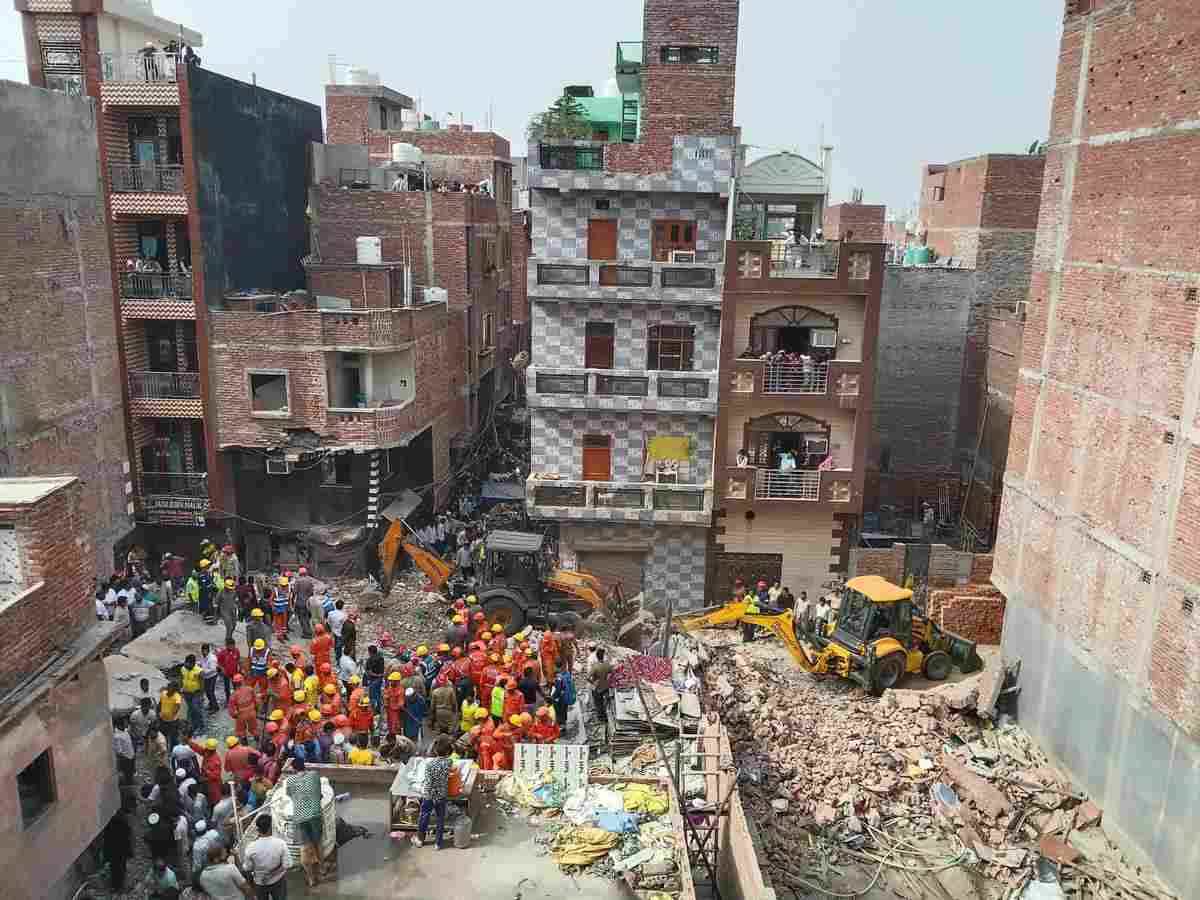
Building collapses in the national capital have become alarmingly frequent, turning Delhi into what experts describe as a ticking time bomb. The tacit acceptance of unauthorised colonies has created a dangerous situation, where governance lapses become evident each time disaster strikes. When buildings fall, much of the state machinery scrambles for answers, with no clear accountability.
A disturbing rise in incidents
Data from the Delhi Fire Services (DFS), accessed by Patriot, reveals a sharp spike in building collapse-related emergency calls. In April this year, up to April 20, DFS recorded 27 such calls—more than double the 12 calls received during the same period in 2024, marking a 55.5% rise.
The trend is not restricted to April. In January 2025, DFS recorded 23 calls, while February and March saw 25 each. The corresponding figures for 2024 were 16, 30 and 21. Fatalities have also risen sharply—15 deaths were reported by April 20, 2025, compared to eight during the same period last year.
The longer-term picture is equally grim. Between 2022 and 2023, 349 collapses resulted in 43 deaths and 315 injuries. The following year saw 371 incidents, 23 fatalities and 171 injuries.
Experts warn that these figures reflect a deeper crisis. Residents of unauthorised colonies—many of whom live outside formal municipal or government records—bear the brunt of this neglect. These settlements often lack civic amenities, proper building oversight and legal protection, leaving residents vulnerable.
Also read: Dark web anonymity fuels hoax threat chaos in Delhi, baffling law enforcement agencies
North East Delhi bears the brunt
North East Delhi has emerged as a hotspot for these tragedies. On the morning of July 12, a four-storey building collapsed in the narrow lanes of Janta Colony near Idgah Road in Welcome, killing six members of the same family.
The victims were identified as Matloob, 50, his wife Rabia, 46, their sons Javed, 23, and Abdulla, 15, daughter Zubia, 27, and Zubia’s two-year-old daughter, Fauzia. DFS officials said residents were asleep when three floors gave way.
Matloob owned the building, which also housed an Anganwadi centre on the ground floor. His family had recently moved back after living in Gautampuri for several years. Four other family members—sons Parvez, 32, and Naved, 19, daughter-in-law Siza, 21, and 14-month-old Ahmad—were injured. Siza, who is pregnant, has been declared safe.
Four members of another family living in a nearby building also sustained injuries. Survivors were taken to Jag Pravesh Chandra Hospital, while Ahmad, in critical condition, was admitted to Guru Teg Bahadur Hospital.
Family members said the building, at least a decade old, had been renovated five to six years ago. Mohammad Shamim, a relative, recounted that the family returned after their Gautampuri house was destroyed in a fire caused by a short circuit last November, days before Aafiyah, Matloob’s other daughter, was married. “They decided to return to this old house after losing everything,” Shamim said.
Neighbours described the difficulty of rescue efforts due to the area’s narrow lanes. “Even cranes could not function properly. Much of the clearing was done manually. Some of us got cuts and bruises while removing the rubble,” said Rahim, a neighbour.
The colony is composed entirely of unauthorised buildings. Many houses lack piped water supply from the Delhi Jal Board, and stagnant drain water is a common problem due to poor sewage systems. Police have filed a negligence case under relevant sections of the Bharatiya Nyaya Sanhita (BNS).
Mustafabad tragedy epitomises the crisis
The Janta Colony incident followed closely on the heels of another major tragedy in Mustafabad, North East Delhi. On April 19, a nearly two-decade-old building collapsed entirely, killing 11 people, including eight members of one family.
The victims included the building’s owner, Tehsin, 60, his wife Zeenat, 58, their son Nazeem, 30, daughter-in-law Shahina, 28, their three children—Anas, 6, Afree, 4, and Afan, 2—Tehsin’s daughter-in-law Chandni, 23, and relative Ishaq, 75. Others killed were Danish, 23, Naved, 17, and Reshma, 38. Only Tehsin’s son Chand, 25, and two young grandchildren survived.
Residents blamed excessive seepage caused by clogged sewer lines for weakening the foundation. Mohammed Gulfam, 52, said, “The sewer lines are in poor condition, causing seepage that weakens foundations. Damp walls are common, but the government has done nothing to address the problem.”
Tehsin’s brother, Mohammed Hajibullah, 62, was scathing in his criticism of civic authorities. “These colonies have always been neglected. Sewers are overflowing, and neither the councillor nor the MLA acts. While death is in God’s hands, this collapse was man-made,” he said.
Preliminary investigation by Delhi Police suggested that renovation work, particularly the demolition of a wall, may have triggered the collapse. An FIR was registered under sections 290 (negligent conduct regarding building repairs), 106 (causing death by negligence), 125 (endangering life), 125A, and 3(5) (common intention) of the BNS against unidentified individuals.
Experts point to systemic failures
The Delhi Development Authority lists 1,731 unauthorised colonies and 69 affluent unauthorised colonies in upscale areas, none of which adhere to civic guidelines.
Architect Pradeep Sharma said substandard construction materials were a key factor. “Buildings in unauthorised colonies deteriorate faster due to poor materials and lack of regulation. A 20-year-old building in such areas can collapse, unlike those in authorised colonies, where guidelines ensure durability,” he explained.
Pushkar Pawar, senior urban planner and former Municipal Corporation of Delhi (MCD) official, added, “These buildings often violate regulations by using substandard materials and ignoring spacing requirements. Some submit plans for three-storey buildings but construct five storeys, overloading foundations designed for less.”
DFS officials noted that most collapses occur in unauthorised areas due to rapid, unregulated construction of additional floors. Referring to the Mustafabad collapse, an official said, “The land was unsuitable for multi-storey buildings.”
An MCD official, requesting anonymity, admitted, “These incidents will continue due to the prevalence of unauthorised colonies, which ignore building bylaws.”
Also Read: Missing persons in Delhi: Adults at a higher risk than minors
Recent incidents highlight the danger
Other recent collapses underline the scale of the problem. On June 9, an eight-year-old boy was crushed to death when a water tank fell from the second floor, causing the ground floor to collapse. A 45-year-old man was also injured in the incident.
On April 11, a dust storm triggered multiple collapses across Delhi, leaving two dead and three injured. In Madhu Vihar, a wall on the sixth floor of an under-construction building in Chander Vihar collapsed at 6:30 PM, killing Chander Pal, 67, and injuring Rajbir Meena, 38. In Karol Bagh’s Siddhipura, a newly built balcony on a four-storey building collapsed due to strong winds, injuring a 13-year-old boy. In Dwarka’s Kakrola, a parapet collapse killed 10-year-old Avani and injured her aunt, Savitri, 31.
By 10 PM, DFS had responded to five building collapses and 18 reports of fallen trees across the city.
Delhi's Old RTR flyover reopens for light vehicles today after repair work following road cracks,…
Visits to Govindpuri, Jangpura, Saket and Mayur Vihar show unlabelled corrosive substances sold for Rs…
Rescue teams recovered two bodies from the debris of a collapsed under-construction house in northeast…
Built on Jawaharlal Nehru’s vision, the Delhi landmark has witnessed the evolution of a young…
Delhi steps up NCR coordination to curb winter air pollution by enforcing strict border checks…
Police probe all angles, including a suspected breakup and CCTV footage, after a Class 12…
