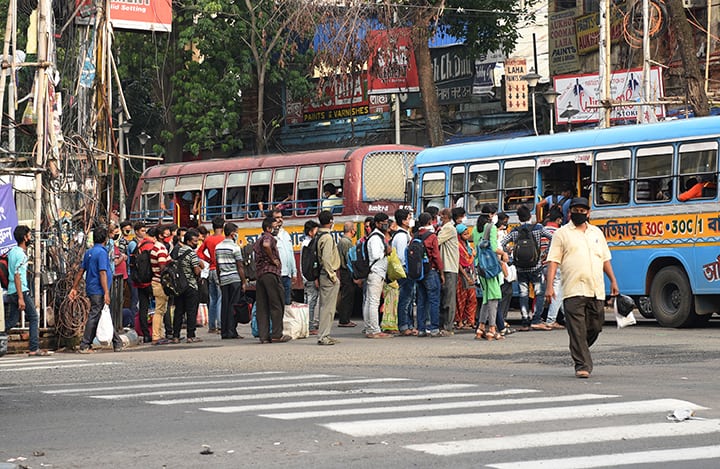
KOLKATA, INDIA - JUNE 29: Commuters wait in a queue to board a bus at Esplanade on June 29, 2020 in Kolkata, India. Transport woes of commuters compounded on Monday with a large number of private buses remaining off the roads in the city, demanding a fare hike in the wake of rising fuel prices and Covid-19 restrictions on the number of passengers allowed to board. (Photo by Samir Jana/Hindustan Times via Getty Images)
Asim Bose, who works in a reputed IT firm, travels every day from Shyambazar in North Kolkata to Sector V, Kolkata’s IT hub. During the lockdown, he worked from home for the next few months. Recently, his company gave him the option to work from the office. He then decided to travel like he used to do just to throw off the boredom of staying at home.
He had heard that buses had started plying on the streets, and it was the easiest way to commute. He thought he would catch a bus at Ultadanga, and from there he would hop on to another bus that went towards Sector V.
However, though he saw on the news that buses were plying on the road like before, his experience was completely different. He stood for more than 40 minutes at the bus stop but there was no sign of buses. The line at the stand kept increasing, even as buses were a no- show. He finally had to take an app-based cab, which cost him Rs 180, while a ride on the bus would cost him a maximum of Rs 20.
Like Bose, many passengers in Kolkata are facing the same plight because of a lack of buses on the streets. Public buses are the lifeline of Kolkata roads in the same way the Delhi Metro is for the Capital.
In the fourth phase of the lockdown, the West Bengal government announced that public buses would be allowed to ply but with only 20 passengers. Bus owners, however, refused to restart operations, as this would mean a loss of business. It was then that the government decided, that the buses could fill the seating capacity but no passengers would be allowed to stand to commute.
However, most of the buses continue to remain parked instead of operating.
The number of buses plying on the roads is nothing compared to the pre-lockdown numbers. According to a report, only 900 buses plied on the roads of West Bengal on 3 July, which is far cry from the usual 5,000 that used to be the daily average.
This is mainly because owners are refusing to hit the roads as the government has strictly prohibited increasing fares. “During the lockdown, we had absolutely no income for three months. We were unable to pay salaries to our bus conductors and drivers”, says Upen Prasad Ray, a bus owner. He says that with limited seating capacity, and no increase in fares, the money earned per day will not be enough to pay salaries and maintain the buses.
“Moreover, diesel prices are at an all-time high, and with much less income now, we do not even have the money to fill our tanks. How can we run through a bus route multiple times throughout the day without fuel?”, he adds. Now, the buses have to be sanitised every day, and that too comes at a cost which he estimates to be around Rs 500 per day.
“It is best to not run the buses at all than face this huge amount of loss and face headaches every day”, opines Ray.
However, other bus owners are now turning a blind eye to social distancing norms and filling vehicles to the brim, adding passengers well beyond their seating capacity. “I went on a bus from Nagerbazar to Rajarhat, and people were standing very close to each other with social distancing going for a toss. This is dangerous and increases the chance of spreading the Coronavirus”, says Ranit Das, a student, who further states that for the time being he would avoid buses.
Taking advantage of fewer buses on the roads, autorickshaws have increased their fares exponentially. An auto plying from Ultadanga to City Centre, Saltlake would take charge Rs 12 before the lockdown, Now the fare has shot up to Rs 30. The same can be said about the Behala Tram Depot to Rashbehari, one of the busiest autorickshaw routes in the city. The fare of Rs 16 has been increased to Rs 30.
This has happened despite a fall in prices of LPG, which is used to run the autos.
“The auto unions can reduce prices at whim as they are directly supported by the ruling party, but when we demand a fare hike of even Re 1, we face vehement protests, and sometimes even our buses are burnt down”, says Hari Pal (name changed), a bus owner.
However, there is some good news for both passengers and bus owners. The government has held a meeting with transport authorities and bus owner’s association and decided to field 3,000 buses a day from now on.
“A deadlock that had snowballed into a crisis over the past few days seems to be heading towards a resolution. We believe the government and the bus operators can find a common ground through talks,” says Rahul Chatterjee, of the All Bengal Bus Minibus Samanay Samity. “The more we interact, the easier it will be to iron out the differences.”
(Cover: Due to fewer buses running on the roads, long lines could be seen at bus stops // Photo: Getty)
Delhi Police seized over 707 kg of illegal firecrackers in Trilokpuri and arrested one person;…
Continuum: Explore 30 years of Asit Kumar Patnaik's artistic evolution celebrating femininity and emotion at…
Protesters marched to ECI headquarters in Delhi against voter roll revision, sparking traffic diversions and…
Three Delhi schools evacuated following bomb threat sent over emails; Delhi police launch search operations
Two arrested in Delhi after a 27-year-old woman died falling from a fair ride operating…
To combat Delhi's mounting water crisis, the MCD looks back 300 years to revive a…


