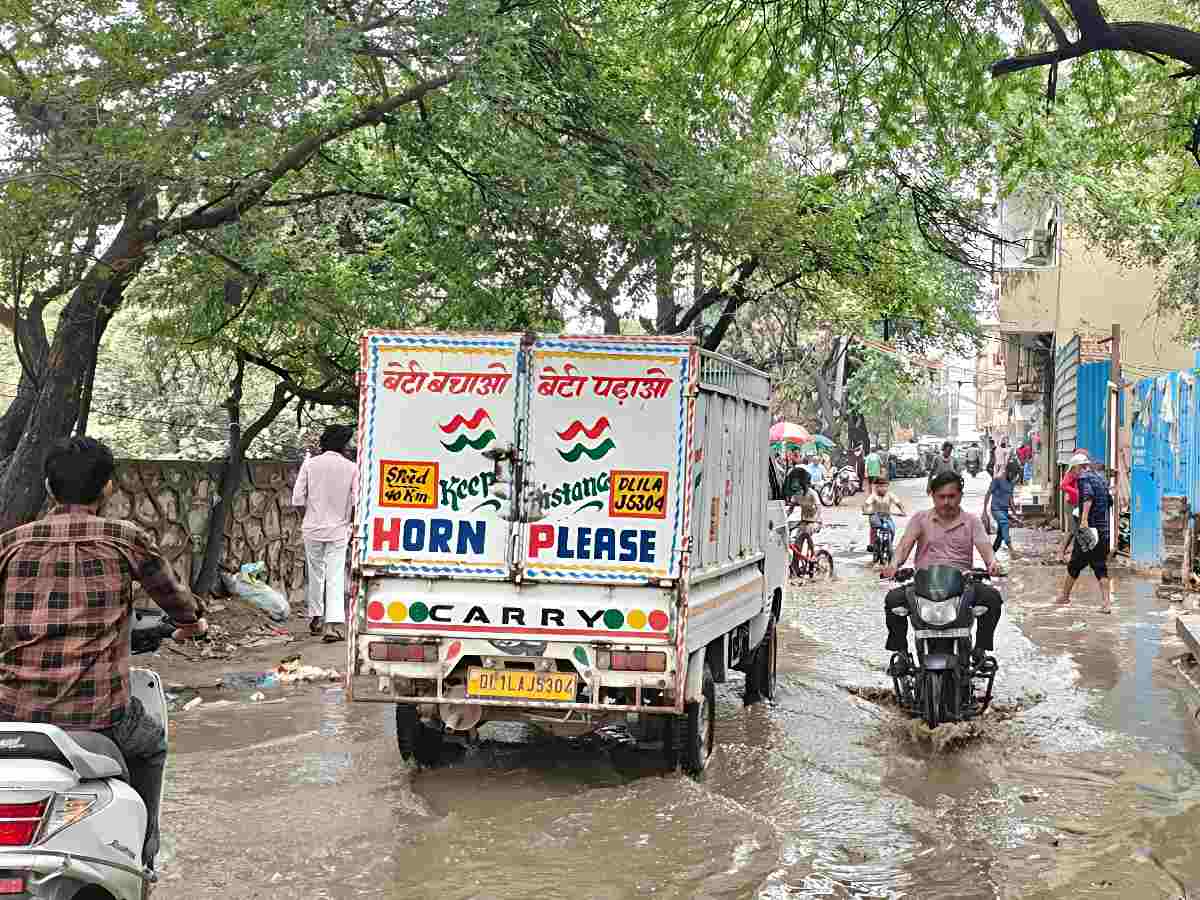
Vehicles pass through a waterlogged road in Hargovind Enclave Chhaturpur amid concerns over poor drainage
Flooded roads and traffic snarls in Delhi are usually associated with the rainy season, but residents in numerous areas of the city say those familiar problems have already arrived.
At Hargovind Enclave, Chhattarpur, Mehrauli, Katwaria Sarai, Vasant Kunj, Saket, Tughlaqabad, and parts of Shaheen Bagh, stagnant water had accumulated on roads and residential lanes despite largely dry weather in recent days. In many areas, damaged roads, clogged drains, and puddles of water had inconvenienced residents, raising concerns about Delhi’s drainage infrastructure and the effectiveness of the annual desilting exercises carried out by civic agencies.
‘Trapped on roads’
In Mehrauli, where narrow roads carried pedestrians, two-wheelers, and cars throughout the day, the roads were waterlogged long after an earlier spell of rain.
“Despite there being no rain for several days, the water remains trapped on the roads,” Rajesh Kumar, a resident of Mehrauli, said. “The biggest problem is that potholes stay hidden beneath the water. People on scooters and motorcycles often lose balance because they cannot judge the depth of the [flooded] water.”
In Chhattarpur, stagnant water is a common sight on several internal roads.
Sunita Devi, who runs a tea stall near a busy intersection, said the logged water had been affecting both public health and her business. “The water attracts mosquitoes and creates a foul smell. Customers often avoid standing near the roadside. We clean the area every day, but unless the water drains out properly, the problem remains,” she said.
Further north, in Katwaria Sarai, residents said drains cleaned ahead of the monsoon appeared to be clogged again.
“Every year, we hear that desilting has been completed. But the roads tell a different story,” Renu Sharma, a resident, said. “If the water is stagnating before the monsoon has begun, residents naturally worry about what lies ahead.”
Hidden hazards
For commercial drivers, stagnant water was inconvenient as well as costly.
Mohammed Salim, an autorickshaw driver operating between Saket, Chhattarpur and Mehrauli, said waterlogged roads slowed traffic and increased vehicle repair costs.
“The danger is not the water itself but what lurks underneath it,” he said.
“Potholes cannot be seen, so drivers have to move slowly. Passengers complain about delays, and vehicles suffer damage.”
Taxi driver Deepak Yadav frequently drives through Vasant Kunj and South Delhi’s arterial roads. He said some stretches remain waterlogged even during dry weather. “It becomes difficult to navigate because the road surface is uneven. Water collects along the sides and does not drain. Tyres, suspension systems and brakes take a beating,” he said.
Impediments to travel
For many office-goers, navigating waterlogged roads had become a headache.
An office worker from Kashmir, who has been working in Delhi for several years, said waterlogging in Chhattarpur regularly disrupted his journey to and from his workplace.
“Almost every day, I have to book an autorickshaw or bike taxi just to cross a stretch of road filled with drainage water and save my shoes and clothes from getting soaked. A trip that should cost me around Rs 20 often ends up costing between Rs 60 and Rs 100,” he told Patriot, requesting anonymity.
Recently, he was left stranded when no ride was available through online platforms. “A few days ago, I was trying to cross the waterlogged stretch, but no one accepted my booking. Eventually, a tractor passed by, and I requested the driver to take me across. That was the only way I could get through,” he said.
Before moving to Chhattarpur, he lived in Devli-Khanpur, where he faced similar challenges. “One day while returning from work, two of my mobile phones were damaged after I got caught in a waterlogged stretch. These are not isolated incidents any more,” he said.
“This is the national capital. If residents here continue to face such basic problems year after year, what message does it send to the rest of the country?”
Lower footfall
The effects were also being felt by local businesses.
In Hargovind Enclave, shopkeeper Ashok Gupta said stagnant water outside commercial establishments discourages customers from visiting the market.
“People don’t want to walk through muddy patches or park near waterlogged areas. Deliveries get delayed, and footfall drops. We are not even in peak monsoon season yet,” he said.
For many residents, stagnant water from nearby drains has raised sanitation concerns.
Jagdeep Kumar, 54, a resident of Hargovind Enclave, said: “Waterlogging has caused seepage in my house and damaged parts of the ceiling. Water from the drain nearby often overflows and remains stagnant for days. During the summer, the smell becomes unbearable, and we worry about the diseases it could spread.”
He said residents had repeatedly approached authorities seeking a permanent solution. “We have submitted complaints several times, but little has changed. Every year we face the same problem, and now we fear the situation will worsen once the monsoon arrives.”
Residents in Tughlaqabad described similar difficulties. “The water enters side lanes and remains there for days,” said Shabnam Khan, a homemaker. “Children cannot play outside, and elderly residents struggle to move around. We are worried because heavier rains are still expected.”
Recurring problems
On Hari Kothi Road in Shaheen Bagh, residents say stagnant water and damaged roads have become a familiar sight. “Water collects near several stretches of the road even after minor rainfall and sometimes remains there for days,” said Mohammad Arif, a resident.
“Pedestrians face difficulties, and vehicles often get stuck in damaged portions of the road. We hope the authorities address the issue before the monsoon intensifies.”
Nadeem Khan, a shopowner, said business activity is affected whenever water accumulates. “Customers avoid parking near waterlogged stretches, and traffic movement slows considerably. We have seen cleaning drives, but residents are waiting to see whether they actually solve the problem this year,” he said.
Flood of complaints
According to data shared by the Public Works Department (PWD), 449 drain-related complaints and 207 waterlogging complaints were received in April. In May, 411 drain-related complaints and 199 waterlogging complaints were received. By mid-June, the PWD had already received 188 waterlogging complaints.
Anil Kumar, Executive Engineer, PWD (South Road Division), said extensive desilting operations are underway. “We are continuously desilting drains and clearing blockages across vulnerable locations. The objective is to improve the flow of rainwater and prevent water accumulation on roads. Residents will see a noticeable change this monsoon season compared to previous years,” Kumar said.
Desilting exercise
The complaints come even as civic agencies claim significant progress in pre-monsoon preparedness.
Earlier this month, the Delhi Development Authority (DDA) announced it had completed around 70% of its desilting work and is set to meet the deadline set by Lieutenant Governor Taranjit Singh Sandhu to complete the remaining work before the onset of the monsoon.
According to the DDA, desilting was being carried out along 69 kilometres of stormwater drains in Narela and 192 kilometres in Dwarka. The exercise involved removing accumulated silt, debris, vegetation and other obstructions that hinder the free flow of rainwater.
Meanwhile, the PWD has directed officials to complete desilting work across its 2,138-kilometre drainage network spread across the city.
For Vasant Kunj and adjoining areas, Shahdab Alam, Executive Engineer and nodal officer for the South Zone of the Municipal Corporation of Delhi (MCD), said field teams are monitoring vulnerable locations.
“Drain cleaning and desilting activities are being carried out regularly. Complaints received from residents are attended to on priority, and inspections are being conducted at waterlogging-prone stretches. Corrective measures are being taken wherever required,” Alam said.
Structural weakness
Urban planners said the persistence of waterlogging during dry weather pointed to structural weaknesses that go far beyond blocked drains. According to Pushkar Pawar, a Town Planner with the MCD, desilting is only one aspect of a much larger drainage problem.
“Despite extensive desilting work undertaken every year, waterlogging and stagnant water continue to be a common problem because many drains in the city are old and no longer have the capacity to handle the increasing volume of water generated by rapid urbanisation and expanding concrete surfaces,” Pawar told Patriot.
He said drains are often re-clogged shortly after cleaning due to the dumping of plastic waste, construction debris, and other solid waste. Encroachments on natural drainage channels, ponds, and water bodies had further restricted the city’s ability to absorb and channel excess water.
“In many areas, leakage from water supply pipelines, overflowing sewer lines and the mixing of sewage with stormwater drains also contribute to stagnant water during dry spells. As a result, water continues to collect in low-lying areas even when there has been little or no rainfall.”
For Pawar, recurring waterlogging was as much an urban planning issue as it was a drainage problem.
“Delhi’s drainage network was designed for a very different city. Over the years, natural drains, wetlands and ponds that once absorbed rainwater have either disappeared or been encroached upon. Meanwhile, paved surfaces have expanded rapidly, leaving fewer spaces for water to percolate into the ground,” he said.
Pawar feels that addressing chronic waterlogging requires a long-term and integrated stormwater management strategy rather than seasonal interventions.
“The city needs to upgrade its drainage infrastructure, restore natural drains, ponds, wetlands and floodplains, and protect them from encroachment. These natural systems play a crucial role in absorbing, storing and channelling excess water. As Delhi continues to expand and rainfall patterns become increasingly unpredictable, infrastructure planning must anticipate future challenges rather than react to recurring crises,” he said.
He stressed the importance of public participation in tackling the problem.
“An efficient drainage system can function effectively only when citizens take responsibility for proper waste disposal. Plastic bags, bottles, food wrappers and other litter often end up blocking drainage inlets and stormwater pipes, restricting the flow of water and causing waterlogging,” he said.
Contour mapping
Pawar feels authorities could make greater use of contour mapping and natural topography while designing drainage systems.
“Before approving new residential colonies and development projects, authorities should mandate detailed contour maps that identify natural slopes and depressions in the land. Stormwater drainage networks should be designed in harmony with these natural drainage patterns, allowing water to flow through gravity along its natural course. Working with the natural topography rather than against it could significantly reduce waterlogging while improving the efficiency and sustainability of the city’s drainage network.”
For residents in South Delhi, however, the concern remains immediate. With the monsoons expected to arrive in the coming weeks, many fear that the stagnant pools already visible on roads today may be a preview of larger disruptions to come.
CTI chairman Brijesh Goyal said the Rahul Gandhi rally could affect wholesale and retail markets…
Established to mark the university’s 25 years, Jubilee Hall has witnessed generations of student life.…
Delhi inaugurates the 70th National School Games, hosting over 14,000 participants in 14 sports across…
Delhi High Court asked "Doosra" filmmakers to respond to Sourav Ganguly's plea over alleged violation…
Delhi L-G appointed Paralympian Suvarna Raj as State Commissioner for PwDs following her gold win…
DDA is planning Delhi's longest 24-km cycling track along the Yamuna floodplain, linking key eco-projects…

