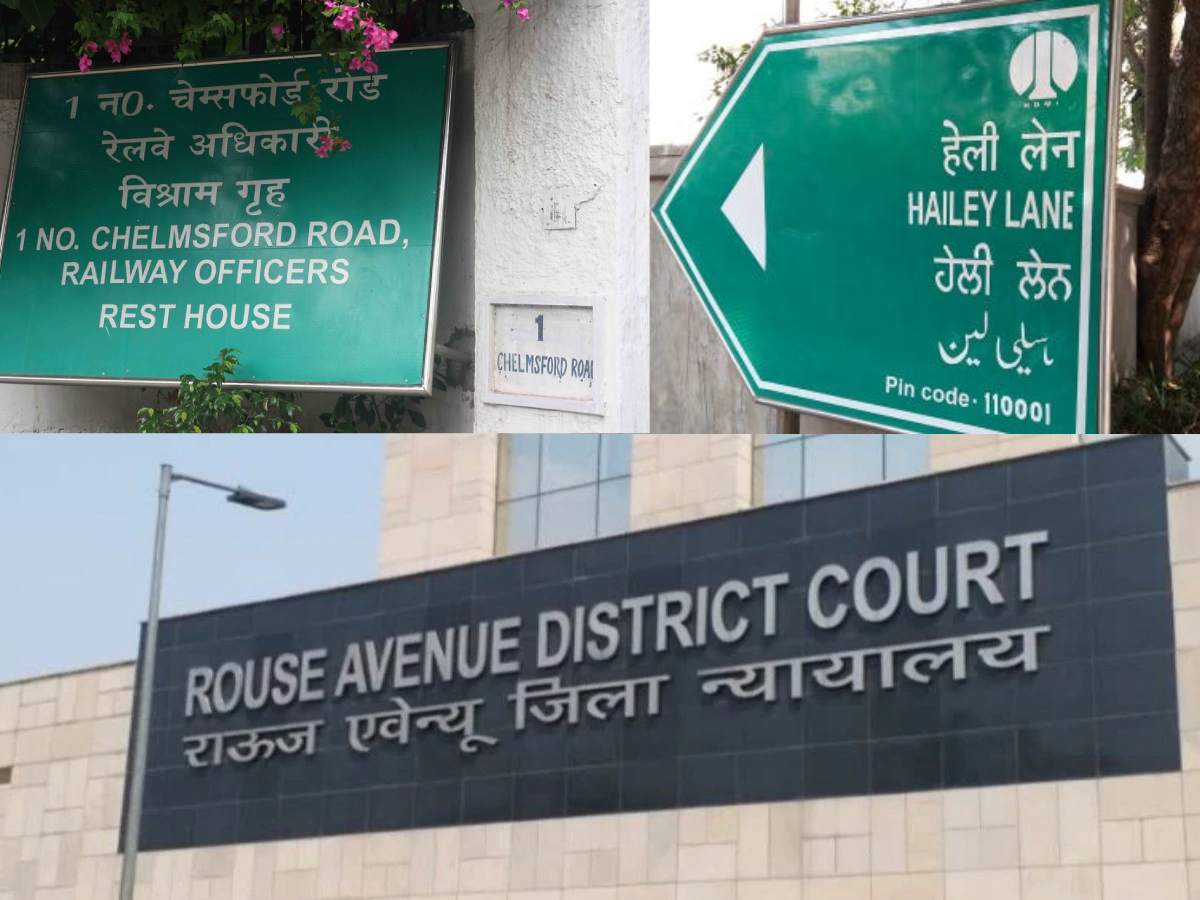
Delhi: As you move forward on the route from ITO, the red light offers three options: turn right toward Delhi Gate, turn left for India Gate, or go straight to reach the bustling Rouse Avenue. Moments later, on the right side of the road, you come upon a grand structure bearing a signboard for Rouse Avenue Court.
But today’s focus is not the court, but the man behind the name—Sir Alexander Rouse (1878–1966). Among the British officers who played a pivotal role in shaping India’s new Capital, Rouse stands out. Delhi was designated the new Capital of India in 1911, and Rouse arrived here in 1913. Before this, he had served as a civil engineer with the Public Works Department of India.
Prior to his posting in Delhi, Rouse was involved in the construction of the Kosi Bridge for the Bengal North-Western Railway. Under the leadership of Hugh Keeling, the Chief Engineer of the Delhi Municipal Committee (DMC), and with Rouse serving as Superintending Engineer, Delhi witnessed the development of its foundational infrastructure—drinking water systems, sewerage networks, roads, government offices, and residences.
Tolstoy Road, which runs parallel to Barakhamba Road, was originally called Keeling Road until 1970. While several colonial-era road names have changed over the decades, many still survive—such as Minto Road, Thomson Road, and Hailey Road.
Also read: Why Yamuna ghat residents refuse to leave despite floods and losses
From Lord Minto to Rouse Avenue
Rouse Avenue lies within the larger Minto Road area, named after Lord Minto, who served as Viceroy of India from 1905 to 1910. Born in 1845, Minto was a British peer and politician with a military background. He had served in the Scots Guards and participated in campaigns such as the Second Afghan War.
Before arriving in India, Minto served as Governor General of Canada (1898–1904), where he contributed to Canadian heritage and helped establish the National Archives of Canada. His tenure in India coincided with the controversial Partition of Bengal and the rise of revolutionary resistance. Minto’s most lasting legacy is the Morley-Minto Reforms (Indian Councils Act of 1909), which slightly expanded Indian representation in legislative councils.
George Thomson and the persistence of names
Thomson Road, located just minutes from Minto Bridge, was officially renamed Bhavbhuti Marg in the early 1970s. However, the original name continues to dominate local usage. The road was named after George Thomson, who served as Chief Commissioner of Delhi from 1926 to 1932.
Rajesh Sharma, a social worker from the Minto Road area, observes, “Hardly anyone calls Thomson Road by its new name—Bhavbhuti Marg.”
Lord Hailey’s mark on the capital
Near Kasturba Gandhi Marg lies Hailey Road, a name familiar to most Delhiites. It commemorates William Malcolm Hailey, Governor of Punjab (1924–1928) and later the United Provinces (1928–1934). Earlier, he had served as Chief Commissioner of Delhi from 1912 to 1918, playing a significant role in administering the newly designated capital.
Hailey Road, unlike many others, has retained its name—a marker of his enduring administrative influence during the formative years of New Delhi.
Lord Irwin survives in name and legacy
Even when names change, old associations often linger. For instance, at the Indian Oil petrol station on Baba Kharak Singh Marg, the attendant will still hand you a bill with “Irwin Road” written in brackets.
Lord Irwin, Viceroy of India from 1926 to 1931, was a Conservative politician who presided over a period of intense anti-colonial activity. His tenure saw the Salt Satyagraha led by Mahatma Gandhi and the First Round Table Conference in 1930. His negotiations with Gandhi led to the historic Gandhi-Irwin Pact in 1931. However, Irwin refused to grant clemency to Bhagat Singh.
His wife, Lady Irwin, founded Lady Irwin College in 1932—a name the institution proudly retains to this day. Likewise, the Lady Hardinge Medical College, established in 1914 by the wife of Lord Hardinge, still bears her name.
“Lady Hardinge was a venerable lady. Delhi must remain indebted to her for giving us a medical college more than 100 years ago,” says Pritam Dhariwal, a well-known social worker from the New Delhi area.
Chelmsford Road and the railway connection
If you are a Dilliwala, you would know that the road outside New Delhi Railway Station is known as Chelmsford Road. Lord Chelmsford served as Viceroy from 1916 to 1921 and is best remembered for the Montagu-Chelmsford Reforms, which laid the groundwork for limited Indian self-governance.
It was on his invitation that Gandhi attended the War Conference on April 28, 1918, held at the Delhi Assembly building. A club bearing Chelmsford’s name still exists on Raisina Road.
Nicholson Road and the ghost of 1857
It might surprise many to know that Nicholson Road still exists in Kashmere Gate. Brigadier General John Nicholson is buried in the Nicholson Cemetery nearby. Old Delhi residents may recall, or have heard from elders, that until 1952 a life-sized statue of Nicholson stood in Agrasen Park.
Born on December 11, 1821, Nicholson was the son of an Irish doctor. He joined the East India Company at a young age. During the 1857 revolt, he was posted as Deputy Commissioner in Peshawar but was swiftly called to Delhi to suppress the uprising. Known for his brutality, he led a fierce crackdown on rebels, reportedly moving about with a drawn sword. On September 14, 1857, Nicholson was critically wounded in battle. He succumbed to his injuries ten days later, at the age of 35.
Sir James Outram and the refugee camps
In north Delhi, near Guru Teg Bahadur Nagar, lies Outram Lines, named after Sir James Outram—a British general who played a key role during the 1857 Rebellion.
“This area, part of the historic Kingsway Camp—renamed GTB Nagar in 1970—was originally established during the British Raj and later housed refugee camps after 1947,” explains Harish Khanna, a former teacher at the University of Delhi.
Hudson Lane: from bloodshed to student hangout
Also located in north Delhi, Hudson Lane gets its name from Captain William Hudson, infamous for his role during the 1857 Rebellion. He captured and executed the sons of Mughal emperor Bahadur Shah Zafar, displaying their severed heads at Khooni Darwaza.
Today, Hudson Lane is a vibrant student hub near Delhi University, popular for its cafés and affordable eateries.
Also read: ‘Next big flood in Delhi is inevitable’: MoJS report ‘overlooks’ key risks
A colonial cartography that lingers
Even after more than 75 years of independence, Delhi’s map remains peppered with names from the colonial era. From road signs to institutions, the legacy of British administrators, engineers, viceroys—and even executioners—continues to echo through the city’s thoroughfares.
Four-month pregnant woman trapped under Seemapuri building rubble called family for water and guided rescuers…
Three women journalists have complained of harassment during the October 3 protest; police transferred the…
A 59-year-old property dealer died after sustaining a gunshot wound at a godown in southeast…
Delhi recorded a minimum temperature of 24.1 degrees Celsius, while the air quality remained in…
Veteran actor Nana Patekar died at 75 after suffering a severe cardiac arrest at his…
A four-storey building collapsed in Delhi’s Seemapuri area, killing a child and injuring at least…
