With the annual monsoon approaching, experts warn that Delhi once again stands on the brink of a major urban flood. A damning report from the committee formed by the Ministry of Jal Shakti (MoJS), which analysed the unprecedented Yamuna floods of July 2023, has raised alarm over the city’s growing vulnerability. The report pointed to structural mismanagement, encroachment, and hydrological blind spots as key reasons behind the worsening flood risks.
However, the report itself has drawn criticism for failing to clearly explain why flood levels in 2023 reached record highs. According to an analysis by the South Asia Network on Dams, Rivers and People (SANDRP), the committee’s findings gloss over crucial factors that contributed to the disaster and fail to provide a clear roadmap for preventing similar incidents in the future. Experts have warned that without urgent systemic interventions, Delhi may face yet another devastating urban flood.
A river with a history of floods
The Yamuna is the main river flowing through Delhi, moving easterly from north to south. As an alluvial river, it has a natural tendency to meander, and historically, it has caused serious flooding by inundating large areas during monsoon seasons.
Before the construction of the Shahdara Marginal Bund and the Left Marginal Bund in 1956, trans Yamuna areas were almost annually inundated. Similarly, on the western side, before the Right Marginal Bund was built in 1977 78, significant parts of northern Delhi, particularly the Alipur block, faced frequent flooding. The inadequacy of flood protection measures was evident even after embankments were built, as seen in repeated inundations, including the catastrophic floods of 1978.
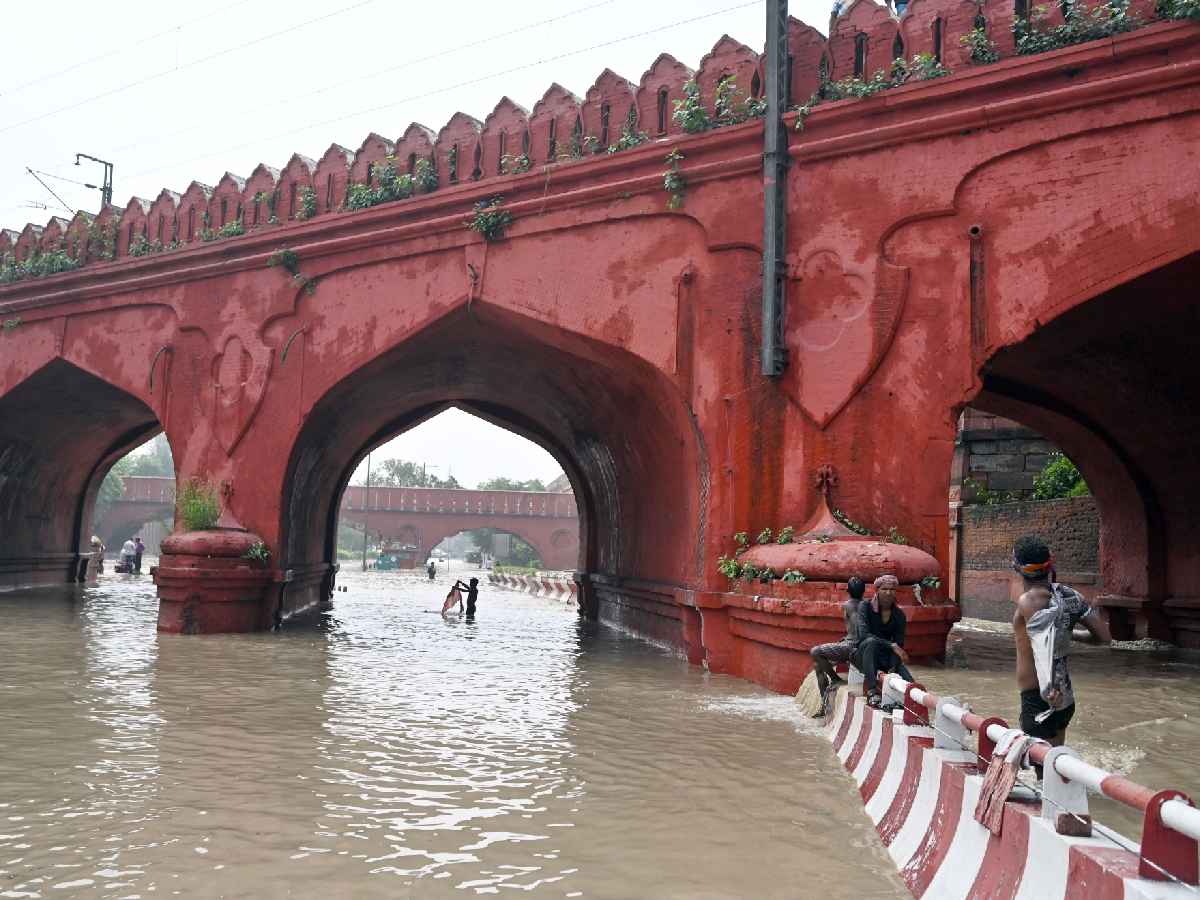
In July 2023, the Yamuna breached all previous flood records, rising to 208.66 metres at the Old Delhi Railway Bridge gauge. The floods displaced thousands, damaged infrastructure, and paralysed life in the capital for weeks. Authorities attributed the disaster to heavy upstream rainfall and high discharge from barrages, but SANDRP pointed to critical lapses in data assessment, barrage management, and urban planning as deeper causes.
Also read: Dark web anonymity fuels hoax threat chaos in Delhi, baffling law enforcement agencies
Historical flood patterns
The Yamuna’s water level at the Old Railway Bridge during the dry season averages around 202 metres. Low-intensity floods— below the warning level of 204.22 m—remain confined to the river’s regime. Medium floods, between 204.22 m and 205.44 m, spread water outside the regime and reach the embankments, while high floods—above 205.44 m—pose significant risks to life and infrastructure, demanding constant monitoring.
Flooding is almost an annual occurrence in Delhi. Notable floods were recorded in 1924, 1947, 1955, 1956, 1967, 1971, 1975, 1976, and 1978. Between 1967 and 1998, major floods struck in 1967, 1971, 1975, 1976, 1978, 1988, 1995, and 1998. Among these, the 1978 floods remain the most catastrophic, peaking at 207.49 metres on September 5-6, with a discharge of 7,175 cumecs (2,53,350 cusecs). Breaches in embankments submerged large areas, including Alipur block and colonies such as Adarsh Nagar, Model Town, and Mukerji Nagar. Property damage was estimated at Rs 10 crores, eighteen lives were lost, and thousands were rendered homeless.
MoJS’s report: A missed opportunity
The MoJS committee’s report, expected to offer insights into the 2023 flood event, has been criticised for being superficial. It acknowledges the extreme water levels but fails to provide credible hydrological data to substantiate its explanations.
According to SANDRP, the MoJS’s committee admitted that the peak discharge of 4.22 lakh cusecs from the Hathnikund barrage during the July 2023 floods was not extraordinary compared to past years. Despite this, water levels in Delhi surpassed all historical records by a wide margin. The committee referred vaguely to “high base flows” and “localised conditions” but offered no empirical evidence to support these claims.
SANDRP calls this a major shortcoming, arguing that without identifying the real causes of the extreme water levels, the committee has failed to formulate an effective flood management strategy. It also noted that the report did not assess river cross-sections or analyse the rising riverbed, which has reduced the Yamuna’s flood carrying capacity.
Barrage mismanagement ignored
The MoJS committee’s failure to examine the role of barrages has drawn sharp criticism. The Yamuna flows through Delhi via three major barrages—Wazirabad, ITO, and Okhla. During the 2023 floods, these barrages acted as obstructions rather than facilitating water flow.
SANDRP’s analysis suggests that delayed gate operations caused water to accumulate upstream, significantly worsening flooding. However, the CWC did not examine real-time operational data or investigate whether gate-opening protocols were properly followed. The report also made no recommendations for structural or operational reforms, raising fears that Delhi may see a repeat of the 2023 disaster.
Encroached floodplains: A disaster in the making
The Yamuna’s natural floodplains, which once acted as buffer zones during peak flows, have been systematically encroached upon over the years. Infrastructure projects, unauthorised constructions, debris dumping, and metro expansions have drastically reduced their capacity to absorb and dissipate floodwaters.
The MoJS committee acknowledged encroachments but failed to assess their extent or quantify their impact. SANDRP stressed that this omission ignores a basic hydrological principle— rivers need space to carry floodwaters safely.
According to SANDRP, the loss of natural floodplain capacity means that even moderate river discharges now translate into urban inundation.
Urban drainage failure: the hidden flood factor
SANDRP has criticised the MoJS committee for focusing solely on riverine causes and ignoring urban drainage failures. Delhi’s stormwater infrastructure is grossly inadequate, unable to handle even moderate rainfall events. Clogged drains, unplanned urbanisation, and concretised surfaces reduce water percolation, causing flash floods.
By treating floods merely as river-induced events, the committee has provided only a partial picture of the capital’s flood vulnerability.
Systemic failures persist
Despite the devastation of 2023, systemic corrections have been minimal. No serious efforts have been made to clear floodplain encroachments, barrage operation protocols remain unchanged, and the city’s stormwater infrastructure continues to crumble under unchecked construction.
With the 2025 monsoon already underway, the risk of another catastrophic flood looms large. According to SANDRP, Delhi’s current disaster preparedness focuses on evacuation and relief rather than prevention—a reactive approach that is “ineffective, disastrous, and unsustainable.”
The way forward
Himanshu Thakkar, Coordinator of SANDRP, has called for a multi pronged strategy to protect Delhi from future floods. He emphasised the need for hydrological transparency and real-time data sharing from barrages, along with independent audits of flood management operations.
“Real-time, transparent sharing of discharge and water-level data must be institutionalised. The use of actual rainfall data from upstream catchments, along with accurate forecasts, must also be ensured. Today, the CWC’s flood forecasting is pathetic and not useful in preparedness. The IMD also needs to provide hourly catchment rainfall and accurate forecasts well in advance,” Thakkar said.
He also called for structural assessments of the Wazirabad, ITO, and Okhla barrages, redesigns to ensure smooth water passage during floods, and revised gate operation protocols based on scientific modelling. All operational information, he said, must be promptly made public.
Thakkar further recommended legally demarcating and restoring the Yamuna floodplains, protecting and desilting water bodies, and implementing rainwater harvesting and groundwater recharge more seriously. “The government, being the largest landlord, must set an example by doing this on all government properties,” he said.
He also called for upgrading stormwater infrastructure, integrating green solutions like permeable pavements, rain gardens, and urban wetlands, and setting up an independent Floodplain Management Authority to monitor and enforce floodplain health.
Also Read: Missing persons in Delhi: Adults at a higher risk than minors
‘A human-engineered disaster’
Environmentalists describe the 2023 floods as a “human engineered disaster.”
Bhim Singh Rawat, Associate Coordinator of SANDRP, said the factors behind the unusual July 2023 flood remain a puzzle and need independent scientific investigation. “Unless questions about the CWC’s failures, the lack of coordination in barrage operations, and the absence of hydrological data in the public domain are credibly answered, corrective measures will remain elusive,” he said.
Rawat questioned why the CWC failed to forecast the floods despite its vast network of stations, why there was poor coordination among the Hathnikund, Wazirabad, ITO, and Okhla barrages, and why hourly flood-discharge data is still not public.
He added that on the ground, “Encroachments on the floodplains, which were a key reason for the 2023 disaster, continue to be a concern. The Yamuna’s flood-carrying capacity has been severely restricted by cross-sectional and infrastructural projects, including three barrages, over 26 bridges, and ongoing road construction.”
Rawat criticised ongoing riverfront beautification projects, saying they have suffered financial losses worth crores while permanently privatising floodplains. “Sedimentation and siltation, which are raising the riverbed and reducing flood carrying capacity, remain unaddressed,” he said.
The Delhi High Court, in a post 2023 hearing, had questioned authorities over delays in clearing encroachments from the floodplains, but compliance has remained lax.