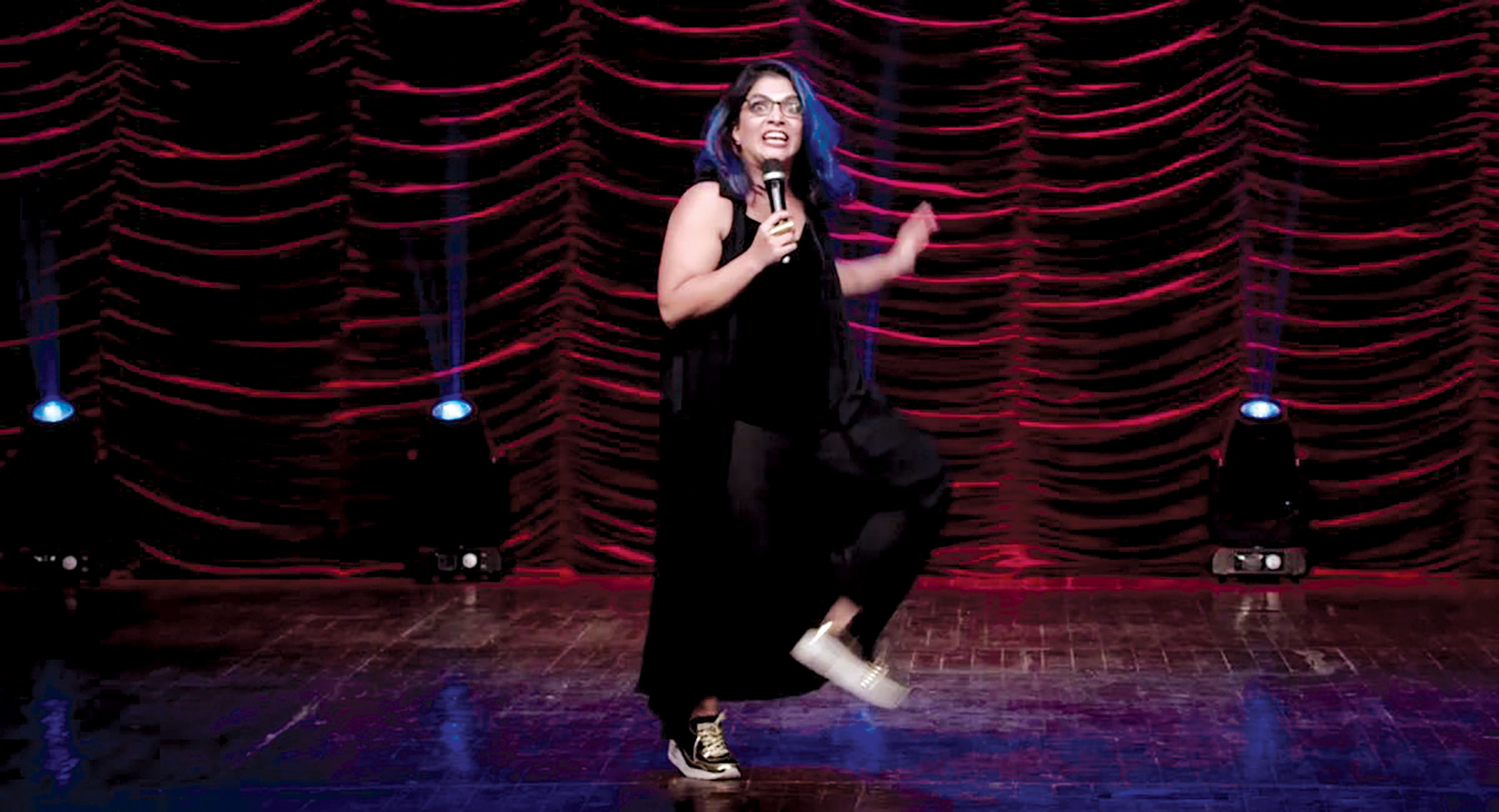
WE ARE living in a time when comedians have more social media following than some film stars. Grover, Zakir Khan and Biswa Kalyan are so much admired that their jokes are part of long- sustaining Internet memes. But when we try to look for women comics in this circle, the picture is not so pretty. One can sense that by looking at various panel discussions on a comedy where only one or two women comedians are invited.
There is a significant difference between male and female comics. Stand-up comedian Neeti Palta, in one of her performances, joked that Indian men don’t like her because she has that smell that keeps them off: Confidence. This joke is outrageous yet funny; it makes some of the male audience uncomfortable, which is often a fallout of comedy.
At open mics organised in various clubs and cafes, amateur male comics often joke about Indian politics, their friends, and their girlfriends. In contrast, female comics taking up open mics often joke about male hypocrisy.
Breaking the stereotype, Vasu Primlani and Daahab Chishti, two of the finest women comics, at a recent event cracked jokes on politics, culture and sex in a stylised manner, challenging the establishment. One of the important features of their comedy was a choice of appropriate imagery–metaphors that are umbrageous yet funny. They forced the audience to think.
Primlani started her performance with a joke about the scarcity of women comics in India. “I am one of the top three women comedians of India…I am actually one of the only top three women comedians of India.” She is an awarded environmentalist and takes up the issue of environment in her comedy with subtlety.
Describing her anti-establishment undertone, she said, “When you question what is happening around you, that’s the process through which you create jokes on these subjects.”
Daahab, on the other hand, cracks jokes on her religion. She made fun of those practices in her religion that are unreasonable. Her jokes have a self-deprecating tone.
The notion that women are not funny has troubled a lot of women comics and they take this issue up in their performances as well. Neeti Palta jokes, “I am funny since childhood and you are saying, women are not funny. You should have told me earlier.” Niveditha Prakasam takes a jibe at her mediocre life after engineering: “I am just trying to fit in.”
Stand-up comedy as a profession now rewards bold, honest, brave comedians who bring home some truths. Comedians like Kaneez Surka, Supriya Joshi, Sonali Thakker, Neetu Bharadwaj, and Urooj Ashfaq and Vasu Primlani are redefining what is it like to be a stand-up comic who speaks about hypocrisies of life under patriarchy.
Netflix is bringing a new show starting 27 March for Ladies Up, stand-up comedy special which features four Indian comics: Kaneez Surka, Niveditha Prakasam, Supriya Joshi and Prashasti Singh. Netflix’s choice of release date is a subject of scrutiny: it could just as well have released it on Women’s Day (8 March).
Comedy is the greatest medium to tell the truth to empower, and women at helm need to tell it earnestly. And they do it that way. Aditi Mittal’s take from sex to politics proves that. Nevertheless, women face challenges to establish themselves against the male macho type comedy that always finds ways to rule the audiences’ mind. Zakir Khan’ ‘sakht launda’ (strict guy) is an example of how male sensibilities overpower the space for comedy.
India is a country where stand-up comedy is an integral part of every Kavi Sammelan (poetry meets) in small towns. But these so-called stages too are patriarchal. Women performers are objectified here. Just one search on YouTube reveals how women performers are treated as a subject of joke at these events. Women taking up comedy is thus a rare thing here.
Outside that limited space women comics in metro cities are creating a space for themselves in a sub-culture that exists in these urban centres, where progressive audiences admire women comics. But still, they face a challenge in terms of popularity when compared to their male counterparts. ■
Delhi inaugurates the 70th National School Games, hosting over 14,000 participants in 14 sports across…
Delhi High Court asked "Doosra" filmmakers to respond to Sourav Ganguly's plea over alleged violation…
Delhi L-G appointed Paralympian Suvarna Raj as State Commissioner for PwDs following her gold win…
DDA is planning Delhi's longest 24-km cycling track along the Yamuna floodplain, linking key eco-projects…
Police detained several anti-SIR protesters heading to the ECI headquarters in Delhi as mass gatherings…
An exhibition that revisits the significance of Indian Modernism through works from earlier and defining…


