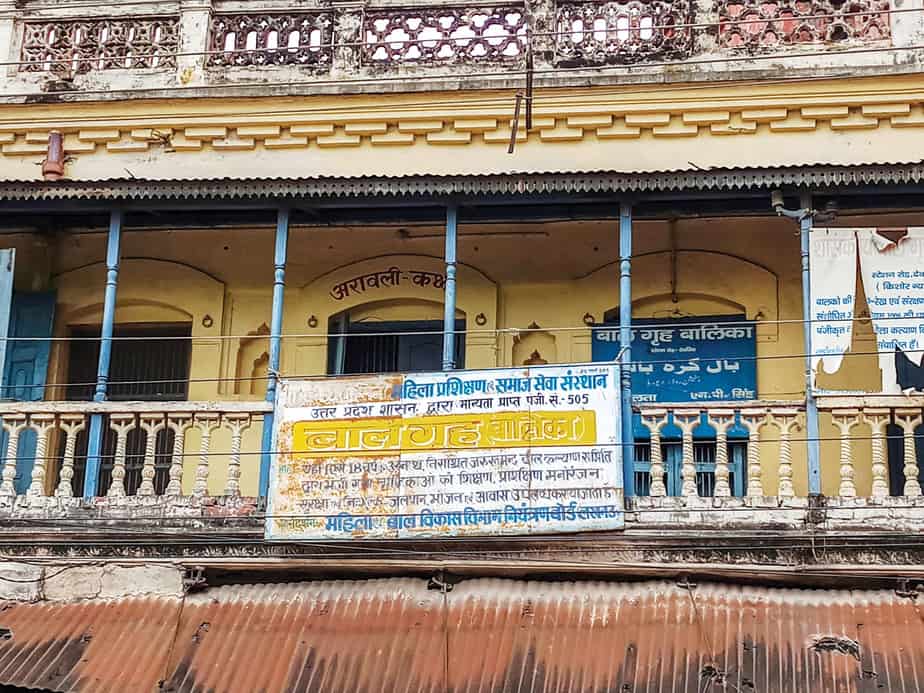
Deoria: A view of the shelter home from where twenty-four girls were rescued after allegation of sexual exploitation of the inmates came to light, prompting the Uttar Pradesh government to swing into a damage control mode by removing the district magistrate and ordering a high-level probe, in Deoria on Monday, Aug 6, 2018. (PTI Photo) (Story no. DEL23)(PTI8_6_2018_000256B)
The recent rescue of 24 girls from a shelter home in Deoria district of Uttar Pradesh amid allegations of a sex racket thriving on its premises has sent shock waves across the state, coming as it does close on the heels of one in Muzaffarpur, Bihar, where minor girls of a shelter home told the police that they used to be stripped and beaten if they refused to submit to sexual demands.
Prima facie, these incidents could take place because of local administrative negligence and a conspiracy of silence According to reports, since 2015, women and child development minister Maneka Gandhi wrote thrice to each one of the more than 700 Lok Sabha and Rajya Sabha MPs, requesting them to “take out some time and visit” such shelters for women and children in their respective constituencies periodically to check the living conditions as well as the level of care being provided to the residents.
To date, not one MP has responded, according to Ms Gandhi. “There is hardly any monitoring by state agencies either. I will not be surprised if more cases like Muzaffarpur and Deoria come out,” she said. Her apprehension came true as ‘Swadhar Grah’ in Hardoi’s Beniganj area had 21 girls registered as inmates. However, when a district administration team inspected the shelter home, only two were found present. Both the girls were “clueless” about 19 other members.
There are 9,000 government-run child care institutions and shelter homes for women and girls across the country. While the Centre provides 60% of the funds for running these institutions, states pay the remaining 40%.
Usually, the state department concerned finds an NGO to run a home. In addition to this, there are shelters funded fully by state governments. The Deoria and Muzaffarpur shelters, for instance, are funded by the Uttar Pradesh and Bihar governments respectively.
The state of child shelter homes in the country merits a comprehensive investigation with shocking details of abuse emerging from an NGO-run facility in Deoria in Uttar Pradesh very recently.
Union Home Minister Rajnath Singh told the Lok Sabha that the shelter home incidents in Bihar and Uttar Pradesh are “sad and shameful” and assured the House that steps would be taken to prevent recurrence of such acts.
“I direct the concerned ministry to issue an advisory to all states so that no such incident is repeated. Running shelter homes can be investigated,” Singh assured the opposition.
“Whatever happened in Bihar and Uttar Pradesh is sad and shameful,” he said. In a quick damage control exercise, the Uttar Pradesh government recommended a CBI inquiry into the Deoria shelter home case, involving possible sexual abuse of the inmates, hours after a girl missing from there was found at an old age home run by the same NGO in Gorakhpur.
Earlier, the UP Women and Child Welfare Minister Rita Bahuguna Joshi admitted there had been laxity at the district level in not shutting down the Deoria shelter even after a closure order last year.
The Deoria case, coming close on the heels of the sexual exploitation and torture of 34 minors at a government supported NGO-run shelter at Muzaffarpur, warrants an immediate review of government policy that outsources the protection of these destitute children to politically connected NGOs.
In the Deoria episode, UP government claims it revoked the license for the NGO to operate a child shelter home and stopped funds a year ago, but is hard pressed to explain where the inmates came from or why they were not repatriated.
Such apathy explains why child predators feel emboldened in India. Parliament has just passed a legislation providing for death penalty for rape of minor girls below the age of 12. But what comfort is such a law when ground level policing and inspection mechanisms remain very poor?
Regular inspections of shelters by district and judicial magistrates must be written into bylaws. When it sends children to these shelters, the state becomes the parent and guardian. The reality, itappears, is that the state is sending these children to a living hell.
That India is not a safe place for women and children is no revelation, but that rampant abuse goes on inside the walls of the very homes meant to protect the hapless is as reprehensible as unpardonable. What is even more abominable is that such incidents are not isolated nor confined to any one state. Haryana, Himachal Pradesh and even Chandigarh; the tale of horror follows the same sickening trail.
Preying on the vulnerable and marginalised deserves the strictest condemnation but no lessons are ever learnt from previous examples. Heads have begun to roll in Bihar and the Yogi Adityanath-led government in UP has ordered the inspection of shelter homes across the state.
But for the innocent who have suffered immeasurably at the hands of merciless perpetrators in the garb of caretakers, the delayed response would bring little succour. Why no action was taken against the Muzaffarpur-based NGO, Sewa Sankalp Evam Vikas Samiti, despite the social welfare report pointing out anomalies way back in 2013, is as inexplicable as the generous funding it continued to receive. Mandatory social audit of shelter homes as recommended by the team of the Tata Institute of Social Sciences, whose report exposed the rot in Muzaffarpur, is the need of the hour.
The Delhi Commission for Women’s decision to go ahead with the same is welcome.
Be it government-funded or privately-run shelter homes, at no cost can these alternative homes for the poor and destitute be allowed to turn into houses of exploitation. If constant vigil backed by foolproof systems is the answer to impeding the recurrence of such incidents, rehabilitation of those rescued has to be the top priority.
In the light of shocking revelations about the shelters for girls, it’s worth recalling Prime Minister Narendra Modi’s call to the nation: Beti Bachao, Beti Padhao. That call seems to have fallen on deaf ears since girls continue to be abused and exploited
by the very people who were trusted with their safety and well-being. There are thousands of such shelter homes across the country whose operations are shady, to say the least. In most cases, the local authorities are hand-in-glove with the shelter home owners. Without their active cooperation, it wouldn’t have been possible for the owners to enjoy immunity from the law for so long.
The state governments must take it upon themselves to do a thorough audit of all such shelter homes and take stringent actions under the POCSO Act.
PTI
Delhi inaugurates the 70th National School Games, hosting over 14,000 participants in 14 sports across…
Delhi High Court asked "Doosra" filmmakers to respond to Sourav Ganguly's plea over alleged violation…
Delhi L-G appointed Paralympian Suvarna Raj as State Commissioner for PwDs following her gold win…
DDA is planning Delhi's longest 24-km cycling track along the Yamuna floodplain, linking key eco-projects…
Police detained several anti-SIR protesters heading to the ECI headquarters in Delhi as mass gatherings…
An exhibition that revisits the significance of Indian Modernism through works from earlier and defining…

