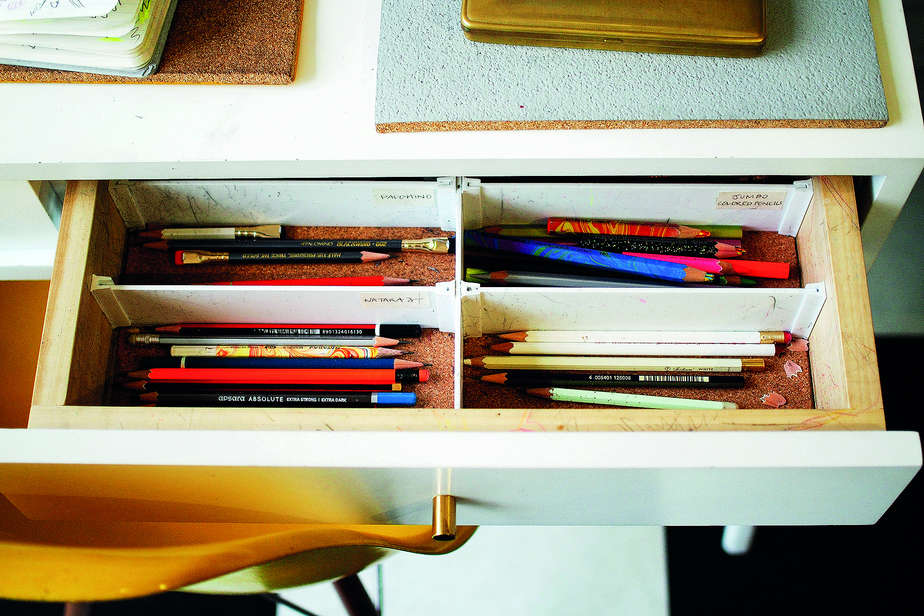
Many creatives have had a special relationship with a pencil, out of the many writing tools available in a stationery shop. Perhaps it is the limitless chances it gives us to correct ourselves. In fact, the availability of an eraser only makes the process of writing more poetic. Pencils continue to be the first tool held by kids. From learning to hold one in a pincer grip, to knowing the right hand to hold it with and start scribbling, the experience is full of happy-sad moments we go through as newbies to eventually join the community of literates, that is, once we start writing.
From using pencils to rectify mistakes to using pencils to iterate an idea and adding details over each iteration is how Mithun, a game developer, sees his relationship with pencils. As kids, it takes us a while before we are allowed to move onto using ink. It creates a space for pencil-making companies to come up with enough fancy variables in the design of a pencil to keep the young ones occupied.
German pencil manufacturers’ productive pencil rivalry has helped a great deal innovation in a pencil’s design. To compensate for the relatively high labour and manufacturing costs companies face within Germany, innovations simply have to be greater. Faber-Castell, one of the world’s largest and oldest manufacturers of pencils, headquartered in Stein, Germany, does business in more than 100 countries, especially developing ones like ours.
Some of history’s most famous inventors, artists, writers and architects were devoted pencil users. Author John Steinbeck was famous for expressing his disinterest in writing until two dozen Blackwing pencils were sharpened and kept at the ready in front of him. Thomas Edison kept a pencil in his vest pocket wherever he went. Frank Lloyd Wright has his own pencil line.
In India, we have had Hindustan Pencils since 1958, manufacturers of Nataraj and Apsara pencils. The Nataraj 621 HB wood-cased pencil with a distinct red-and-black stripe design is the most well-known product by them. Every kid from the 2000s has used it. In 2018, the company also began to manufacture special sharpeners for left-handed people, for the first time in India.
“I remember buying Nataraj pencils for one rupee when I was a child,” says Latika, a Mumbai-based copy writer. “I used to chew them a lot and I wondered how they put the lead inside. I thoroughly enjoyed sharpening the pencil from both ends just for the thrill of it.
It’s a simple invention. A pencil is still made up of a mineral discovered under a fallen tree. It’s the graphite crammed inside a stick, that leaves marks on paper — a genius mechanical device. Let us praise the humble pencil for its simplified writing and easy erasing. A device that creativity around the world reached for when one was close to an ‘Eureka’ moment.
The wave of organic and sustainable products has also changed the design of a pencil. Multiple initiatives in South India have come up with biodegradable pencils made of waste paper. Some also have seeds inside that grow into a plant when sowed and nourished. With over 8 million trees getting cut per year to produce just pencils, a vision like that is a great move by upcoming enterprises in the country to have minimum carbon footprint.
One label from Coimbatore is Plantcil, that uses old newspapers to manufacture around 6,000 pencils a day. Co-founders Divya Shetty and Vishnu Vardhan’s research shows that over 13 million hectares of forest is lost to deforestation, of which 36 per cent is for paper manufacturing and 42 per cent for manufacturing timber-based products that include 18-20 billion pencils. Their effort saves around 10 trees every month.
The future of pencils is imagined with replaceable nibs and shapes of a stick that can write on our computer screens and in the air. Much like the digital stylus available in the market, imitating the experience of a wood-cased pencil.
Sweety, a math teacher at DAV school, Chander Nagar says, “I have mostly seen kids super excited about using a pen when they are promoted to Class 6. But I find it doesn’t take them long to miss pencils and start using one again.” Pencils don’t record mistakes like a pen does.
With the enormous number of options one gets in pencils, a few of us will always want a stick in hand. To play with and to nibble on sometimes. A pencil has lived with us enough to attain functions other than writing. Even while using a computer, a notebook and a pencil never fail to provide extraordinary ease and contentment. Nothing can replace the fun of a graphite scribble.
BNSS caps custody at 24 hours and requires production before a Magistrate; force permitted only…
An SEM court reserved its order on extending the judicial custody of CJP leaders Saurav…
Delhi recorded its first 'poor' air day of the season on Wednesday as AQI hit…
Stage I of GRAP was invoked later this year in Delhi due to govt's preventive…
DDA plans to resume tethered hot air balloon rides at Baanseera park from Nov 14,…
NDMC is consulting RWAs and traders on draft 2026 property tax bye-laws, seeking feedback on…
