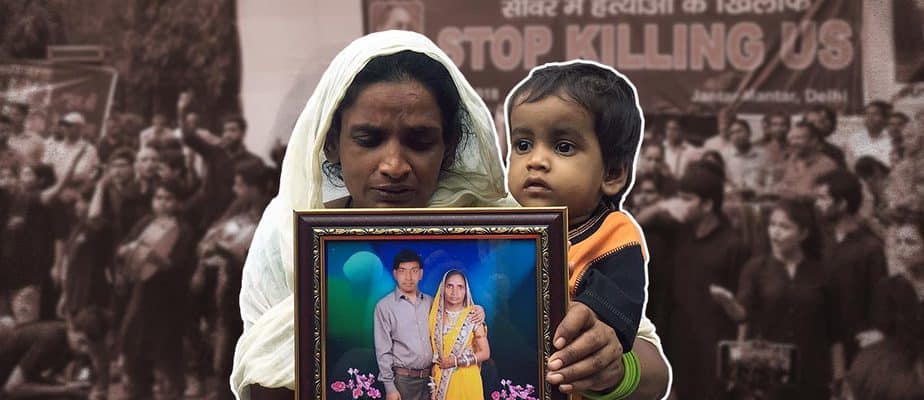
“They offered him Rs 500 and made him enter the sewer,” recalls Suraj Kala. Her 22-year-old son Armaan entered the sewer and never returned. “He was given no safety gear,” she says. A resident of Ludhiana, Suraj Kala along with other families who have lost their loved ones to sewers sat in protest at Jantar Mantar on Tuesday.
Bezwada Wilson’s Safai Karamchari Andolan (SKA) brought these families, sewer workers, activists and politicians together to demand an immediate ban on manual scavenging. Wilson in his address was critical of the Narendra Modi government. He says that while the Bharatiya Janata Party (BJP) central government has invested hundreds of crores on advertisements for its pet project, Swachh Bharat, it has kept aside barely crores for those who die cleaning sewers in urban areas.
The SKA had organised similar protests in 19 states of the country. Wilson says deaths in sewer tanks, or “murders”, are directly related to the malice of caste in India. Wilson tells Newslaundry, “The government is completely in silence about the deaths of manual scavengers. We are documenting the deaths and have been intimating the governments, but no administration is taking any action.” He further added, “To make the PM accountable and to seek answers, we and women who have lost their family members have gathered here.”
On September 9, five died inside a sewage tank in west Delhi’s DLF apartment. Later, it came to be known that all these men were untrained sewage workers and had no safety gears. Barely, five days later 28-year-old Anil died while cleaning a Delhi Jal Board sewer pit in West Delhi. These deaths triggered the protest call given by SKA.
Anil’s partner Rani too attended the protest march. With a photo of her and Anil and a child in her hand, she spoke to reporters, as tears continued to roll down her cheeks. Rani said, “He used to go in wearing only his underwear, and nothing else.” She said she was going to marry Anil the very next Monday, “but he died on Friday.”
Notably, the event was not only attended by affected families and workers but also students and young activists from different Delhi-based universities — including Jawaharlal Nehru University and Delhi University.
According to an Indian Express report, since January 1, 2017, one person has died every five days, on average, while cleaning sewers and septic tanks across the country. Swaraj India chief Yogendra Yadav pointed out that if the actual numbers were put together to show just how many workers have lost their lives while cleaning septic tanks, the nation would hang its head in shame. He encouraged NGOs and other social groups to engage in such a study, so people would begin to take note of the issue.
Pramod Kumar, who works as a contractual worker for the Ludhiana civic body, says: “We risk our life everytime we enter the septic tanks, without safety gears. We are not sure whether we will come out that tank alive or dead.” Kumar risks his life every day for Rs 6,500 a month.
The families who had gathered at the protest sought an answer from PM Modi — when would his government end this social and economic stigma and ensure rehabilitation? The sewer workers also questioned why governments after governments have failed to bring technology to ensure that humans beings aren’t forced to enter the tanks where even insects don’t survive.
www.newslaundry.com
Students marched against Jantar Mantar’s de-notification and demanded the release of detained CJP leaders.
Union Minister Bhupender Yadav and CM Rekha Gupta reviewed pollution control measures and inaugurated air…
The Supreme Court deferred pleas on Delhi protests and metro and train service curbs to…
A plea in the Supreme Court challenges restrictions on protests at Delhi’s Jantar Mantar and…
Delhi recorded an AQI of 138 in the moderate category on Tuesday, with the minimum…
A 29-year-old driver was allegedly beaten to death by nightclub bouncers in Delhi following a…
