‘Bol ki lab azad hai tere,
Bol zaban ab tak teri hai,
(‘Speak Out! Your words are free, Speak up! Your tongue is still your own…’)
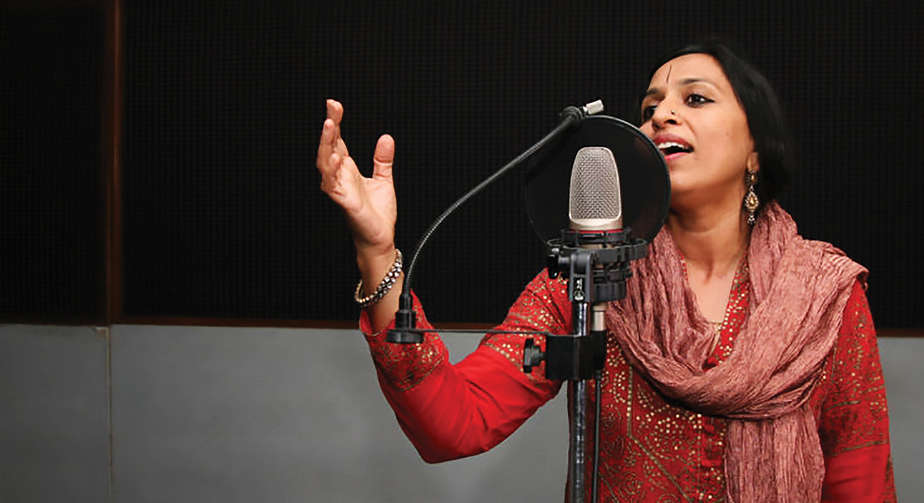
These words, penned down by the legendary poet Ahmed Faiz Ahmed, were given voice by the renowned classical singer Ustad Rashid Khan for the Nawazuddin Siddiqui starrer Manto. The film marks the directorial debut of the critically acclaimed actor Nandita Das, who thought of giving ‘Bol’ a female voice too. This is when Delhi-based classical singer Vidya Shah came on board.
In a conversation with the Patriot, the talented singer talks about her debut, how she feels Bollywood music is at a wonderful phase, about the ongoing #MeToo movement in Bollywood and much more.
When did you set foot in the world of music?
I come from a South Indian family and thus was always interested in music. So, I was taught music from a very early age. I learnt South Indian classical music for many years. And because I live in Delhi, I was always exposed to North Indian music. So, I started learning Hindustani music as well.
How did you get the opportunity to give voice to ‘Bol’ from Manto?
At one point, she (Nandita Das) was looking for a voice for the song ‘Bol’. She has worked with Ustad Rashid Khan on the song and she felt that the song needs a female interpretation. It was my good fortune that Nandita had heard me performing around the time she was looking for a female voice for it and made me a part of it.
Please tell us a little about your experience of collaborating with Sneha Khanwalkar (the composer of ‘Bol’)?
Sneha is a young, dynamic music director. She has done some interesting and new kind of work in the film world. So, it was quite exciting for me to work with her. Sneha had thought of what she wanted to put in the track. So, she gave me very precise directions. And she knew what feel should the music have, which was nice because she instructed me likewise. For example, the first word of the song ‘Bol’ – she gets me to repeat it many times.
Also, the Bollywood industry is very professional now. So, it was an eye-opener to go into their professional studios and work there.
The song was in Urdu. How tough was it to adapt to the diction?
I sing a lot of ghazals and thus I am used to the language. The song — ‘Bol ke lab azad hai tere’ — is a poem by the legendary poet Faiz Ahmed Faiz – which I was familiar with. It was, in fact, a lovely experience for me to be able sing something that I believe in.
Being part of a song with Ustad Rashid Khan, how was the experience like?
I have huge respect for Rashid Khan’s work – be it his singing or understanding of music. So, for me it was an honour to be a part of the same track with him.
You have authored ‘Jalsa’ – which captures Indian women’s journey from salon to studio. What do you feel about the contributions of women singers towards Indian music?
Women have always been an important part of Indian music. There was a time when they were only seen as community of musicians who were meant to entertain their patrons. So, ‘Jalsa’ captures the phase of transition of women to the recording studios. It also portrays and acknowledges the contributions of some women who made this transition possible.
Subsequently, we always had great women singers — from MS Subbalaxmi to Lata Mangeshkar — both of whom had been awarded Bharat Ratna for their contributions to Indian music. So, I think ‘Jalsa’ was in a sense to highlight and acknowledge the beginning of how technology came into the listening of music and how women contributed to that experience.
What is your take on today’s Bollywood music scenario in India?
I think some excellent music is coming out of Bollywood. There are some fantastic voices. We have some really good singers and some very intelligent music directors like Vishal-Shekhar, Salim-Sulaiman, Amit Trivedi – they all are doing some amazing work. It is definitely a lot more entertaining and has a lot of variety than before.
I am also a part of a film music award jury. So, every year I see that the quality of songs is changing, there are many experiments with music and there is a lot more informed composing. Thus, it is quite exciting to see that we are at a time when there is so much interesting and intelligent music. Also, there is a lot of junk — but that is also a part of the entertainment industry, I suppose.
What is your take on the ongoing #MeToo movement in India?
I think any movement that eventually leads to creating a more empowered community is definitely worth its while. And it is also an effort which will create a less oppressive scenario where creativity will score over other things — be it in any field. Ideally, in a situation like this, creativity should score over other ways which are unfair and inappropriate. So, if #MeToo is about empowering women, if it is about social justice, if it is about how men and women should have equal opportunities, then it is going to make a lot of sense.
Would you like to share with us your upcoming projects?
There are a couple of projects I am considering – but will not be able to divulge too much about them at this point. Also, I have a concert in Delhi on October 23 – which is a part of a beautiful series called ‘Music Under the Banyan Tree’ and is going to be titled ‘Abhi Toh Mein Jawan Hun.’
Delhi Police remove ~300 social media posts and seek block on misleading content to curb…
Abhijeet Dipke slams Jantar Mantar denotification, warning "poora desh Jantar Mantar banega" and accusing PM…
Delhi traffic police warn of major diversions and delays on Monday as opposition plans Supreme…
Fire broke out near Yamuna Vihar market in northeast Delhi, fire department is investigating the…
Delhi Police denotifies Jantar Mantar, naming Ramlila Maidan, Burari Ground, and CBD Ground as new…
Delhi HC gives police till Oct 13 to reply to IYC plea for Jantar Mantar…



