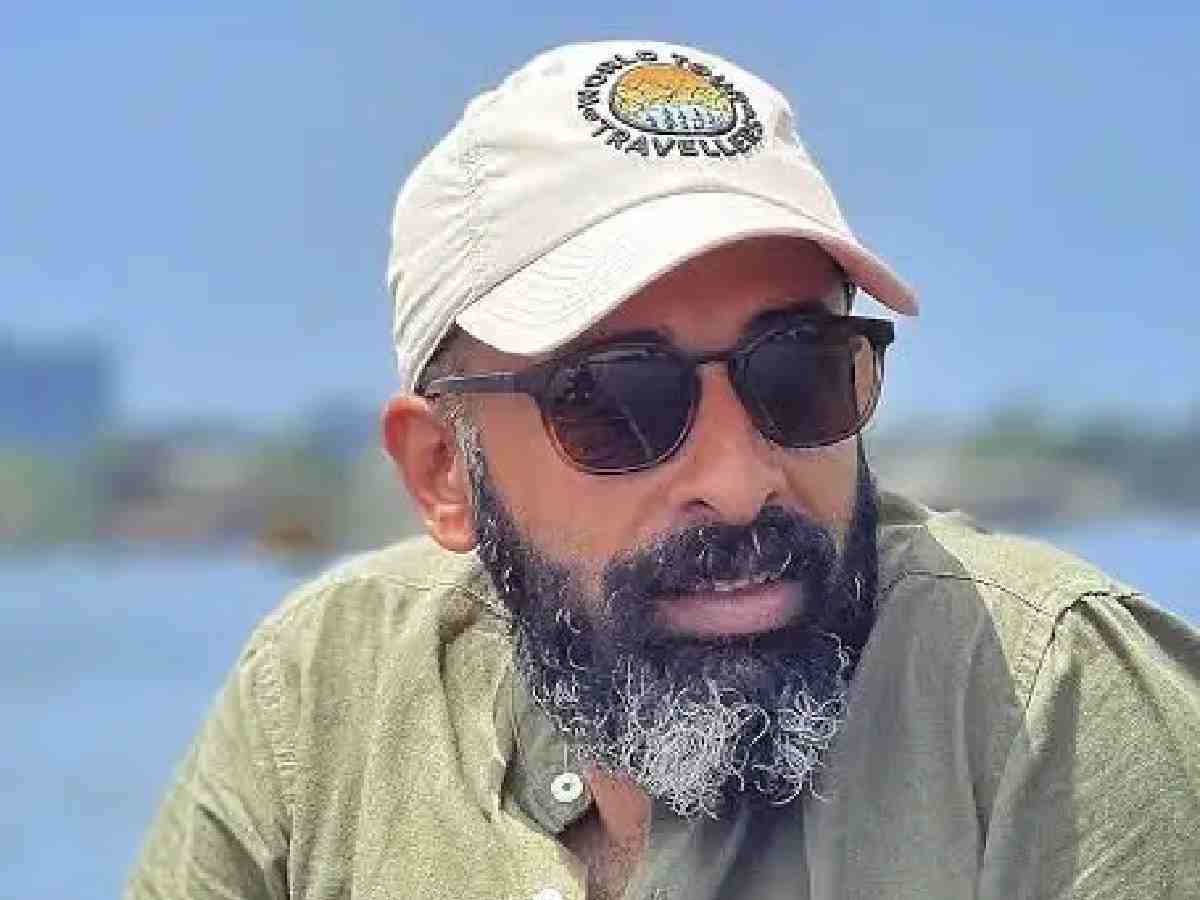
Palash Vaswani
For Palash Vaswani, filmmaking was never a calculated career move. If anything, it emerged from a series of detours that included engineering, advertising and YouTube before settling into what now feels inevitable. Best known as the director of Gullak Seasons two and three, both Filmfare OTT Award winners for Best Series, Vaswani has carved a space for himself as a storyteller who privileges emotional truth over spectacle, and observation over excess.
An alumnus of the Indian Institute of Technology Bombay and former Executive Creative Director at The Viral Fever (TVF), Vaswani is currently directing Bada Naam Karenge, a SonyLIV series that revisits the emotional grammar of 1990s Hindi cinema for contemporary audiences. Across his work, from Cheesecake and Awkward Conversations with Parents to Gullak, one thing remains constant: a belief that stories rooted in lived experience will always find their audience.
An accidental beginning
Vaswani’s professional life began far from film sets. “I was an engineer,” he says plainly. He worked at Infosys before being fired, a moment that, in retrospect, proved decisive. “When you’re pushed out of the rat race, you realise maybe this is not what you want to do.”
His love for cinema, however, predated any formal training. As a child, he made home movies, even completing a one-hour film while still in school. “I didn’t know I wanted to be a director,” he admits. “I just knew I enjoyed making movies.”
That instinct eventually led him to design school at IIT Bombay, where he made short films that caught the attention of an advertising creative director. Vaswani entered advertising as a copywriter at Lowe Lintas, seeing it as a possible doorway into filmmaking. “I thought this would give me an entry,” he recalls. What followed was a long phase of self-discovery that included writing, shooting, editing and sound before he understood that direction was where all his interests converged.
TVF and the OTT turn
Vaswani joined TVF in 2013, at a time when both the platform and India’s digital content ecosystem were still finding their feet. “My journey in OTT began with the best,” he says.
While he was associated with Permanent Roommates as a creative director, his first major directorial success came with Cheesecake on MX Player. Smaller shows like Awkward Conversations with Parents and Zeroes followed, each sharpening his understanding of audience behaviour, especially during TVF’s YouTube-driven phase.
“You’d get instant feedback,” he says. “You’d know immediately whether an emotion or a joke worked.” That constant conversation with viewers, he believes, shaped his instincts as a commercial storyteller more than any formal training.
Story over stardom
Vaswani is unequivocal about what draws him to a project. “I’ve been fortunate to work with people who understand that story is more important than stars,” he says. Whether at TVF, SonyLIV or with Rajshri Films on Bada Naam Karenge, he has gravitated towards collaborators who share that belief.
For Bada Naam Karenge, Rajshri’s first web series, the intent was clear: revisit the emotional world of films like Maine Pyar Kiya, Hum Aapke Hain Koun..!, and Dilwale Dulhania Le Jayenge without nostalgia as a crutch. “We wanted to make a love story where family is as important as romance,” he explains. The idea was to create a show that could be watched across generations.
Casting newcomers was a conscious decision. “I wanted innocence,” he says. “No preconceived notions for the audience.” That Rajshri backed this conviction, even for a large-scale release, left a deep impression on him.
The Gullak philosophy
If Bada Naam Karenge reflects Vaswani’s affection for classic romance, Gullak distils his core philosophy as a filmmaker. “We made Gullak with a pure heart,” he says. The show’s nostalgia may appeal instinctively to millennials, but its emotional core is universal. It explores family tensions, financial struggles and unspoken relationships between parents and children.
He cites the Season two climax, the family photograph scene, as an example of his approach. “In films, conflicts are resolved through long monologues,” he says. “That doesn’t happen in real life.” Instead, Gullak relies on gesture and silence. A father pulls his son closer, both break down without a word. “That touch solves everything,” he says. “Especially for men, who don’t know how to express themselves.”
Subtlety, for Vaswani, is not a limitation but a choice. “I’m more interested in exploring quiet emotions,” he says, rather than crafting larger-than-life drama.
Small towns, lived truths
Much of Bada Naam Karenge draws from Vaswani’s own background. Born in Gwalior and raised in Raipur, he is acutely aware of how small-town realities are often flattened in mainstream cinema. “There’s a lived-in truth that city filmmakers sometimes miss,” he says.
From community dynamics to class distinctions, his intent was to portray wealth and conservatism as he has seen them. He describes them as restrained, private and deeply rooted in social codes. “India is a big country,” he says. “There is no single idea of ‘rich’ or ‘traditional’.”
Conviction as craft
Asked how he balances nostalgia with contemporary sensibilities, Vaswani dismisses formulas. “There is no shortcut to storytelling,” he says. Adding violence, sex or trend-driven elements, he believes, cannot compensate for lack of clarity. “If you don’t know what you want to say, there will always be a problem.”
What matters instead is conviction. He speaks of giving 100 per cent to the story, trusting lived experience and staying honest to the emotion at its centre. “People have the remote in their hands,” he says. “If the story doesn’t work, they will switch it off.”
Looking ahead
Having worked closely with veterans like Suresh Menon, whom he describes as a “masterclass”, Vaswani remains grounded about success. OTT, he believes, has reinforced one truth: stars may draw attention, but stories sustain it.
As platforms expand their demographic reach, he sees family-oriented, emotionally rooted narratives finding renewed relevance. “Gullak was discovered first by young people,” he recalls. “They then watched it with their parents. That’s how it grew.”
For aspiring filmmakers navigating YouTube, OTT and beyond, Vaswani’s advice is implicit in his own journey. Trust your voice, stay close to what you know, and let the story lead. Everything else, he suggests, follows quietly and in its own time.
Coforge opened its first library in Noida in February 2024; it now claims a combined…
Of the 237 spa centres across 10 zones with valid MCD licences, the South East…
CTI chairman Brijesh Goyal said the Rahul Gandhi rally could affect wholesale and retail markets…
Established to mark the university’s 25 years, Jubilee Hall has witnessed generations of student life.…
Delhi inaugurates the 70th National School Games, hosting over 14,000 participants in 14 sports across…
Delhi High Court asked "Doosra" filmmakers to respond to Sourav Ganguly's plea over alleged violation…
