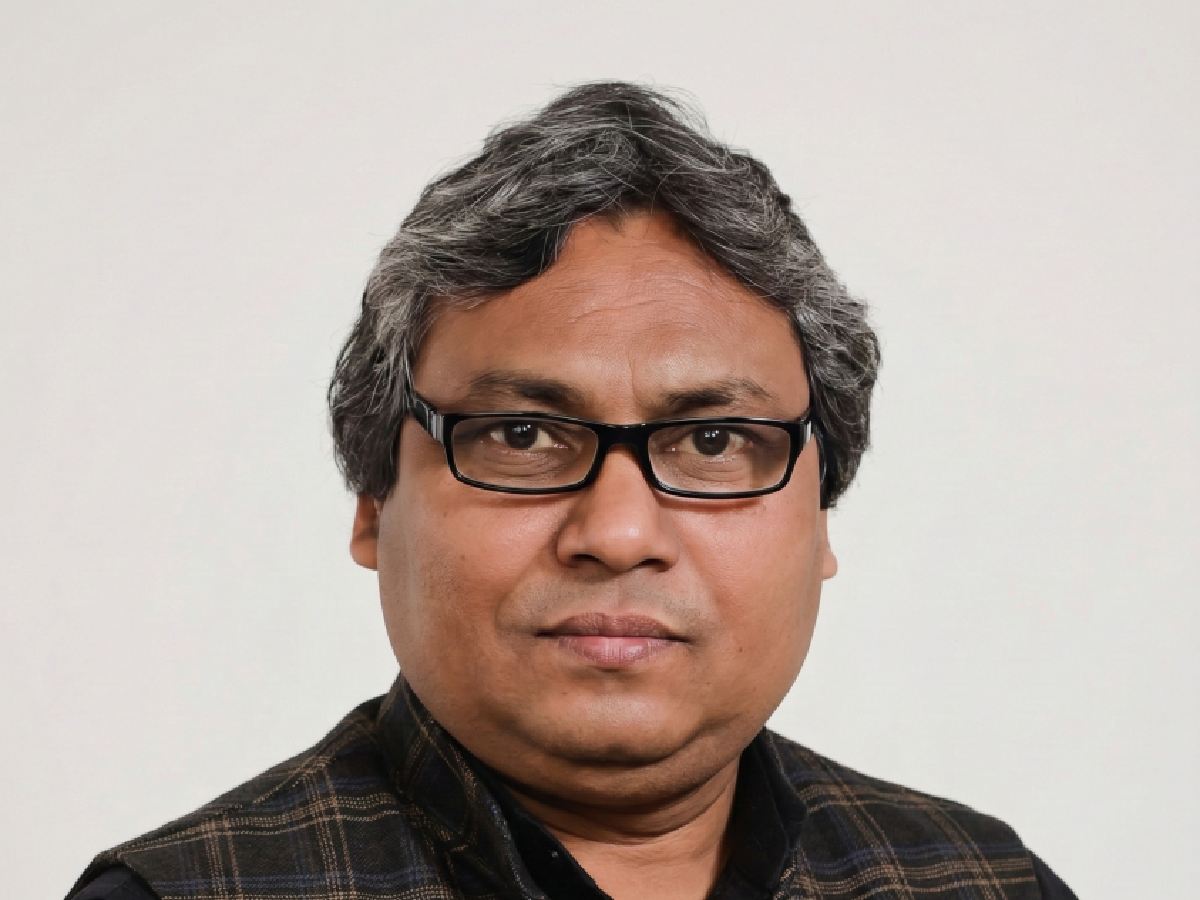
Shakeel Azmi, a noted Urdu poet and Bollywood lyricist, traces his creative journey not to geography or cultural centres, but to deeply personal experiences that shaped his emotional world. Born in Azamgarh, Azmi resists the idea that a place alone can produce a poet, instead emphasising the role of individual sensitivity and lived realities.
“Literature is not a factory… a poet is born, not made,” he said, underlining his belief that poetry cannot be manufactured through environment alone.
Even as he continues to engage with literary platforms, Azmi remains modest about recognition. Reflecting on his recent invitation to the Shankar–Shad Mushaira, he said, “This is the first time I have been invited to this Mushaira. I don’t usually reach out for such invitations, and while this Mushaira has been celebrated for decades, I’m delighted to finally be a part of it. I’m truly looking forward to the experience.” The Shankar–Shad Mushaira is scheduled to be held on April 4 at Modern School, Barakhamba.
Inner landscapes
For Azmi, poetry is less about external influence and more about internal turbulence. His early life was marked by profound personal loss and emotional displacement, which became the foundation of his creative voice.
“The first incident is that my mother died when I was very young… I don’t even remember her face,” he recalled. “Then there was a failed love… and I did not live with my father. My upbringing happened at my grandmother’s house.”
These experiences created what he describes as a deep sense of deprivation.
“You desire something, you want something, and you don’t get it—that is deprivation,” he explained. “All these things… created an environment inside me where, at a certain age, a poet was born—broken from within.”
That past, he says, continues to fuel his writing even today. “What keeps me motivated to write after decades in both literature and cinema? The past—especially the wounds it has left behind. Some wounds heal with time, but those inflicted by people close to you often remain. A failed love, the bitter experiences of childhood—these stay with you. It is these lingering memories, these echoes of the past, that continue to drive me to write even after all these years.”
He insists that such emotional intensity is central to poetry.
“A poet is the most sensitive person in the world… whatever sorrow and emotions he carries, that is what becomes poetry,” he said.
The making of a poet
Azmi began writing in the mid-1980s during his time in Baroda, Gujarat, where his poetic instincts took shape. Inspired by stalwarts like Kaifi Azmi, he aspired to create a space for himself across literature, stage, and cinema.
“It was my desire to write for films as well… the way Kaifi Azmi sahab worked in literature, on stage and in films, I also wanted to do something like that,” he said.
He fondly recalls a time when poets like Sahir Ludhianvi, Shakeel Badayuni, Majrooh Sultanpuri and others seamlessly moved between poetry, stage performances, and cinema.
“That was a golden era… today it has become very rare,” he added.
A journey in films
Over the years, Azmi has carved a space for himself in Bollywood as a lyricist, contributing to films across genres—from romantic dramas to socially conscious cinema. His work includes films like Article 15, Mulk, Thappad, and Bheed, where his lyrics complement layered narratives.
Reflecting on songwriting, Azmi highlights the discipline it demands.
“If I give you a tune, you can write on it… but how good or bad it is, that is the real question,” he said. “Today, anyone can write a song if they understand music.”
At the same time, he points out that songwriting often operates within constraints, unlike independent poetry.
“There is a hook line… something that catches people immediately. But why it is written, how it reaches like poetry—that is often missing,” he noted.
Writing for socially conscious cinema
Azmi acknowledges that the thematic depth of a film directly influences his writing. For him, lyrics must align honestly with the story.
“If you are not honest to the story, you are not doing justice to it,” he said. “The impact of the film and the impact of the song should be equal.”
Using a simple analogy, he explains the balance required in songwriting: “The size of your body decides the size of your clothes… otherwise it becomes a joke.”
He emphasises that a sensitive director and a strong script are crucial for meaningful lyrical expression.
“The director makes the story his own… and only then can everything, including songs, reach that level,” he said.
A critique of modern songwriting
Azmi offers a sharp critique of contemporary Bollywood lyrics, arguing that the absence of poets in the industry has diluted the quality of songs.
“The people writing songs today are not basically poets… they just have an understanding of music and are fitting words into it,” he said.
He contrasts this with earlier generations of lyricists who emerged from literary traditions.
“All the songwriters of that time were original poets… they came from literature, their books were published,” he said.
For Azmi, this disconnect explains why modern songs often lack depth.
“People say songs don’t have that feeling anymore… that is because the songwriters are not poets,” he remarked. “Music cannot run without poetry.”
Poetry in the digital age
Azmi also reflects on how Urdu poetry is evolving in the age of social media, where access and visibility have dramatically increased—but not always with depth.
“How do I see Urdu poetry adapting to younger audiences and digital platforms? Social media certainly allows poets to share their work instantly, but it doesn’t pass through the discerning eyes of an experienced editor. There is no real gatekeeping—so while one may receive immediate appreciation, it lacks the validation that comes from an established authority,” he said.
Using a metaphor, he added, “When a mango cutting is planted, it can bear flowers and fruit within just a couple of years. But a wise farmer does not harvest it immediately. Instead, he allows the plant to grow and mature, so that over time it becomes far more productive.
“In the same way, social media fame often prevents poets from growing organically. It offers instant recognition, but that kind of success is rarely lasting.”
Between literature and cinema
Azmi also reflects on the technical differences between poetry and film writing, particularly the demands of storytelling.
“A short story cannot become a film… you need many characters, a structure, a technique,” he explained. “Screenplay writing uses more of the brain than the heart.”
Yet, he insists that poetry remains the foundation of meaningful expression—even in cinema.
“Poetry is a great power… people can listen to poetry for hours,” he said.
An enduring voice
Through his journey—from personal grief to poetic expression and cinematic storytelling—Shakeel Azmi remains rooted in the belief that poetry is born from within. His work continues to bridge literature and film, even as he reflects on the widening gap between the two.
“A poet is born from his own sorrow, his own pain, his own emotions,” he said. “That is where poetry comes from.”
Over 130 volunteers, doctors and lawyers mobilised legal, medical and mental health aid for CJP…
Delhi Police released a video claiming Dipke was informed of his grandmother’s death in custody…
MCD acted against 1,046 properties over illegal construction and unsafe buildings in Delhi between September…
AAP accused Delhi Police of using force against protesters and vowed to continue the CEC…
Saffron-clad groups allegedly attacked Delhi protesters, with Hindu Raksha Dal chief claiming responsibility for the…
Delhi Police issued fresh notices to CJP leaders in a case involving allegedly morphed objectionable…
