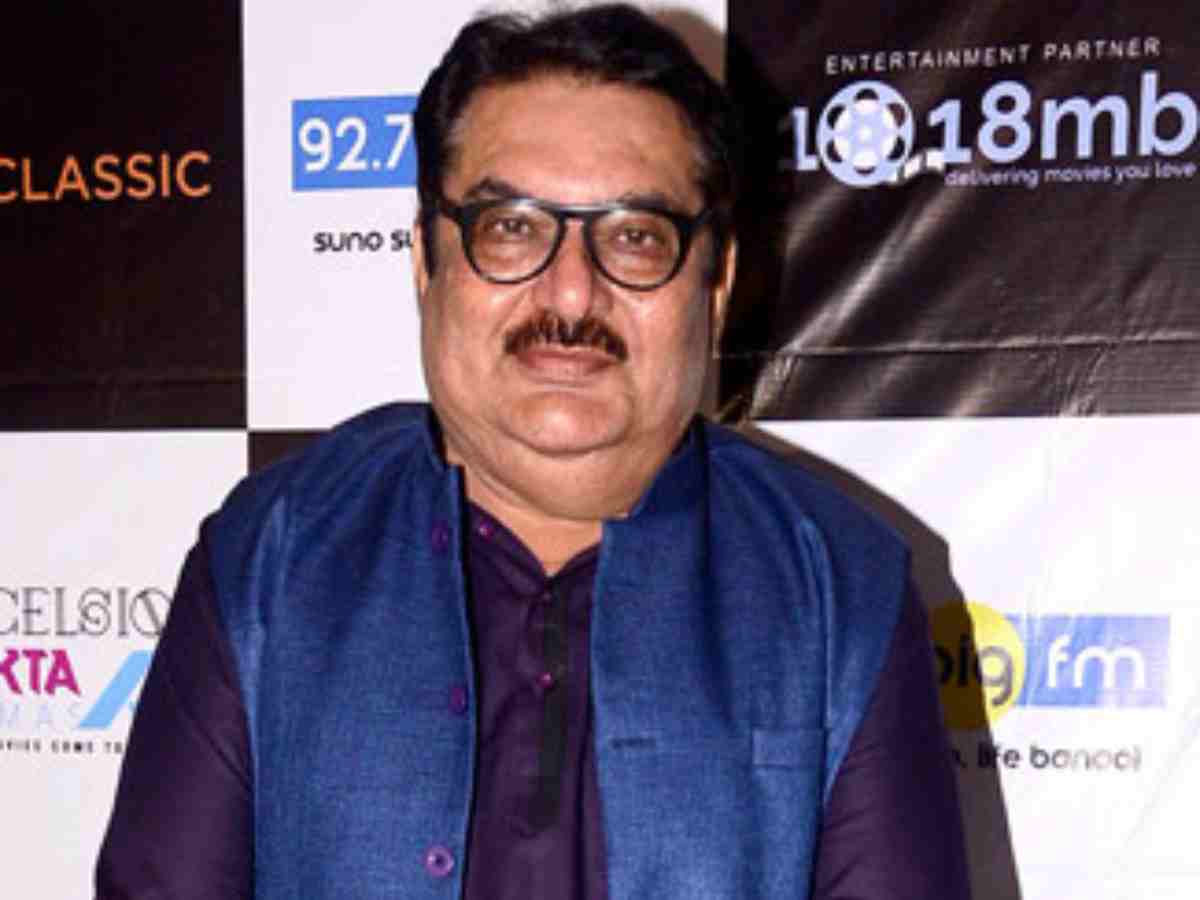
Raza Murad
For more than half a century, Raza Murad has been a commanding presence on Indian screens — cinema, television and now streaming. Born in 1950 into a family rooted in film, Murad has appeared in over 580 released films across 19 languages and remains one of Hindi cinema’s most recognisable voices and screen presences. Even at 75, he says he approaches every day on a film set with the excitement of a newcomer. “There is excitement every day… the day the excitement ends, then you stop there as an actor.”
Legacy, Early Influences and FTII
Murad traces his beginnings to his father, Hamid Ali Murad. “My father is an actor. In 1943, his first film was Najma, by Mehboob Khan. He came to become a writer, but Mehboob Khan made him an actor,” he says, remembering someone who “was very handsome… fair, red and white, with green eyes… he looked exactly like an Englishman.”
Born in Rampur, Uttar Pradesh, Murad’s formal training began at the Film and Television Institute of India (FTII) in Pune. He recalls his father’s advice: “My father told me that there was no acting institute in his time. But if there is one in Pune, where acting is taught, then why don’t you take advantage of it?” He enrolled in 1969, graduated in 1971 and entered the profession at 20. “In 1971, I got out of there, and at the age of 20, I became a professional actor… it has been 55 years since I started working in films.” About FTII’s impact, he is clear: “What are the details of acting? What is natural acting? How is the character built? What is spontaneity? All that is taught to you there.”
Early Roles and the Raj Kapoor Turning Point
In the 1970s, Murad was often cast as a sympathetic brother or supportive figure. But this phase changed dramatically when Raj Kapoor saw him in Namak Haraam (1973). “Shehar becomes Raj Kapoor… he had seen my film Namak Haraam. At 3 o’clock in the night, he called his production manager and said, ‘In the film Namak Haraam, the one who has played the role of a poet… I want him.’”
Murad says he understood immediately that this was transformative. “I felt that a turning point is coming in my life. The biggest showman of Asia is taking me as a villain… this is a very good opportunity to shift from character acting to villainous roles.” And the shift held. “After Ram Teri Ganga Maili, I was established as a villain.”
Craft, Work Ethic and Collaborations
Despite hundreds of films, Murad insists acting never becomes routine. “When you leave the house to go to the set, you don’t know what you are going to do today… every day feels like the first day.” The desire to explore, he says, defines his approach: “We will do something new.” Among his many performances, one stands apart. “My favourite role is that of the film Heena. I played Pakistani police inspector Shahbaz Khan.”
He has worked with iconic stars, including Amitabh Bachchan, and with meticulous directors such as Sanjay Leela Bhansali. “He is a perfectionist… until he is satisfied, he keeps taking shots. He is a very hard taskmaster. Working with him is a very big challenge.” For Murad, the joy of doing the work remains paramount. “After doing good work, the satisfaction is not in wealth or fame. The happiness of doing a good job—there is nothing like it.”
The Villain’s Evolution and a Pan-Indian Career
Murad has seen the screen villain change radically over the decades. “Before, the villain was completely black, and the hero was totally white. Today the villain has become greyish.” The impact, he believes, has diminished. “When Pran Sahab or Amrish Puri or Prem Chopra came on screen, people used to shudder. Today the villain has been sidelined… made a common character.” And for him, the essence of a strong antagonist remains simple: “Memorable villain, powerful villain is the one who also does a lot of dishonesty.”
His range extends across industries. “I have worked in 19 different languages… there has been a lot of change, even in the international market. A new generation has come… they take risks and make films beyond the ordinary.” Technology, too, has reshaped filmmaking. “Today, due to technique, you can create 5,000 junior actors… through VFX.”
With OTT projects, he finds himself working frequently in the NCR. “We do shooting in Delhi, Gurgaon, Ghaziabad, Noida… this is a series that has started.” He remembers earlier shoots with equal fondness, especially New Delhi with Jeetendra. “We did the whole shooting in Delhi… we never had any problem with the crowd. Delhi’s hospitality and food… we have very good memories.”
Relationships, Reflection and the Road Ahead
Murad speaks warmly of Dharmendra, with whom he acted in 26 films. “That person lived a full life… wealth, honour, fame, love. Everything was provided to him by God because he was a very good person.” He adds, “He never hurt anyone… and he worked for 65 years. Such honour, such love — no one gets it.”
On satisfaction and regrets, he is content. “I have a lot of satisfaction in my nature. I am happy with what Allah has given me.” With another collaboration with Sanjay Leela Bhansali ahead, Murad shows no signs of slowing down. His discipline and passion continue to drive him, grounded in the same feeling that brought him to FTII more than fifty years ago — the excitement that, in his own words, must never end.
MCD rolled out 12 multi-purpose anti-smog vehicles to suppress dust, wash roads, and tackle rising…
NSUI staged a dharna outside CP police station, alleging Delhi Police assaulted and detained women…
Delhi HC will hear a PIL on Oct 16 seeking to allow peaceful protests at…
DU has approved a ₹5,889 crore plan to build and reconstruct hostels, creating residential accommodation…
Delhi LG said the capital’s development priorities are interconnected, stressing that PPPs must be chosen…
Delhi HC sought the Centre's stand on pleas to regulate protests, with traders and lawyers…
