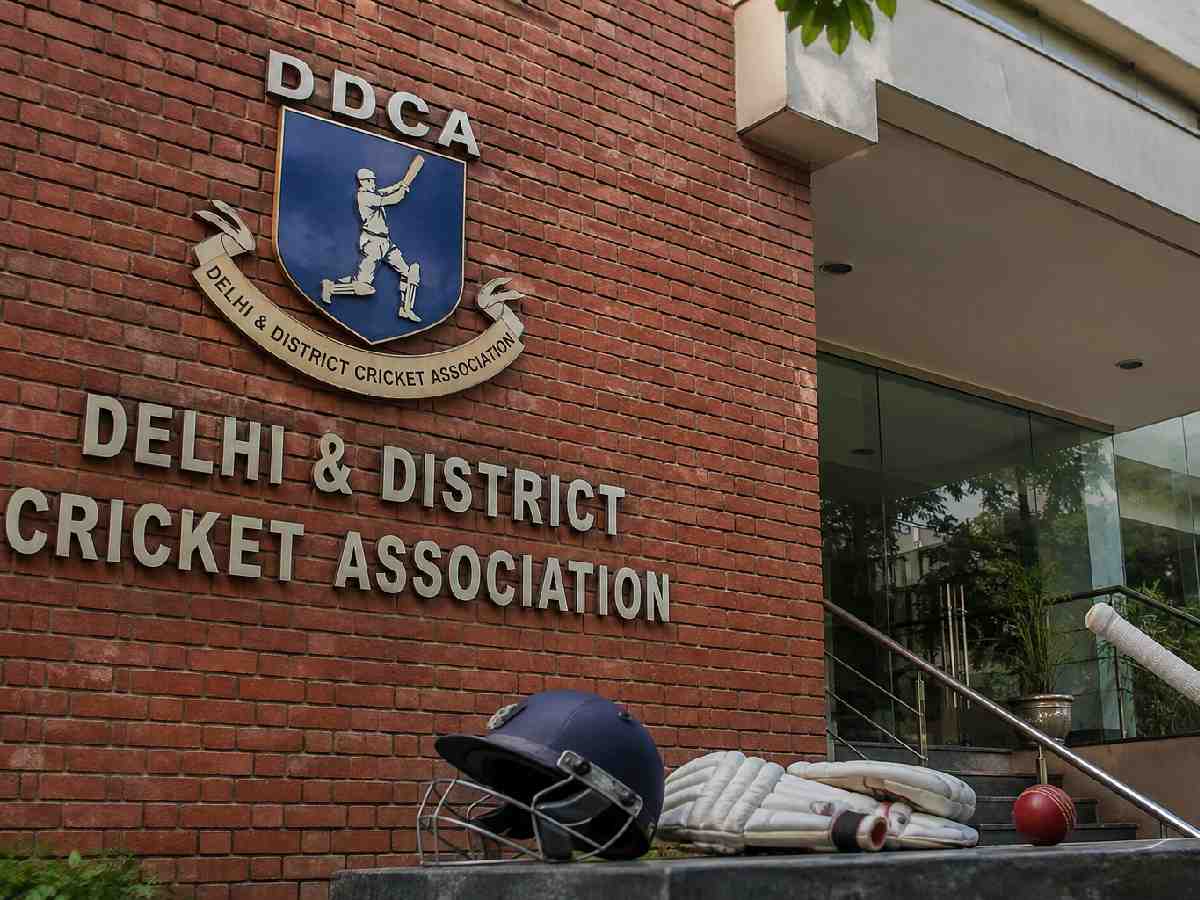
Delhi and Districts Cricket Association (DDCA)
The slightest indication of lightning or thunder during a match in the 2026-27 domestic cricket season will be enough to suspend play immediately. Players, spectators and officials operating around the ground will be taken to designated safe locations, with play resuming at least 30 minutes after the last lightning flash or thunderclap has been seen or heard. This playing condition has been added for domestic matches for the first time and is among an extraordinary 109 changes made for the season, which got underway with the Duleep Trophy on August 23.
Usually, both on-field umpires must agree before play is suspended in different situations during a match. But according to the new “Lightning Guidelines for BCCI Domestic Matches,” if even one of the two on-field umpires feels there is an imminent threat of lightning or thunder, they may suspend play immediately.
Safety first
A copy of the new playing conditions, finalised after a combined workshop of umpires and match referees in Ahmedabad from August 10-19, is with Patriot. The Board of Control for Cricket in India (BCCI) has explained in detail the steps to be taken under the Ground, Weather, and Light (GWL) principles when there is a threat of a lightning strike during various men’s and women’s tournaments.
“The umpires must err on the side of caution and must prioritise the safety of those within the ground over and above the maximisation of play, irrespective of the state of the match,” reads the new rule. “If one umpire feels that the GWL situation is unsafe due to the threat of lightning, play should be suspended. This deviates from the standard GWL protocol —normally both umpires must agree to suspend play.”
An umpire said there had been no instance of a lightning threat during the previous domestic season that might have prompted the BCCI to introduce the new safety measure.
The BCCI has outlined a protocol for umpires and match referees when the threat of lightning, “whether actual or perceived,” is imminent. According to the new rule, they should agree on a course of action after taking into account all relevant factors, including the globally accepted 30/30 safety guidelines for lightning and thunderstorms.
“If the on-field umpires agree that the lightning threat is imminent, then they should immediately direct the players to leave the field of play in a safe and orderly manner with the umpires and relocate to a secure and safe location as designated by the host [cricket] association,” says the playing condition.
“When the match has been suspended because of the threat of lightning, the stadium announcer should announce the locations of the designated safe zones for the spectators and officials operating around the ground. This information should also be placed on the electronic board and the big replay screen for a short period of time. It shall be the obligation of the Match Manager to communicate with the stadium announcer in this regard,” it says.
The return to play
The new playing condition could pose practical challenges for some state cricket associations — not due to lack of funds, but their lackadaisical attitude. For example, the Delhi and District Cricket Association’s (DDCA) Arun Jaitley Stadium does not have a public address system or electronic board; these are put in place only for international and IPL matches. Nor are there any known designated safe zones for players, match officials and spectators at the stadium.
To resume play, the umpires must agree that the lightning threat has passed and that it is safe to restart the game. While deciding whether to suspend or resume play, the on-field umpires must also consult the match referee.
The decisions must be taken in accordance with the widely accepted 30/30 guidelines. “Play should be suspended, and shelter immediately sought when there is 30 seconds or less between the flash of lightning and the associated thunder clap,” says the new rule.
“It is generally safe to return to the field of play a minimum of 30 minutes after the final flash of lightning or clap of thunder has been seen or heard. It might be possible to resume play earlier than 30 minutes but only if it is clear and agreed by the umpires that the storm has moved on and there is no threat of lightning. For clarity, the final decision remains in the hands of the umpires and BCCI match referee.”
This playing condition applies to all men’s, women’s and junior tournaments conducted by the BCCI.
Penalty runs after the result
The BCCI has also made several other changes to the playing conditions, some specific to multi-day or limited-overs matches and others applicable only to women’s cricket.
One amendment relates to the award of penalty runs for transgressions by players, aligning the playing conditions with the Marylebone Cricket Club’s (MCC) 2026 edition of the Laws of Cricket. Under the MCC rules, umpires can award penalty runs even after a result has been achieved in a match.
“Penalty runs shall be awarded in each case where these playing conditions require the award, up until the umpires leave the field at the end of the match, even if a result has already been achieved. Note that if the award of penalty runs means that a result has no longer been achieved, the match continues,” reads the rule.
The amendment clarifies that offences committed after the winning hit can still result in penalties that alter the result. If the award of penalty runs means that a result is no longer achieved, play should continue, if possible. Umpires must also award penalty runs in cases involving multiple offences.
Tackling slow over-rates
Slow over-rates have been a constant issue in domestic as well as international cricket. Captains are responsible for ensuring that the minimum quota of overs is bowled per hour. This season, the BCCI has amended the rule to ensure that the captain leading the side in the match in which the offence occurs is penalised, even if the Captain notified before the season is also playing in that game.
The BCCI has also stipulated that at least 100 overs must be bowled in six hours of play in women’s multi-day matches, amounting to a minimum of 16.67 overs per hour. On the last day, 83 overs must be bowled before the start of the final hour, during which a minimum of 17 overs must be completed. The purpose of these measures is to prevent deliberate slowing down of the game.
The minimum and maximum boundary distances in women’s multi-day and limited-overs matches have also been made uniform. Previously, the boundaries in women’s multi-day games were the same as those in men’s matches — a minimum of 60 yards and a maximum of 90 yards from the centre of the pitch being used. Now, both women’s multi-day and limited-overs matches will have boundary distances ranging from 55 to 70 yards.
More opportunities for umpires
This season, umpires from a zone can officiate matches involving state teams from that zone. Until last season, they could officiate only in matches in other zones. An umpire welcomed the change.
“Now we will get more opportunities to officiate matches. The only thing is that an umpire can still not officiate in matches involving the team of his home association,” the umpire told Patriot on the condition of anonymity.
The rule governing the preparation of pitches for subsequent matches while a game is under way at the same ground has also been amended. This season, the BCCI has barred the preparation of the “immediately adjacent” pitches on either side of the match pitch so that the latter is not affected. Until now, groundsmen used to tend to the “immediately adjacent” pitches during drinks, lunch and tea intervals, as well as after a day’s play in multi-day matches.
Behind the 109 changes
These are among the amendments made to the playing conditions for the 2026-27 season. Why were as many as 109 changes required?
Each day of closure costs shops in Khan Market and Connaught Place between Rs 60,000…
Delhi generates nearly 15,000 tonnes of waste daily, prompting the government to deploy 1,000 mechanical…
Delhi Police has issued an NOC for the Congress rally at Ramlila Maidan on November…
CJP chief Abhijeet Dipke received conditional bail following his arrest for participating in a Connaught…
The DPCC has floated ₹104 crore tenders to test pilot pollution-control technologies across 40 key…
MCD pushes Bhalswa cleanup to Feb 2027 due to agency transition, leaving over 10 lakh…
