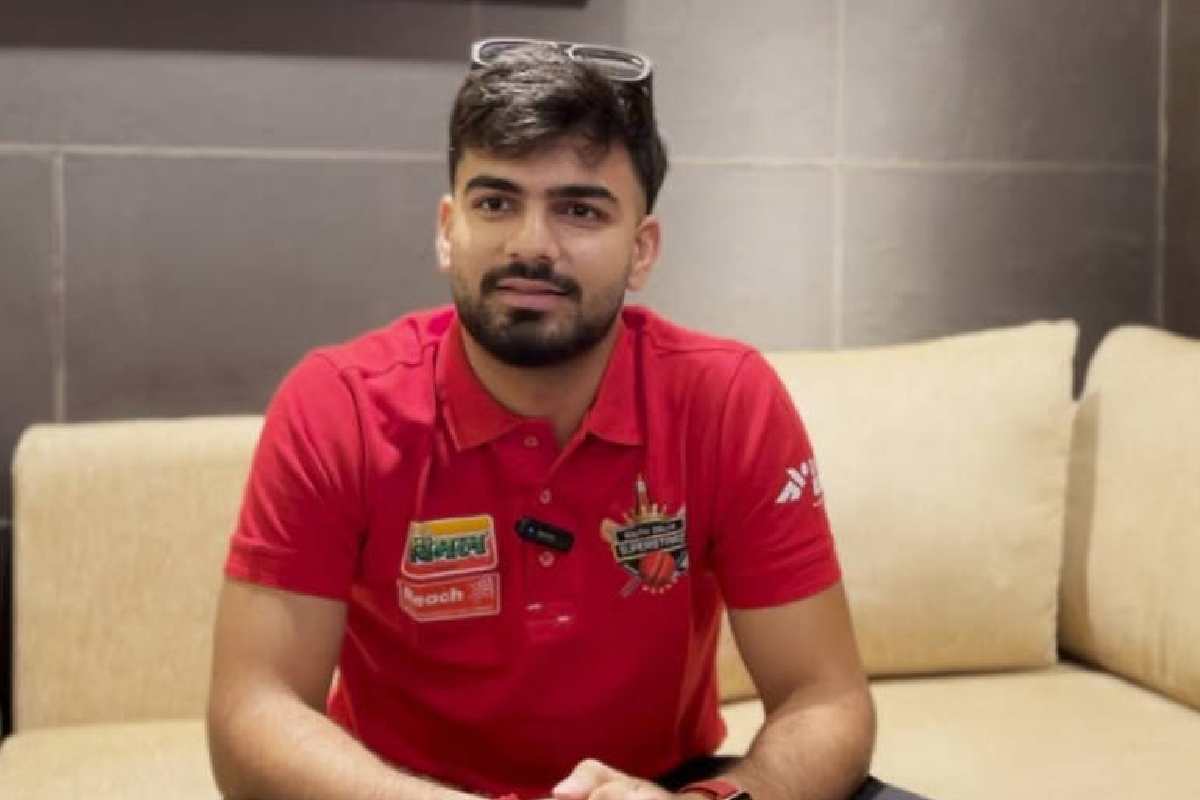
Tejasvi Dahiya
Tejasvi Dahiya, a promising hard-hitting batsman-wicketkeeper, emerged as the costliest player at the recent T20 Delhi Premier League (DPL) auction as South Delhi Superstarz (SDS) retained him for Rs 40 lakh using the Right to Match card.
Dahiya, 24, represented SDS last season as well and set the stands alight with his six-hitting ability. During the season, he smashed 29 sixes—second only to West Delhi Lions captain Nitish Rana’s 34—and 20 boundaries. He also hammered the fastest half-century in DPL history, off just 12 balls. This performance made Indian Premier League (IPL) teams sit up and take notice, with Kolkata Knight Riders (KKR) buying him for Rs 3 crore, 10 times his base price of Rs 30 lakh.
Now, with the third edition of the DPL set to start on July 31, Dahiya has more responsibility as he has to live up to his price tag. With that in mind, he prepared by playing tournaments and recently visited his childhood coach Sanjay Bhardwaj’s Bhopal-based academy, where he spent around 20 days sharpening and polishing his game. Dahiya spoke on a variety of subjects in an exclusive interview with Patriot. Excerpts:
Your reaction to emerging as the costliest player at the recent DPL auction.
That feeling—to be the highest-paid player—is great, and it comes with more responsibilities. But I am not looking at the money or putting any kind of pressure on myself. I am just focusing on playing cricket and will try to win the trophy for my team.
Everything seems to have gone well for you in the recent past—becoming the costliest player at the DPL, a brilliant season with the bat in the DPL, lots of awards, and the Kolkata Knight Riders stint. How do you look at these last few months, or maybe the last year?
To be honest, the last few months have been amazing for my personal growth. I kept calm and stuck to the process, and that fetched me some good results. I scored the fastest 50 (off 12 balls) in DPL history, besides playing some crucial knocks for SDS in close matches. I was happy that I scored so many runs for SDS (339 in 10 matches at a breathtaking strike rate of 190.44). At the same time, I felt bad that my team didn’t win the trophy because we had a great season until we lost in the Eliminator. After the DPL, I was picked in Delhi’s teams for the 50-over Vijay Hazare Trophy and the T20 Syed Mushtaq Ali Trophy, in which I performed particularly well batting down the order. Then came the main part, for which I had been waiting for the last few years: the IPL auction. I’m thankful to KKR for showing immense faith in me and picking me in the auction. Looking back at the KKR stint, I feel I could have done a few things better. I am working on those areas where I fell short and on the mistakes I made. Hopefully, next season the results will be much better.
Did SDS give you the freedom to play the way you like, or was it your decision to play your game?
The coaches and support staff, especially at SDS, don’t add any additional pressure or tell us to play in a certain way. They tell us to play according to the situation and not have a negative approach.
What all did you do in the off-season, including playing in tournaments and practising/training? You also had a stint at your childhood coach Sanjay Bhardwaj’s residential academy in Bhopal.
Soon after the IPL, I played in the All-India Uttarakhand Gold Cup in Dehradun, representing the Lal Bahadur Shastri Club. Yes, I went to Bhopal and worked on some small technical aspects during my 20-day stay there. I wanted to develop some shots, like the reverse and scoop, and worked on those there, besides a little on tactical approaches. It helps me dominate in the shorter formats. Sanjay Sir told me to be more mature, natural, and confident. He also pointed out that the skill set I possess is enough to represent the country. It was definitely a very fruitful visit.
Did you also work on the physical aspect at the academy?
I worked on all aspects of my game—batting strength, batting for longer durations, and wicketkeeping—and physically I am feeling good now. When I go to the Bhopal academy, my life revolves around cricket 24×7 because it’s a residential academy, and I don’t have to spend hours travelling between practice sessions. Everything is available within the premises there—the gym, swimming pool, grounds, etc.
In situations when you end up batting until the last over in a match and then have to keep wickets after a gap of only a few minutes, how do you manage that, considering wicketkeeping is a tiring job?
It is tiring and is not an easy task. I would say it is all in the head. If you are motivated and have great focus, you can do things no matter how tired you are. It depends on how mentally tough you are. Like they say, pressure is a privilege. I have worked on these aspects—training and endurance—in the off-season.
Also Read: I aim to take more wickets: Parunika Sisodia, DPL’s costliest woman cricketer
For example, right now I am working with my coaches, trainers, and physios on the areas where I have to develop strength, overall endurance, and fitness. The more you work on these things in the off-season, the easier it will be during the season.
You hit 29 sixes in the last DPL. Which of those thrilled you the most, or which one did you enjoy the most?
In the rain-affected match against Outer Delhi Warriors, reduced to 16 overs per side, we needed, I think, 13 off three balls and seven off the last two balls. I smashed two sixes off the last two balls. That match was really interesting, as we probably needed around 50 runs off the last three overs. We had lost seven wickets, and only three were left. I would rate it as my best innings of the 2025 DPL.
When you hit sixes, the bat has to be good. What’s generally the weight of your bat?
I don’t focus on the weight, to be honest; I just focus on the pickup of the bat and its balance. But the weight remains between 1,150 gm and 1,180 gm, somewhere around 1,160 gm or 1,165 gm. And when I play on fast pitches, I go for a 1,140 gm bat.
Do you also look at the opposition bowlers, especially fast bowlers, while choosing bats?
I look at the kind of pitches I play on. In the DPL, for example, we have similar types of wickets in Delhi, but for outstation domestic matches we get red, black, or mixed-soil pitches. If I play in Mumbai, the pitches there have good bounce, so I would go for a lighter bat, while Delhi pitches are comparatively slower, so I can go for a slightly heavier bat. But I prefer lighter bats.
And how many bats do you usually carry for outstation matches?
Let it be a secret (laughs). I don’t want to reveal it. If I reveal it here and someone close to me reads this interview, he might ask me for a bat.
In SDS’s last league match last season, you scored the fastest 50, off 12 balls, and went on to hit 69 off 21.
It was a rain-curtailed match, reduced to seven overs per side. I led the team in the last two league games and took responsibility by opening the innings, instead of batting in my usual middle-order position. They scored 133 for three in seven overs. I said, “If they have scored this much, we can also do that; we just have to score one extra run.”
The Supreme Court will hear a plea on Sunday seeking contempt action against authorities for…
Over 7,000 protesters, including CJP chief Abhijit Dipke, were detained as security forces sealed off…
Mamata Banerjee called Delhi’s crackdown “beyond Emergency” after being detained during a protest against Gyanesh…
From kuttu ki poori and sabudana to paneer and festive desserts, these restaurants have put…
Sonam Wangchuk condemned the arrests of student and youth leaders in Delhi, calling the situation…
Court said Sharjeel Imam apparently violated bail conditions by contacting media but refused to cancel…
