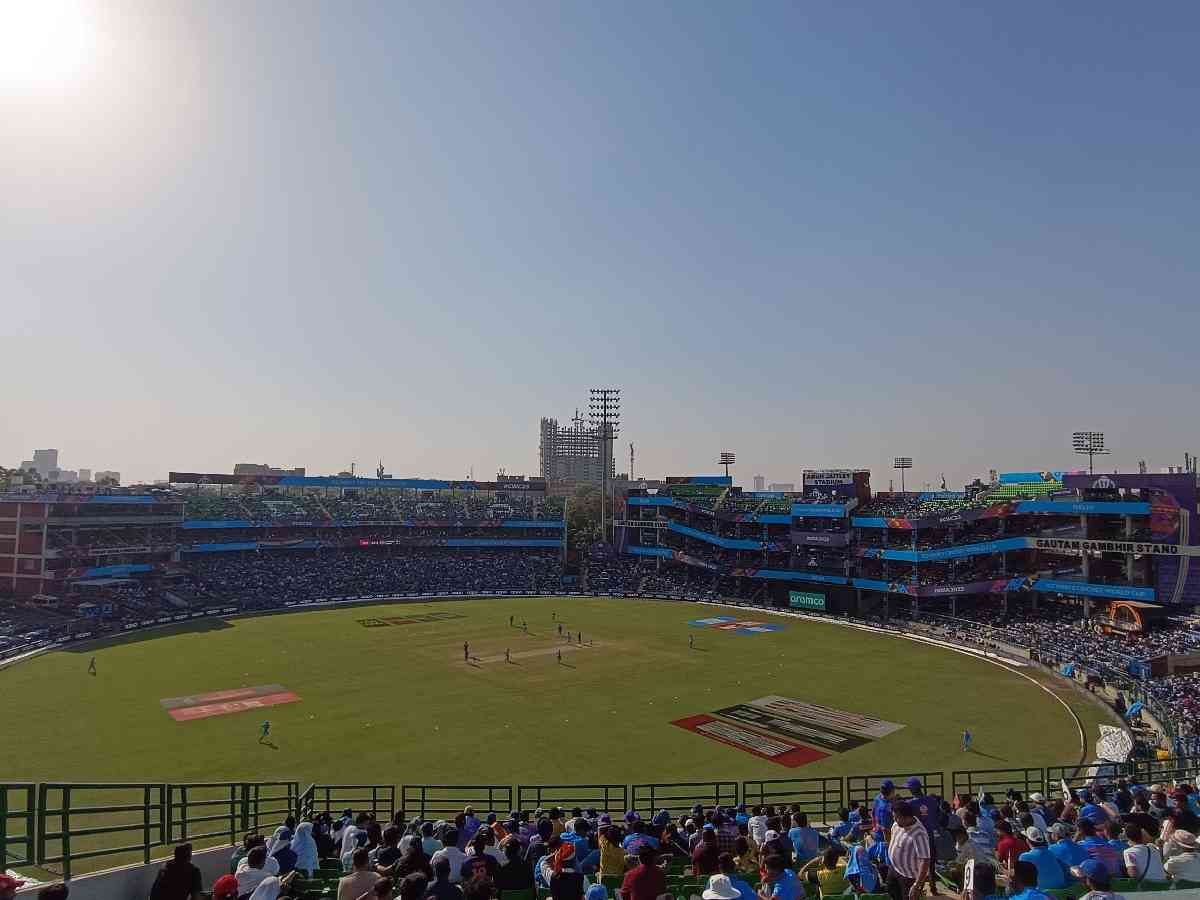
The historical Feroz Shah Kotla stadium has reached a significant milestone as a first-class (F-C) cricket venue. The Ranji Trophy match between Delhi and visiting Himachal Pradesh, played from October 25 to 28, was the 300th F-C game at this ground.
However, Kotla remains second behind Kolkata’s Eden Gardens in the list of Indian venues that have hosted the most F-C matches. By the end of the Bengal-Tripura Ranji Trophy game, Eden Gardens had hosted 324 matches, while Kotla now has 301, including the Delhi-Puducherry encounter that concluded on November 4. Chennai’s MA Chidambaram Stadium, known as Chepauk, stands third with 284 matches.
Globally, Lord’s in London leads the tally with 2,853 F-C matches since July 1814, followed by The Oval, London, which has hosted 2,149 games so far.
The beginning
The maiden F-C game at Kotla was a three-day affair between ‘India’ and the visiting ‘Ceylon’ (now Sri Lanka), played from December 30, 1932, to January 1, 1933. The match, which ended in a draw, featured several players who had appeared in India’s first-ever Test match against England six months earlier in London.
The first Ranji Trophy encounter at Kotla took place between Southern Punjab and United Provinces from February 12 to 14, 1936 — also a draw. Both teams are now defunct.
The first Test match staged at this venue was in November 1948, between India and the West Indies, with debutant Hemu Adhikari scoring a century in the drawn game. All matches of three or more days, including Tests, are classified as first-class.
Top performances
Sunil Gavaskar, Sachin Tendulkar, Anil Kumble, Madan Lal and Maninder Singh are among the top individual performers at this venue.
Gavaskar scored his 29th Test century against the West Indies in 1983, equalling Don Bradman’s record for most centuries in Test cricket. He reached his ton off just 94 balls and eventually finished his career with 34 centuries.
Also read: Women’s World Cup triumph a watershed moment for Indian sports not just cricket: Amol Muzumdar
Tendulkar surpassed Gavaskar’s 22-year-old record with his 35th Test century, against Sri Lanka in December 2005. His 109 — his 73rd international hundred — helped India win by 188 runs. Tendulkar went on to register 100 international centuries before retiring after 200 Tests.
Among bowlers, Kumble’s 10-wicket haul against Pakistan in February 1999 remains unforgettable. He took 10 for 74 in the second innings, in addition to the four wickets in the first, as India won by 212 runs.
Delhi’s highs
Gritty all-rounder Madan Lal, who shifted to Delhi from Punjab after four seasons (1968/69–1971/72) with his home state, became one of the greatest match-winners for his adopted city. Over 18 seasons (1972/73–1989/90), he not only led Delhi to multiple Ranji Trophy titles but also captained North Zone to several Duleep, Deodhar and Irani Trophy triumphs.
After the legendary Bishan Singh Bedi led Delhi to its first Ranji Trophy win in 1978–79, and again the following year at Kotla, Madan Lal emulated his senior by captaining Delhi to the Ranji crowns in 1985–86 and 1988–89.
However, Madan Lal remains modest about his contributions. “I am always grateful to DDCA for providing me with the platform,” he said. His career-best knock of 223 (398 minutes, 24x4s, 6x6s) for Delhi against Rajasthan in the 1977–78 Ranji Trophy quarterfinal also came at Kotla. “Rajasthan used to be a strong team in those days. Our aim was to win matches outright to qualify for the next round,” he recalled.
Kailash Gattani captained Rajasthan in that game and opened the bowling. “He used to bring the ball sharply into the batsman,” Madan Lal said.
Madan Lal revealed how he used to set targets for himself before each season. “If I were to play three matches at Kotla, I’d target at least 15 wickets. Since the pitch was usually flat, I wouldn’t set high bowling targets. But in batting, I’d aim big — at least one century in three games. The goal was to make the North Zone team for the Duleep Trophy. If, in five Ranji matches, a player scored 350–400 runs and took around 20 wickets, he’d usually be picked,” said the 74-year-old.
Maninder’s turn
Left-arm spinner Maninder Singh, part of Delhi’s three Ranji Trophy triumphs, was a prolific wicket-taker at Kotla despite its batting-friendly nature. Of his 606 F-C wickets, 174 came at Kotla, with a best of eight for 54 in Haryana’s second innings of the 1985–86 Ranji final. Added to his three wickets in the first innings, his 11 scalps helped Delhi beat Kapil Dev’s side by an innings and 141 runs.
“Ninety-five per cent of the time I’ve bowled at Kotla, the pitch has been flat. That’s why every wicket here is precious to me,” Maninder told Patriot.
He also recalls his three-wicket burst against Australia in the 1987 World Cup as one of his best spells. “I dismissed Geoff Marsh, captain Allan Border and Dean Jones — the last dismissal was planned with Kapil Dev. The way Jones was batting, it looked as if he’d take the match away from us. I bowled a flighted ball just outside off stump,” he said. India won by 56 runs, though Australia went on to lift their maiden World Cup.
Record partnership
The year 1995 began on a high note for Delhi captain Raman Lamba and opener Ravi Sehgal, who was making a comeback after a year. Against Himachal Pradesh at Kotla, they put up 464 for the opening wicket, breaking the Ranji record of 451 between Karnataka’s Roger Binny and Sanjay Desai against Kerala in 1977–78. Lamba scored 312 and Sehgal an unbeaten 216, his first century.
“When our partnership crossed 400, someone told Raman about the record during the tea break on the second day. He joked that if I got out before we broke it, he’d drop me for the next match — even if I had scored a double ton. When we finally broke it, he patted my back,” Sehgal recalled. “The pitch was typical Kotla — good for batting and offering little help to bowlers. Since it was my comeback game, my focus was high.” Delhi won by an innings and 310 runs.
Former Rajasthan left-arm spinner Suresh Shastri, who both played and umpired at Kotla, fondly recalled Madan Lal’s 223. “Our bowling wasn’t poor, but Madan Lal and Arun Lal (177) were at their peak. Delhi’s team was formidable — some were India regulars, others on the verge of selection,” he said.
Later, as an umpire, Shastri officiated the volatile 1995 Delhi–Punjab Ranji semi-final with AV Jayaprakash. “We cautioned the Delhi boys for ball tampering — it was Manoj Prabhakar. However, we couldn’t do more as there was no referee or video recording at the time. We reported it to the manager,” he recalled. Delhi made 554, Punjab replied with 780/8, and advanced on a first-innings lead.
In September 2019, the stadium was renamed after Arun Jaitley, a former president of the DDCA, although it continues to be popularly referred to as Feroz Shah Kotla.
Elected to the Delhi Golf Club general committee, Mansher Singh says he wants to build…
A $780 million market built on pavements, where the pleasure of reading meets the price…
Supreme Court advocate Abhishek Pawar alleges women were denied washroom access for seven to eight…
Each day of closure costs shops in Khan Market and Connaught Place between Rs 60,000…
Delhi generates nearly 15,000 tonnes of waste daily, prompting the government to deploy 1,000 mechanical…
Delhi Police has issued an NOC for the Congress rally at Ramlila Maidan on November…
