
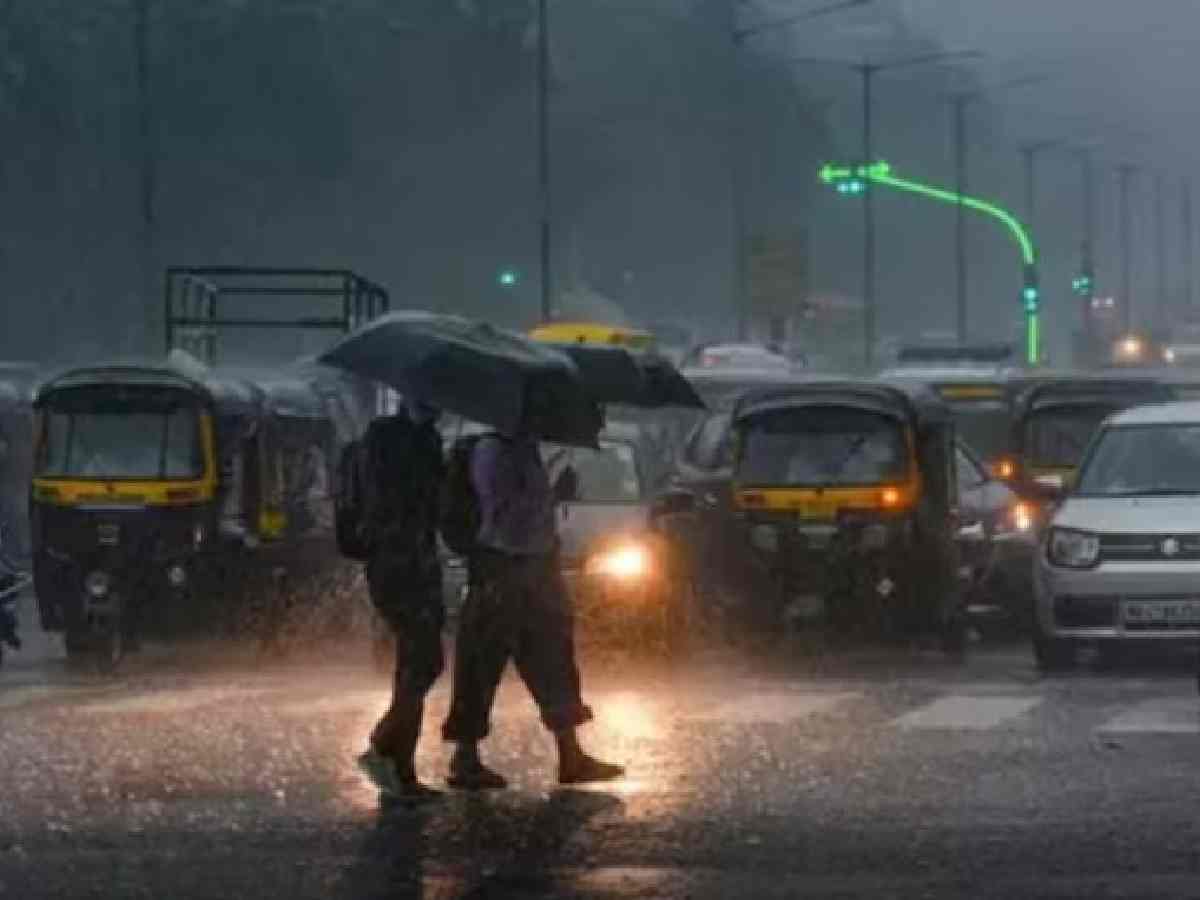
Delhi weather: Several parts of the national capital witnessed rainfall on Monday evening, accompanied by gusty winds.
According to the India Meteorological Department (IMD), the maximum temperature at Safdarjung, the city’s base observatory, was recorded at 33.6 degrees Celsius, 1.9 degrees below normal.
The minimum temperature settled at 23.6 degrees Celsius, 3.7 degrees below the seasonal average.
The weather office had issued a Yellow alert for Delhi-NCR, predicting light to moderate rainfall with thunderstorms and gusty winds (30-50 kmph) across all four regions — northwest, northeast, southwest, and southeast Delhi, during the evening hours between 5.50 pm and 8 pm.
According to IMD data, Lodi Road recorded the highest cumulative rainfall at 18.5 mm till 8.30 am on Monday. Pragati Maidan received 24.3 mm of rain, Ayanagar, 15.5 mm, Safdarjung, 15.8 mm, and Palam, 8.5 mm.
More rain was recorded later, including 4.8 mm in Palam, while Safdarjung recorded trace rainfall between 8.30 am and 5.30 pm.
The humidity levels oscillated between 100 per cent and 67 per cent.
The IMD has forecast more showers on Tuesday, with the possibility of thunderstorms in several parts of the city.
The maximum and minimum temperatures are likely to hover around 33 and 25 degrees Celsius.
The air quality was recorded in the ‘satisfactory’ category at 4 pm on Monday, with an Air Quality Index (AQI) reading of 59, Central Pollution Control Board (CPCB) data showed.
An AQI between zero and 50 is considered ‘good’, 51 to 100 ‘satisfactory’, 101 to 200 ‘moderate’, 201 to 300 ‘poor’, 301 to 400 ‘very poor’, and 401 to 500 ‘severe’, according to the CPCB.
Read more
Sheesh Mahal reopens, but restoration exercise yet to be concluded
On a humid Sunday morning in Shalimar Bagh, the air hung thick with the scent of wet clay and dust. The narrow pathway leading to the Sheesh Mahal, once a glittering jewel of Mughal architecture, was cluttered with construction tools and freshly laid red tiles, still soft underfoot. Labourers rested under the shade of neem trees, taking a break from the relentless work, while their children played barefoot nearby, darting between piles of bricks and sacks of cement. From behind the monument, a group of local children emerged through a densely wooded park, slipping through the iron fencing unnoticed. There was no guard to stop them.