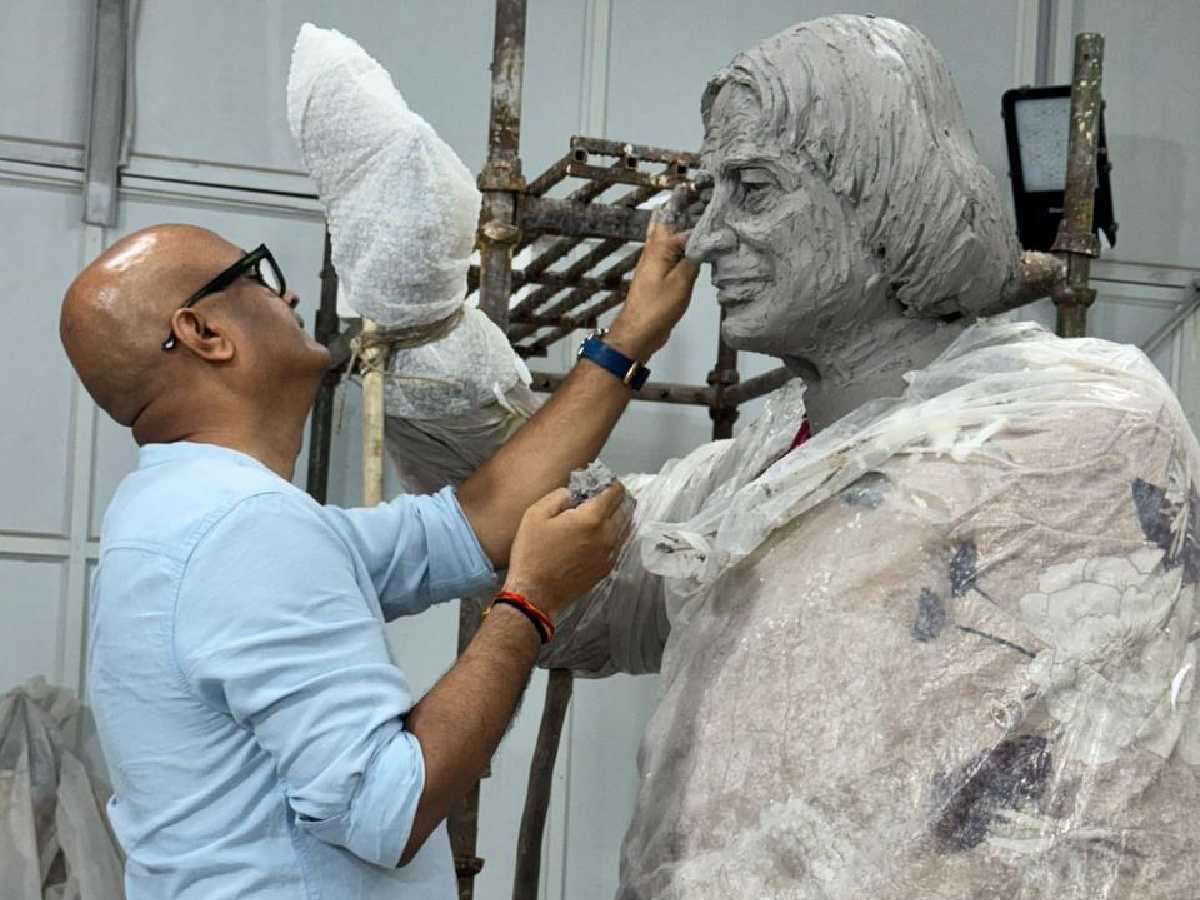
In a world of fleeting images and short attention spans, Naresh Kumar Kumawat, a third-generation artist from Rajasthan, believes in the enduring power of permanence — sculpted in stone, bronze, and spirit. An internationally acclaimed sculptor and Director of Matu Ram Art Centers, he has more than 600 installations across 80 countries.
“I am a sculptor by lineage, passion, and lifelong dedication,” Kumawat says. “I come from a three-generation legacy of sculptors originating in Rajasthan, where art was treated not as a business, but as a sacred duty.”
His earliest influence was his father, Matu Ram, whose towering Shiv Murti in South Delhi (crafted between 1989 and 1993) marked a turning point in India’s public sculpture history. “That work set the foundation for monumental sculpture in modern India,” he recalls. From the 369-ft Statue of Belief in Nathdwara to the Samudra Manthan mural in the Indian Parliament and the statue of Dr Bhimrao Ramji Ambedkar at the Supreme Court, his work continues to shape public imagination.
Also read: Sisson House and Haryana Canal Rest House wait to welcome their new neighbour-Delhi CM
Delhi as a living classroom
For Kumawat, Delhi is more than a workplace — it is a living classroom. “It’s a city where every corner holds stories, and every skyline invites a dialogue between the ancient and the contemporary,” he says.
His professional roots run deep. “My father sculpted the iconic Shiv Murti at Rangpuri. When I formally entered the field around 1998–1999, one of my first independent projects was a monumental Lord Shiva statue for the T-Series building in Noida — a turning point in my career,” he says. Since then, he has sculpted more than 20 large-scale Shiva statues across India and abroad.
Currently, he is working on projects with the Indira Gandhi National Centre for the Arts and other government bodies. But he believes Delhi can do more. “The city has the vision and the cultural depth to become a global capital of public art. What’s needed now is sustained commitment — dedicated zones, long-term maintenance, and respect through policy.”
Sacred practice, modern purpose
Unlike many contemporary artists, Kumawat views sculpture as a sacred act. “It’s not just an artistic pursuit; it is a sacred practice,” he says. “Like meditation, it demands deep concentration, patience, and surrender. Hanumanji is my constant source of strength and clarity.”
This devotion was tested during the making of the 369-ft Statue of Belief. “Early on, I urgently needed advanced machinery to carve the 1:1 scale model, but I didn’t have the funds,” he recalls.
Carving stories from epics and ideals
Among Kumawat’s most acclaimed works is the Samudra Manthan mural in India’s new Parliament building. “It represents the eternal struggle between positive and negative forces, the pursuit of balance, and the deeper churnings of human nature,” he says. “The mural is not just a depiction; it’s a dialogue between ancient wisdom and contemporary relevance.”
His sculptures of Mahatma Gandhi, installed in more than 30 countries, also embody this philosophy. “Gandhi is a universal figure, but deeply rooted in India’s soul,” he says. “I adapt to local contexts abroad, but I never compromise on his iconic elements — the walking stick, glasses, or khadi dhoti.”
Public art for the people
At a time when art is consumed through screens, Kumawat believes monumental sculpture remains irreplaceable. “Unlike digital images, sculptures exist in physical space. They can be touched, walked around, experienced at scale,” he says. “They shape how we remember and relate to history, culture, and values.”
In Delhi, a city of contrasts, he sees public art as a bridge. “Every community holds its own identity. Public art can foster pride, dialogue, and a sense of shared belonging,” he says.
Passing on the torch
Despite global recognition, Kumawat’s advice to young sculptors is simple. “Treat your art as a responsibility, not just a profession. Don’t chase trends. Study the masters. Understand your roots. Build your own voice,” he says.
“I began with very little. There were moments when I had to rely purely on faith and perseverance. But every difficulty carved me, just as I carved stone.”
Also read: Anti-Corruption Branch report exposes corruption in Delhi Pollution Control Committee
The legacy he hopes to leave
Among his many works, two remain especially meaningful: the Samudra Manthan mural and the Dr Ambedkar statue at the Supreme Court. “I portrayed Dr Ambedkar not just as the architect of the Constitution, but as a dignified lawyer — capturing his intellect, resolve, and quiet strength,” he says.
But for Kumawat, legacy lies in values, not volume. “More than just sculptures in stone or bronze, I want to leave behind a legacy of devotion to craft, respect for tradition, and the courage to innovate while staying rooted in our culture.”
“If my work can encourage even a few to believe that art has the power to heal, unite, and uplift,” he says, “then that, to me, is the true legacy.”