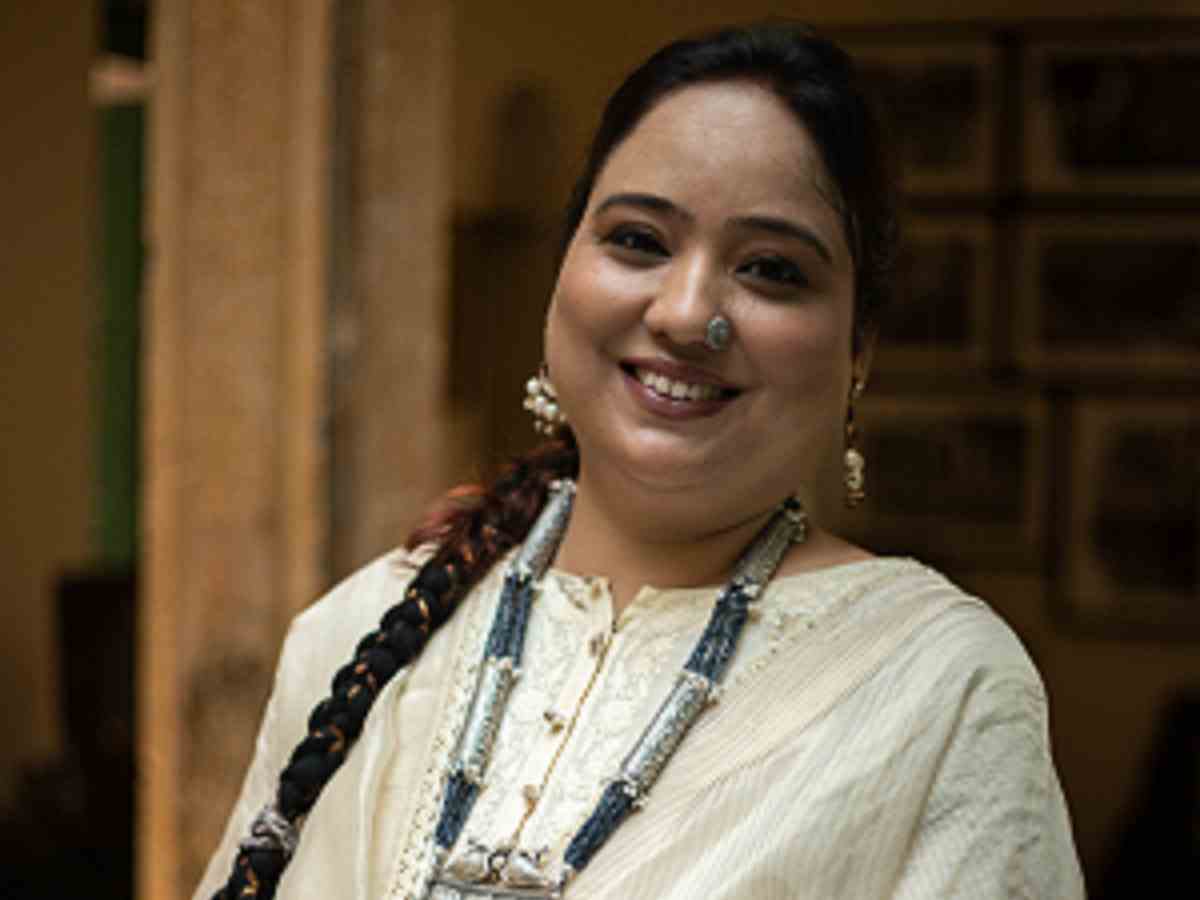
In the lanes of Old Delhi, where every gali hums with voices of the past, Fouzia Dastango first discovered her love for stories. “Every courtyard holds an echo of voices,” she says. “As a child, I was always surrounded by zubaan—Urdu, Hindi, and the everyday tales that women around me shared. My mother’s storytelling and the rhythm of Old Delhi’s culture shaped my ears and heart long before I knew the word dastangoi.”
Fouzia’s journey took a decisive turn in 2006 when she watched Danish Hussain perform dastangoi at Dayal Singh College. “Sitting in that audience, I felt something stir deeply in me—as if this centuries-old art form had been waiting to call me home. That night, I knew this was what I wanted to dedicate my life to.”
Leaving behind a secure teaching job, she immersed herself fully in this art. “It wasn’t easy stepping into this world, especially as a woman in a tradition dominated by men. Many questioned whether I could carry the voice, the presence, and the jazba required. But I believed that our culture and our zubaan carry no gender—they belong to everyone. So I worked—late nights memorising scripts, practising my breath, polishing my words. I carried with me the begamati zubaan of Old Delhi, the softer registers that women once spoke in homes, and slowly wove it into my performances.”
For Fouzia, dastangoi is not just performance—it is rooh ki guftagu, i.e., a conversation of the soul.
Also read: PVR INOX expects strong festive season, clocks 50 pc occupancy during Dussehra
Breaking barriers in a male-dominated tradition
Entering dastangoi as the first woman came with its share of challenges. “The tradition had been revived almost entirely by men, and many people questioned whether a woman could command the same stage, the same voice. I faced stereotypes about women being ‘too soft’ for such a powerful form, and even social pressures—coming home late from rehearsals in Old Delhi meant dealing with raised eyebrows and restrictions,” she recalls.
Without female role models, Fouzia carved her own path. “Being the first woman in a male-dominated tradition meant carrying both the burden and the joy of opening that door for others. And for me, that has been worth every struggle.”
The power of a story
For Fouzia, the emotional resonance of a story defines the art of dastangoi. “One of the most powerful moments for me was after performing the Dastan of Bhavri Devi. People came to me with tears in their eyes and said they had never known her story before, but now they felt her courage and her pain. A woman in the audience told me, ‘I want to meet Bhavri Devi and tell her she is not alone.’ For me, that is the true power of dastangoi—to create that connection between a story and a heart.”
Her story selection is deliberate. “When I select a story, I look for three things: it must resonate with me, it must speak to our times, and it must carry the beauty of our zubaan. Some stories come from the streets of Old Delhi—full of humour and everyday characters. Others are feminist narratives that give voice to women and the marginalised. Humour opens hearts, while stories of struggle create empathy. Whether it’s a tale from Ismat Chughtai, a slice of history, or even the Ramayana in Urdu, what guides me is the belief that stories belong to everyone, and they must connect deeply with the audience.”
Fouzia believes that dastangoi is both cultural preservation and social change. “Every performance is a way of honouring the voices of the past and ensuring they are not forgotten. At the same time, storytelling is never neutral. Through the dastan, I can speak of women’s struggles, of justice, of communal harmony, of everyday lives that are often invisible. It allows me to question power, to spark dialogue, but in a way that touches hearts instead of raising walls. For me, dastangoi is not only about looking back with pride—it is also about imagining a more humane future.”
Shaped by stories
Two decades of performing have left an indelible mark on her own life. “It has taught me patience, discipline, and the power of listening—not just to words, but to silences and emotions. Through stories, I have learned empathy, the weight of history, and the subtle strength in ordinary lives, especially of women. Dastangoi has also given me courage: to speak, to stand on stage alone, to navigate a male-dominated space, and to trust that language, rhythm, and story can touch hearts and inspire change. On a personal level, it has made me deeply aware of my roots, my culture, and the responsibility of carrying these tales forward.”
Her vision for the future is to keep dastangoi vibrant and accessible to younger audiences. “I want children and young adults to see that stories are not just history—they are mirrors of our lives, our values, our humour, and our struggles. I hope to blend classical tales with contemporary themes, from social justice to identity, so that young people can connect with the art in their own language and time.”
Bringing Guru Dutt alive on stage
Recently, Fouzia explored a new format, blending dastangoi with music in a tribute to Guru Dutt. “Creating this tribute was both exciting and delicate. I immersed myself in his films, letters, and songs, trying to understand not just his art, but the emotions behind it—the longing, the melancholy, the humour, and the poetry of his life.”
She credits producer Vikas Jalan and researcher Asha Batra for shaping the show. “Ultimately, my aim was to make the audience feel as if they were walking alongside Guru Dutt—seeing his dreams, his struggles, and his artistry unfold in real time.”
Dastangoi, she says, complements Guru Dutt’s legacy perfectly. “His cinema is remembered for depth, sensitivity, and poetic storytelling. Dastangoi, too, is about evoking emotions through words, rhythm, and pauses. It becomes a bridge—connecting contemporary audiences to the emotional richness of his timeless cinema, making them feel, laugh, and reflect just as they would while watching his films.”
Also Read: Art is expression, not business, says Manish Mundra
What she hopes audiences carry
After every performance, Fouzia hopes audiences leave with a sense of connection. “I want them to carry empathy, having felt the joys, sorrows, and struggles of people they may never have met. I want them to remember the power of language—how Urdu, its rhythm and nuance, can move hearts, provoke thought, and open conversations long after the performance ends. Ultimately, I hope they take with them a little wonder, a little reflection, and the feeling that stories are alive, and that we are all part of them.”
Fouzia is carving a space for women’s voices, preserving Old Delhi’s cultural cadence, and ensuring that centuries-old stories continue to speak, resonate, and inspire.